Where does the alliance between Rufián and Montero come from?
Both entered Congress after the 2015 elections and have maintained an ideological affinity
-
CAT -
CAST
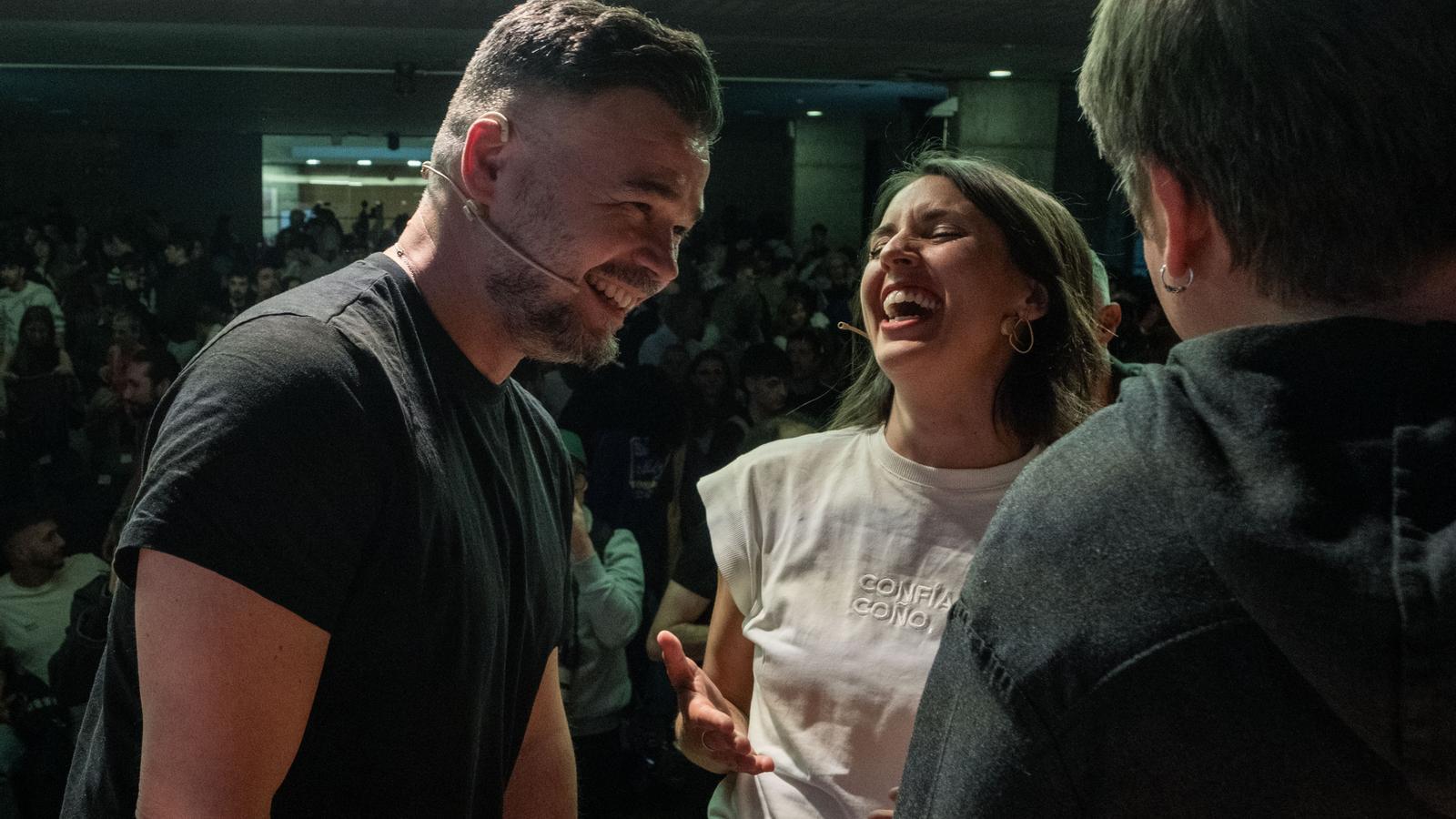
Barcelona / MadridGabriel Rufián has spent the last few months calling for a left-wing front for the upcoming general elections, but the only alliance that the republican leader has ended up signing –without an agreement with Ada Colau's Broad Front– has been with Irene Montero, the Podemos candidate. Both, in fact, already held an event together on April 9th in Barcelona and, in recent months, they have been strengthening ties, although their political affinity is not new. Rufián had come to Montero's defense several times in the face of the right-wing's offensive when she headed the Ministry of Equality. However, since when have both leaders known each other? Have they always had political complicity?
Both arrived in Congress after the 2015 elections, at a time when the 15-M movement had changed the political paradigm in the State and Podemos (as well as Ciudadanos) had broken with the two-party system. At that time, Rufián already valued what the movement of the indignant represented, but the archives show that he did not exactly have sympathy for the party that had politically capitalized on those encampments. “What I like most about the PSOE is Pablo Iglesias,” he wrote, for example, in May 2015. “What I like most about Podemos is Lerroux,” he also said. “If they fool you once, it's the other person's fault. If they fool you twice, it's your fault. If they fool you three times, you probably vote for Podemos,” he ironized, calling the purple party "the new PSOE".
However, over the years, Rufián modulated his criticisms towards a Podemos that in 2019 ended up forming a coalition government with the PSOE. It was then that the ideological affinity between Rufián and Montero became even more visible. “It costs me absolutely nothing to say that this woman is one of the most talented and truthful politicians I have ever met in my life. If not the most,” said Gabriel Rufián in May 2022. It was just after one of the numerous attacks that the then Minister of Equality had received from Vox. A few months later, the same republican leader came out, alone, in her defense when a PP deputy called her “useless” from the lectern of a Congress hemicycle where Montero was not present.
“Faced with the witch hunt and violence against Minister Montero. They are going after her for being a woman, from the left, and from the working class: sexist and class violence, it challenges us all,” he said in an intervention in Congress in November 2022 after a sexist attack by Vox. In fact, Rufián was one of the left-wing leaders who most defended Montero with the only yes is yes law. His complicity with the former minister contrasted with the bad relationship he had with Yolanda Díaz, with whom bridges were broken after ERC's 'no' to the labor reform. “I understand each other better with Irene Montero than with Yolanda Díaz,” said Rufián himself in an interview with Público in May 2023. In fact, after Sumar's veto on Montero for the 2023 general election lists, Rufián wrote an article in this same newspaper defending her: “There are those who are yours without acronyms or flags. Irene Montero has not been vetoed, Irene Montero has been sold out.” The purple leader responded to him with a thank you on X: “Very proud of the plurinational and feminist alliances that we have built, and that continue to be fundamental for conquering rights”.
The 29-N campaign
Now, months after Irene Montero admitted that “teaming up” with Gabriel Rufián was a “good idea”, ERC and Podemos have reached an agreement to collaborate ahead of the 29-N elections. The Republicans shy away from the tandem label between the two leaders, but the 'purples' make as much of a banner as they can of the pro-independence candidate, the politician best valued by the public in the polls. So much so that the party leader, Ione Belarra, has even gone as far as to make him her own: “They are two people who go beyond their acronyms and political projects, which is why we have chosen them as our candidates”. In plural. “We are 100% convinced that it is the tandem that everyone was asking us for, they are the two most highly valued leaderships to do battle against the right-wing parties”, said Belarra last week.

Without the Podemos logo
Just this Monday, Podemos launched the website for its electoral campaign without any reference to the party or the purple color that has characterized the organization since it was born. Everything revolves around the figure of the candidate: a large photo of her, her first name –without the surname– and her social media accounts. All this accompanied by the slogan “Peace, housing and work”. “There is nothing more Podemos than Irene, there is no need to put Podemos,” they defend from the leadership of the purple party off the record.
Before the cameras, the party's general secretary, Ione Belarra, maintains that they want to “recover what is simple and basic” and bet on “people who are reliable”. “These elections are about whether we can trust our representatives to obey the street,” she added to justify the absence of the brand. Likewise, although Podemos denies that the chromatic strategy has anything to do with the intervention of the ERC leader in Madrid, Ione Belarra has put him in the same bag: “Gabriel Rufián and Irene Montero working as a team can go much further than any acronym of any party,” she summarized.
It is true that this is not the first time that Podemos has shed its traditional color. Without going any further, the lectern and the staging of the State Citizens' Council –the party's most important body between congresses– last Saturday also avoided purple, which was replaced by a light pink. The party logo also did not appear, which is also absent in the latest election video published by the group. By the way, the poster for the first event that both will share, on Saturday in Barcelona, is equally devoid of colors or logos from either group. On the other hand, ERC assures that, beyond Saturday's poster, they will not hide the Republicans' logo, but rather it will be present throughout the campaign. Except when resorting again to the Rufián-Montero formula, which the president of the Republicans, Oriol Junqueras, acknowledged this Wednesday on Catalunya Ràdio that it could be done again without logos.
