The State's sewers sit on the accused's bench: who is who in the Kitchen case
Jorge Fernández Díaz and the leadership of the Ministry of the Interior with Mariano Rajoy sit on the accused's bench for having stolen information from Luis Bárcenas that splashed the PP
MadridYear 2013. Mariano Rajoy governs Spain with an absolute majority and the "papers of Luis Bácenas" come to light, revealing the existence of a black box within the PP. Following this, the Ministry of the Interior, led by Jorge Fernández Díaz, designs and –according to the Public Prosecutor's account– launches an "illicit police intelligence operation" with the aim of stealing information and evidence from Luis Bárcenas, the former treasurer of the PP, that would incriminate popular leaders in the context of the Gürtel case. The ultimate objective is to "prevent" it from reaching the hands of the investigators. Five years later, that corruption trial ends with the sentence that leads to the motion of no confidence that brings Pedro Sánchez to La Moncloa. And now, thirteen years later, the leadership of the patriotic police sits on the defendants' bench, with "requests for fifteen years in prison by the Public Prosecutor's Office, in a trial that begins on Monday at the National Court and which will have to shed light on the maneuvers of the state's sewers to protect the PP. The main crimes they are accused of are cover-up, embezzlement, bribery, disclosure of secrets, and influence peddling.
- If you want to investigate the infographic in more detail, open the high-resolution version in another tab.
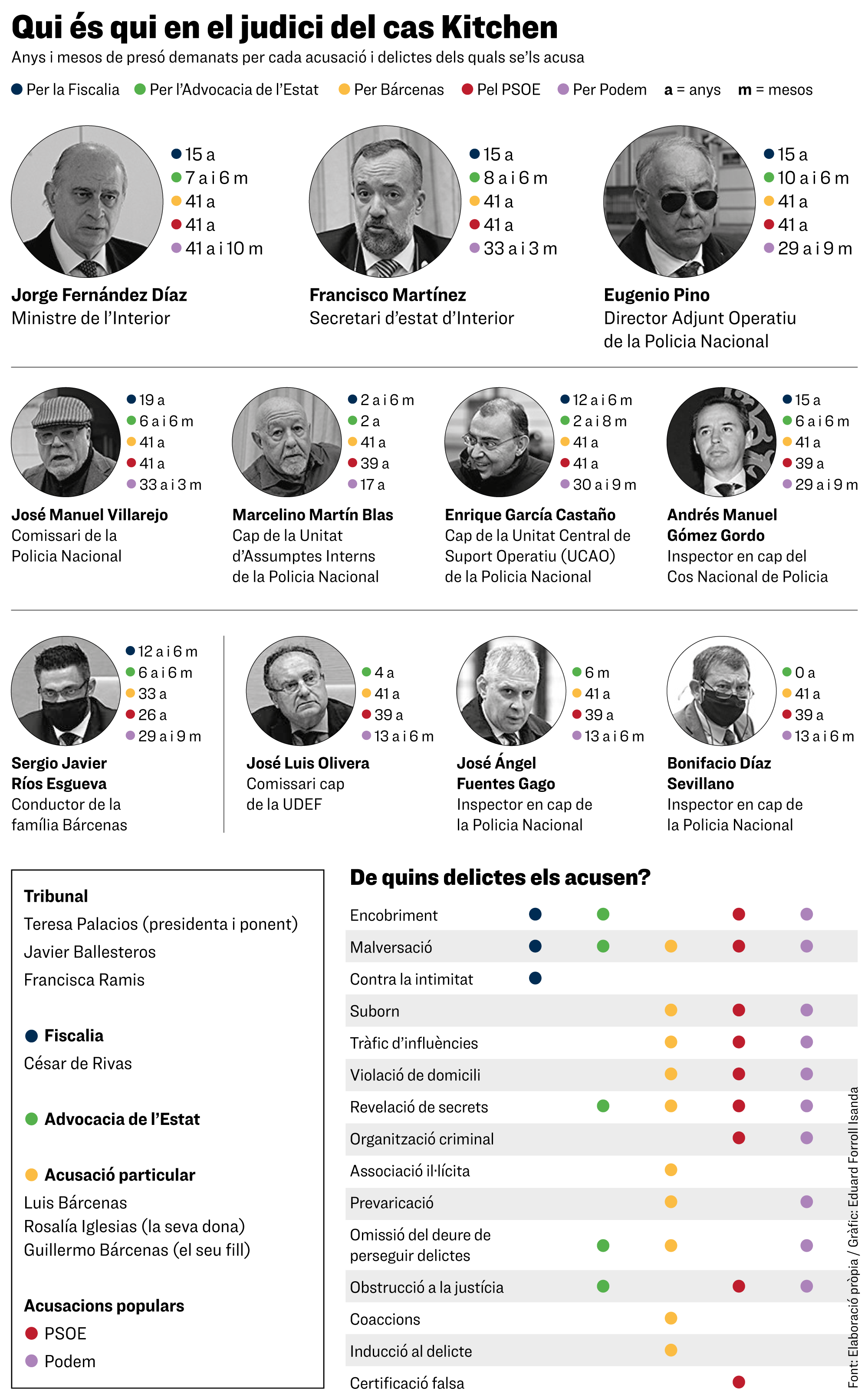
The Prosecutor's Office will not be alone. Luis Bárcenas is part of the case as an injured party and requests 41 years in prison for all the accused – except for his former driver, who collaborated with the dirty war – and there are two popular prosecutions: the PSOE and Podemos, who also double most of the Prosecutor's Office's prison requests. The trial will extend until June 30. 35 sessions are planned and a hundred witnesses have been summoned. Three of the big names who will have to explain themselves are Mariano Rajoy – former President of the Spanish government –, María Dolores de Cospedal – former Secretary General of the PP and who was exonerated from the case – and Soraya Sáenz de Santamaría – former Spanish Vice President.
What did the accused orchestrate? After Jorge Fernández Díaz took the first step, the operation was coordinated by Francisco Martínez – Secretary of State for the Interior, the number two in the ministry, and for whom the PSOE has now requested preventive detention –, and planned by Eugenio Pino – Deputy Operational Director of the National Police and convicted of attempting to introduce a pen drive into the Pujol case –. These two "reported all the information" to the minister. Below them, the person in charge of putting it into action was Commissioner José Manuel Villarejo, a regular in these maneuvers, who allied himself first with Marcelino Martín Blas, who was the head of Internal Affairs of the Spanish police, and then with Enrique García Castaño, who led the Central Operational Support Unit (UCAO).
Once the plan was agreed, the first step they had to take was to find a collaborator close to the Bárcenas family who was willing to betray them by providing information and access to documentation in exchange for remuneration. The chosen one was Sergio Ríos Esgueva, who was the chauffeur of Luis Bárcenas and his wife –Rosalía Iglesias– and was a person of their utmost trust. Those responsible for the operation nicknamed him cuiner because he was the one who could “entrar fins a la cuina” –kitchen, in English– of the family. And that's where the case name comes from.
The one who managed to contact him was Andrés Manuel Gómez Gordo, who was chief inspector of the National Police and had been director general when Cospedal was president of Castilla-La Mancha. As a reward, Bárcenas' driver would receive 2,000 euros per month from the reserved funds. 54,000 euros in total. And he had two more benefits: they bought him a 700 euro pistol and proposed that he become an agent of the Spanish police. For his part, Villarejo received 3,200 euros for expenses for meals, transport, and parking tickets during the operation.
A room with a double-bottomed chest
What did the accused do? Firstly, they ordered “estrict surveillance” on Luis Bárcenas and Rosalía Iglesias, which was carried out by about twenty police officers. Furthermore, they monitored the office of Bárcenas's lawyer. And when the former PP treasurer went to prison in June 2013, they also controlled his movements and communications inside Soto del Real.
Finally, thanks to information from Sergio Ríos Esgueva, they became aware of a commercial premises in the Salamanca district of Madrid where Rosalía Iglesias worked as a furniture restorer. There was a chest with a false bottom that Bárcenas had used to store documentation he had at Génova that could be incriminating for the PP. For example, recordings of conversations with Mariano Rajoy. García Castaño entered it to confiscate the documentation. The investigating judge, Manuel García-Castellón, says he found what he was looking for, but the prosecution maintains that it “does not appear” that he achieved his purpose. For now, nothing is known about the supposed documentation inside the chest.
Around that time, those involved in the operation also obtained text messages, emails, and contacts that Luis Bárcenas had. They wanted to check if there were any conversations that could compromise PP leaders. The family driver met with García Castaño at a VIPS restaurant and handed him two mobile phones and a tablet. There, they downloaded the content onto a memory stick which they sent to Francisco Martínez and Jorge Fernández Díaz. During the investigation, in March 2019, García Castaño handed the court a copy of everything they had extracted. In fact, his cooperation has led the prosecutor to request a lesser prison sentence for him.
The accused did not share “at any time” the information they obtained with the investigators of the Gürtel case, nor with the prosecution, nor with the judge. “They always kept it hidden with the aim of preventing the case from reaching PP leaders”, states the prosecution.
There are three more names that will sit on the defendant's bench despite the Public Prosecutor's Office requesting that the case against them be dismissed. José Ángel Fuentes Gago and Bonifacio Díaz Sevillano, inspectors of the Spanish police, were people of trust of Eugenio Pino. And José Luis Olivera, head commissioner of the UDEF, tried to persuade the person responsible for the investigation of the Gürtel case to change destination and, according to the State Bar Association, tried to boycott the reports of the investigation.
The face-to-face between Francisco Martínez and Jorge Fernández Díaz in 2020
The two main defendants are Jorge Fernández Díaz and Francisco Martínez. After a long time as allies, they ended up parting ways. Proof of this is the confrontation that both protagonists staged in November 2020 during the investigation. L'ARA has had access to the video in court, which highlights the bitter confrontation between the two.
This browser does not support the video element.
This browser does not support the video element.
This browser does not support the video element.