Sánchez maintains that Morocco did not "plan" the massive entry, but commits to investigate
The Spanish president now admits that the 'Moroccan gendarmes' let people pass for ten hours
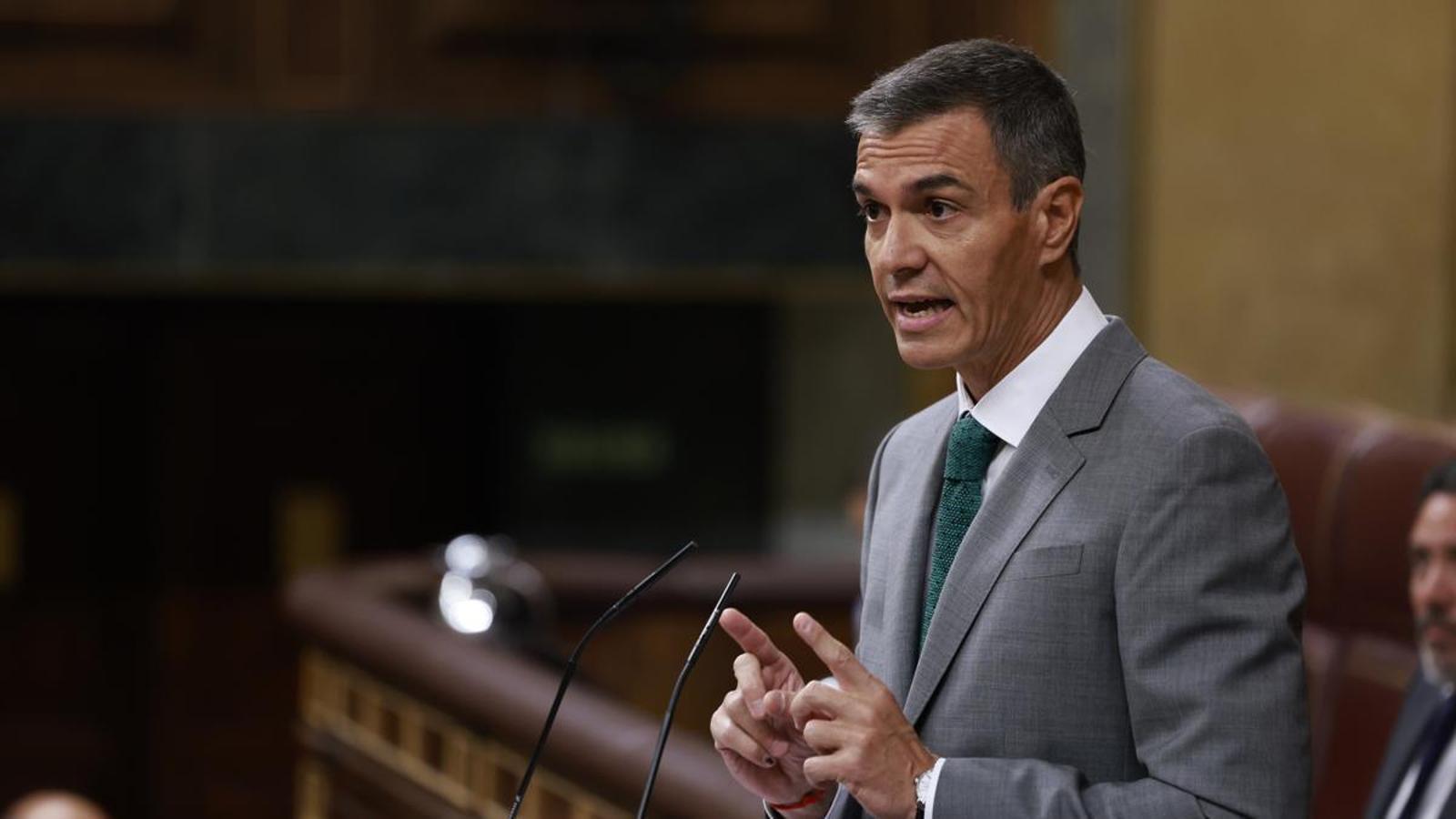

MadridPedro Sánchez faced one of the most difficult appearances of his presidency this Thursday. He had to account for his management in Ceuta, which was immersed in a humanitarian and social crisis due to the massive entry of migrants on July 30 and 31. But the day was not complicated only for that reason: just this Wednesday a police report, advanced by El Español, came to light, putting the president's narrative on the ropes: while the Moncloa has exonerated Morocco, the National Police's immigration unit points to Moroccan security forces as facilitators for more than 70,000 people crossing the border in just over 24 hours. After this police document sent to the National Court, which the Moncloa claims it was unaware of, Sánchez maintained that there is "no solid evidence" pointing to Morocco having "planned and executed" the massive entry of migrants, but he admitted that during the central ten hours of July 30, the Moroccan gendarmerie "allowed the crossing of the border". "It will have to be determined whether there was incapacity or inaction, it is something that must be clarified", he assured, thus committing to investigate. A nuance in the narrative that the Spanish government had maintained until now, but which has not been enough to convince either partners or the opposition. "Why are you afraid? What does Morocco know about you?", the leader of the PP, Alberto Nuñez Feijóo, snapped at him.
Sánchez stated that there are three moments in relation to Morocco's role on July 30th: before, during, and after the massive entry of migrants. The Spanish president recounted that prior to the most critical point, Moroccan officials acted normally and reported only a few incidents; a second moment in which he acknowledged that "during the ten central hours of July 30th, the Moroccan gendarmerie allowed passage at the border"; and a third moment in which the same body "effectively controlled the border by carrying out hundreds of arrests, preventing thousands of illegal crossings, and decisively facilitating returns." In this regard, he has committed to investigating the events and taking necessary measures if evidence actually appears, beyond that, which proves that Morocco is behind the crisis. He also took a jab at the police and courts, after making it evident that the Minister of the Interior was unaware of the National Police report that points to the Moroccan regime and which emerged this Tuesday. "Why didn't they inform?", he asked, and added that this must also be clarified.
The Spanish president, therefore, has maintained the main thesis of the Moncloa: that without Moroccan collaboration, the immediate return of the majority of migrants, the "largest in history," would have been "impossible." He also noted that the amplification of the 'fake news' networks that generated the crisis came from pro-Russian, pro-Israeli, and far-right international accounts, but he clarified that he has no proof that these states are behind it. However, he revealed a relevant fact: that on August 21st, he summoned the Moroccan ambassador to Spain, following the claims of sovereignty over Ceuta and Melilla by Moroccan ministers. "Ceuta and Melilla are Spanish and will be until the end of time," Sánchez asserted.
However, the Spanish prime minister has found himself more alone than ever in the Congress of Deputies. There has been no other group besides the PSOE that has considered the explanations sufficient, and all the rest, including the partners in Sumar, have lamented that the Spanish government does not clearly point to the Alaouite regime. "It was organized by Morocco, in coordination with the United States and Israel," said Sumar deputy Enrique Santiago. "Defending another hypothesis is not credible," he declared. And from the other extreme, the PP and Vox have been harsher: "No personal fear can be placed above the national interest; Spain cannot have a prime minister under blackmail," proclaimed Alberto Núñez Feijóo during his intervention. "What document or indication was on your phone for you to behave in this way?" he asked, alluding to a hypothetical unconfirmed intervention of Pegasus by Morocco on Sánchez's device. "You go up to the podium to defend your king, Mohammed VI," Santiago Abascal told him in turn.
Without prior "exceptional" warnings
Sánchez's speech was interrupted several times by the noise from the right-wing benches, who were laughing or shouting indignantly at what the Spanish president was saying. Despite the narrative of the right and the far-right, the government has maintained that it did not have prior "exceptional" warnings that would have alerted them to the entry of more than 70,000 people. "None" of the messages or verbal notes from the State security forces and bodies and the National Intelligence Centre (CNI), he said, "went beyond the description of the data and routine warnings." "None foresaw either the scale or the probability of what finally happened," he stressed.
In any case, to dispel doubts, he has committed to publishing a dossier with all the reports made by all intelligence and security agencies. "We will be transparent. We have nothing to hide," the Spanish president stated.
Be that as it may, Sánchez has wanted to defend the actions of the Spanish police at the border during the most critical moments of July 30th, when the mass of people entered by sea and also by land. "They had to choose, they had to choose between defending the border and human life, and they chose the second option," he asserted. "They did the right thing," the president reaffirmed, since in the face of the threat they responded with "humanity." And now, he argued, they cannot expel everyone who is in Ceuta in an express manner either. Thus, he insisted that individualized files are needed: "You cannot take a human being by the arm and remove them as if they were a sack of dirt".
The promises
The last part of Sánchez's speech served for promises. After the council of ministers approved 309 million euros to help Ceuta, the Spanish president has pledged to mobilize all necessary resources to return to "normality" and also to strengthen the European integration of the two autonomous cities, as he opined that at the time there was a lack of "ambition". He will request that they be included in the customs union, and also that they be recognized as "outermost" regions, as well as a permanent seat on the Committee of the Regions.
