Has Sumar failed?
The parties in the left-wing coalition are negotiating a "horizontal" coalition to relaunch the project, with the question of Yolanda Díaz's leadership remaining uncertain.


-
CAT -
CAST
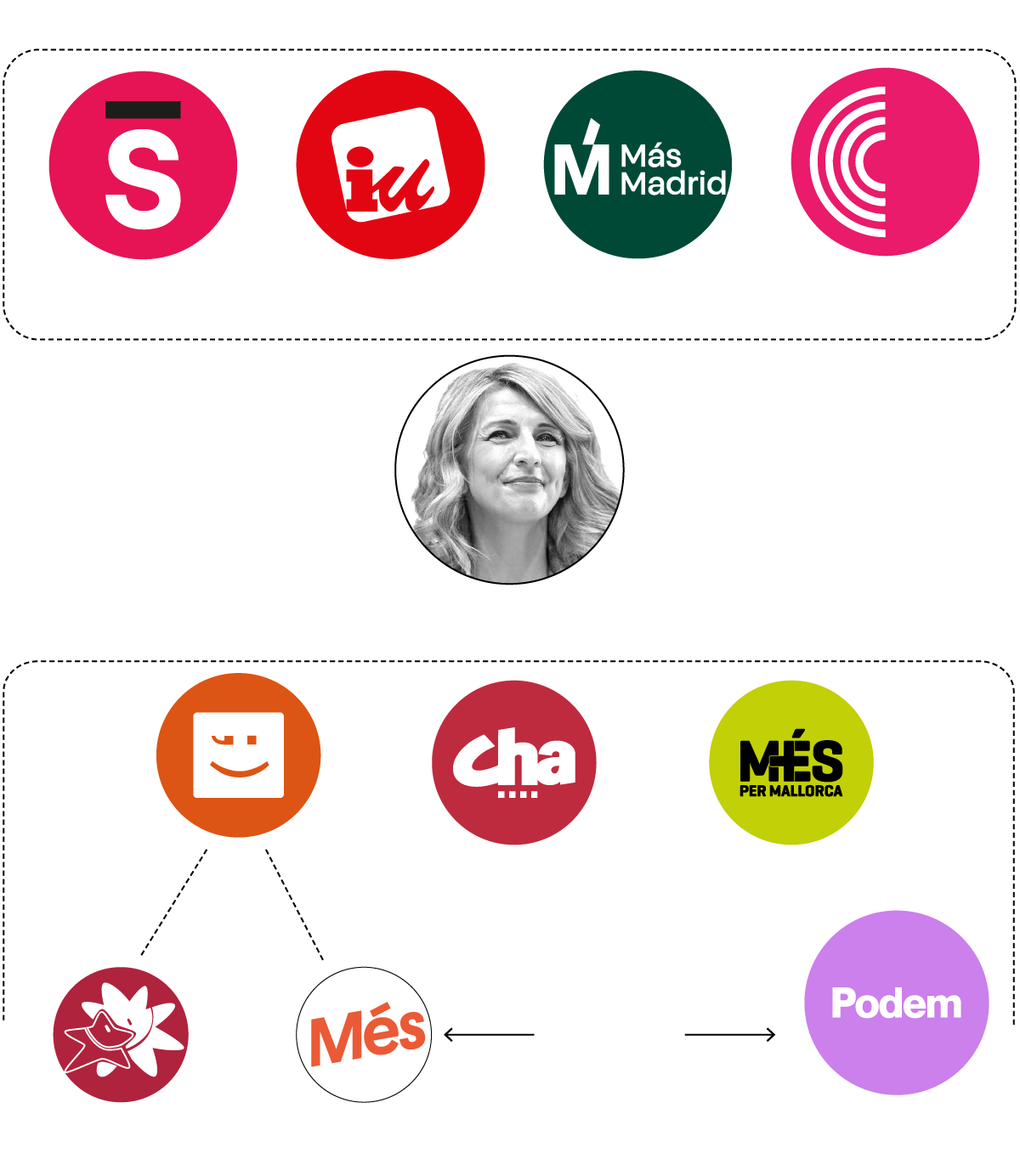
MadridThe left wing of the PSOE has long been engaged in a renewal process. Sumar, the citizens' movement launched by Yolanda Díaz in April 2023, hastily transformed into an electoral coalition for the June 23rd general election, aiming to unite progressives across Spain. However, nearly three years later, it has lost its initial momentum. Since its initial unity, the Sumar alliance has suffered an irreparable split with Podemos; the defection of part of Compromís; three electoral defeats in Galicia, the Basque Country, and the European elections; and has produced a diverse range of positions on key issues without achieving the desired appeal. Nevertheless, the left is not throwing in the towel and has joined forces to revitalize itself. For months, with particular emphasis in recent weeks, the Sumar Movement, United Left, Más Madrid, and Comunes—the four parties with representation in the cabinet—have been holding talks to carry out a necessary comprehensive update to the alliance in preparation for the upcoming general elections. However, the new horizon is emerging after Podemos has separated from him and Compromís has distanced itself from him, without a defined leadership and with deep doubts about the role that Yolanda Díaz should have.
Estan dissenyant una nova coalició
Esquerra
Unida
Moviment
Sumar
Més Madrid
Comuns
Yolanda Díaz
Van anar a la coalició del 23-J
Compromís
Més per Mallorca
CHA
Chunta
Aragonesista
Han sortit
del grup
parlamentari
Iniciativa del
Poble Valencià
Podem
Més-Compromís
Estan dissenyant una nova coalició
Esquerra Unida
Moviment Sumar
Comuns
Més Madrid
Yolanda Díaz
Van anar a la coalició del 23-J
CHA
Chunta
Aragonesista
Més per
Mallorca
Compromís
Han sortit
del grup
parlamentari
Iniciativa del
Poble Valencià
Més-
Compromís
Podem
Estan dissenyant una nova coalició
Esquerra Unida
Moviment Sumar
Comuns
Més Madrid
Yolanda Díaz
Van anar a la coalició del 23-J
CHA
Chunta
Aragonesista
Més per
Mallorca
Compromís
Han sortit
del grup
parlamentari
Iniciativa del
Poble Valencià
Més-
Compromís
Podem
"There's no agreement or concrete plan yet, but there is a willingness to continue working together," sources from the Comuns told ARA. "There are no deadlines; they're talking and exploring strategies. They're laying the groundwork and making progress to try and renew the coalition," Sumar sources added to this newspaper. The assessment, however, is fairly well-received. Until now, Sumar has revolved around Yolanda Díaz and followed the lead of the PSOE, which has bothered some sectors: they question both the leadership of its public face and the fact that it hasn't sufficiently differentiated itself from Pedro Sánchez's policies. And now they're working to rectify this.
Everyone, for example, wants to reduce hierarchies. The Comuns welcome the fact that they've begun working "from a more horizontal perspective" and assert that in this new phase they have a more proactive role because there isn't a "leading national political force to set the pace." Más Madrid—which emerged from a split with Podemos instigated by Íñigo Errejón—is calling for a "democratization of the political sphere" that would mean decisions are made in a "more collective" way. Izquierda Unida is demanding a system "free from impositions and oversight" and sees a change of course as essential after realizing that Sumar "is not an instrument capable of uniting" all left-wing parties. These aspirations reveal the current fragilities.

Two of the things that are particularly at stake are the bastions that the movement has held until now: its name and its leadership. United Left is openly demanding a "different name" and is pushing for a system of two primaries to choose who should be the leader, so that it ceases to be a kind of automatic and unquestionable appointment. Meanwhile, the left-wing coalition believes it is necessary to "remain an identifiable force" and prefers that the leadership emerge from "agreement and understanding" among all parties, rather than from a grassroots vote. These are issues that haven't been addressed yet, but the starting positions seem far apart.
Will Podemos win them over?
The major rift in the project was Podemos, which in December 2023, a month after Pedro Sánchez's investiture, jumped ship and He went to the mixed group in order to establish its own identity. Since then, Podemos's attacks on the Spanish government and the role played by Yolanda Díaz have been constant, making it impossible to foresee a feasible scenario for future understanding. In fact, Podemos has taken a more direct approach and already has anointed Irene Moreno as candidateIt is precisely this person whom Yolanda Díaz vetoed on June 23rd. Despite the breakdown in relations, the Comuns assure ARA that they are having "conversations" and "dialogue" with Podemos to keep them updated on the evolution of the new project, with the hope that they will also join. "We are willing to adapt things so that everyone feels comfortable," they say. Podemos avoids commenting on it.
Compromís observes from the sidelines
In the Valencian Community, Compromís is observing from a distance. The party's leader in the Valencian Parliament, Joan Baldoví, made it clear a few days ago that they have "no negotiations" underway. "We are completely on the sidelines; we don't feel involved in this process," a member of Més, the pro-independence and majority wing of the coalition, told ARA. Their deputy, Águeda Micó, left the Sumar parliamentary group seven months ago demanding to have their own voice. However, the Valencian nationalists are "fully prepared" for a single list and a "necessary understanding." They do, however, remind everyone that they are the ones with the territorial muscle: "No outside force should tell us the rules of the game, least of all a coalition made in an office in Madrid," party sources emphasize.
The paradox is that Alberto Ibáñez, deputy for Iniciativa del Poble Valencià – which is part of Compromís – continues to align himself with Sumar. He is directly advocating for a candidacy that "doesn't exclude anyone" and that brings together all the left-wing parties, including Podemos and ERC from the Valencian Country. In fact, this week the leader of Esquerra in Congress, Gabriel Rufián, He will take a tour of Valencian villagesIt is precisely he who has bet on to promote a common "plurinational" fronta proposal that ignited ERC and that was disavowed By Oriol Junqueras. According to the CIS, Rufián is the fourth preferred to be president of Spain, surpassing, for example, Isabel Díaz Ayuso or Yolanda Díaz.
The CHA doesn't know anything either.
In Aragon, the Chunta Aragonesista (CHA) has not received any proposals: "They haven't approached us," party sources told ARA. They are leaving it for after the regional elections. However, the CHA, which boasts that it has "always favored" alliances to "ensure that Aragon's voice is heard in Madrid," will "actively" seek to repeat the agreement.
Now, Más is postponing it.
From the Balearic Islands, Ara Més – the coalition of Més per Mallorca, Més per Menorca, and Ara Eivissa – is focused on "strengthening and consolidating the relationship" between the islands and will assess in the future what the "best strategy" is to maintain representation in Madrid. "The Sumar experience has not been what we expected," admit sources within the ARA party. The party, which two months ago decided to stay Within the Sumar parliamentary group in Congress, they are not ruling out renewing the alliance, but they warn that they will have to "learn lessons from things that have not worked."
