Congress rescues the Maricarmen decree a few hours from the start of the campaign
The progressive majority of the standing committee endorses suspending evictions of vulnerable people and the two-year extension of rents
-
CAT -
CAST
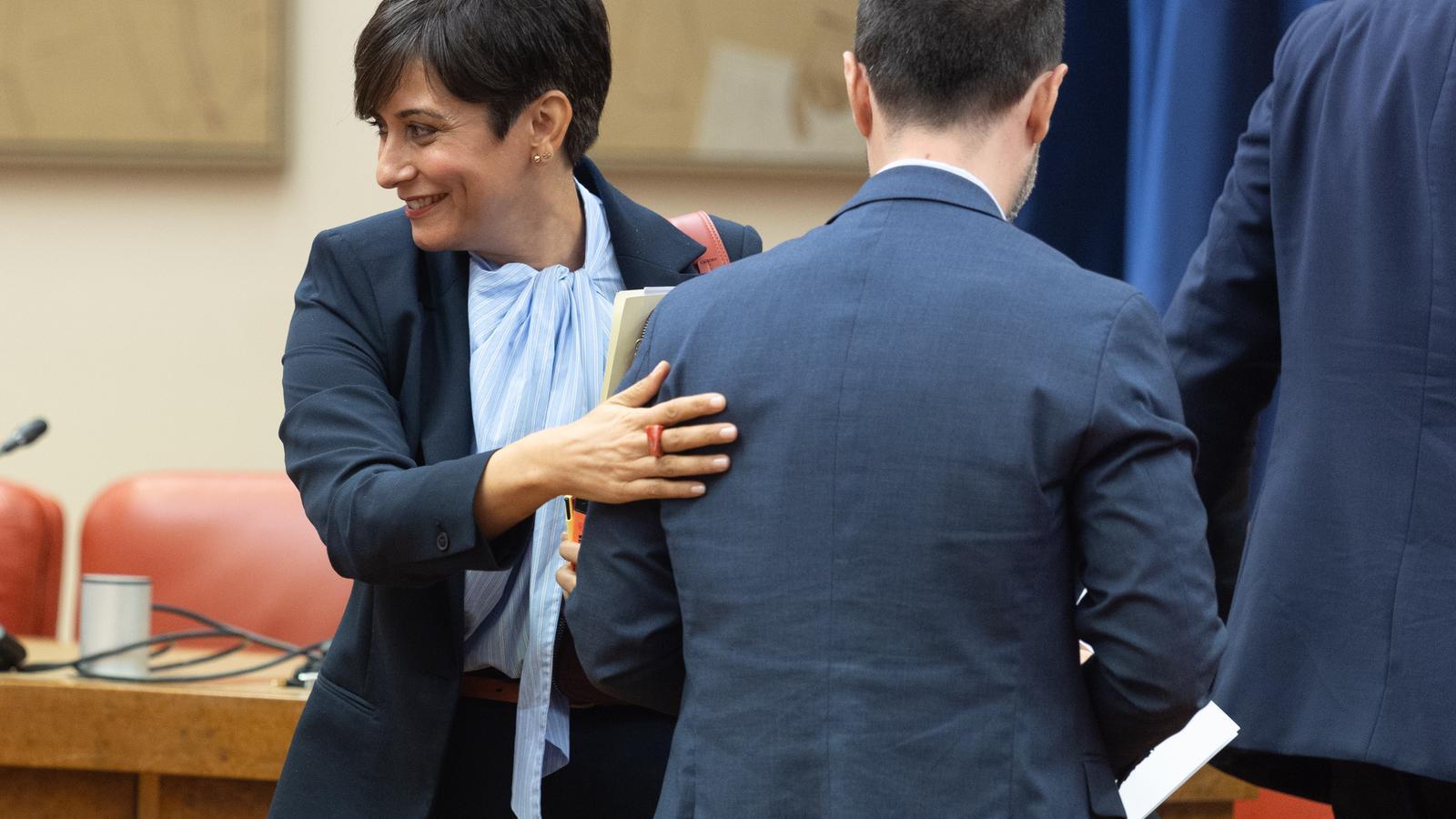
MadridA few hours before the start of the 29-N election campaign and the day after the general strike for housing, Congress has rescued the Maricarmen decree that temporarily suspends evictions for vulnerable families and extends leases for two years. The progressive majority of the permanent deputation—the body that remains in office after the dissolution of the lower house—has approved the decree that PP, Vox, and Junts struck down a month and a bit ago. Finally, the Spanish government was able to save it because to reach an absolute majority in the permanent deputation, they do not need the votes of the Junts members. Thus, with the yes of the PSOE, Sumar, ERC, EH Bildu, PNB, and Podemos, it was enough to validate the measures that the Council of Ministers recovered days after the first no from Congress and the day after Pedro Sánchez called for early elections. On the other hand, the rejection by the Basque nationalists blocked the second decree that established indefinite rental contracts.

The parliamentary debate has been inevitably marked both by the street protest this Wednesday, November 11th, and by the upcoming election date. “I call for the mobilization of people who believe in the right to housing to manifest themselves at the polls on November 29th,” said the Socialist Minister of Housing, Isabel Rodríguez, during this Thursday's parliamentary debate. The Minister of Social Rights, Pablo Bustinduy, from Sumar, who intervened in defense of the decree that was not approved, praised the general strike, which he called a “success,” and rebuked the position of the right-wing. Bustinduy estimated the average savings for a tenant at 4,341 euros—the Spanish executive calculates there are about 5 million—who would have benefited from the successive and indefinite extension of contracts—the decree also established compensation for the tenant if the landlord wants to end the contract early—. The head of Social Rights urged the PP, Vox, and Junts to “review their electoral programs and find a proposal that implies such savings” for the working class.
The PNB spokesperson in Congress, Maribel Vaquero, opined, however, that it is a “counterproductive” measure because its effect would be to “reduce the supply” of rentals. “We do not accept that in order to protect some, we must go against others,” she stated, considering “sufficient” the two-year extension included in the decree that they did endorse because it gives time to bring another proposal that is not done like this one: “through the back door,” “without dialogue, without agreement, and without justification.” The Junts deputy Josep Maria Cruset, who opposed both decrees, denounced that the Spanish government has acted by engaging in “far-left populism” and labeled these legislative initiatives, pushed forward with the legislature practically finished, an “electoralist operation.”
From the PP, deputy Sergio Sayas accused the PSOE and Sumar executive of “totalitarianism” and “absolutism.” “What we are experiencing this morning is a fraud against democracy. The government has sneaked in through the back door and behind the backs of the Spanish people some decrees that Congress had already rejected, taking advantage of a final configuration of the permanent deputation that does not represent the plenary session,” he said. Precisely the rejection of these decrees was the trigger for the electoral call, for which just over two weeks remain.
ERC-Junts confrontation
As is customary, the debate was the scene of tension between the ERC spokesperson in Congress, Gabriel Rufián, and Junts. The republican criticized the 'juntaires' vote against it and once again displayed a 50-euro bill to argue that money is the "estelada" for Carles Puigdemont's party. Junts deputy Josep Maria Cruset accused the ERC spokesperson of acting as an "emotional abuser from the moral superiority that characterizes him," to which Rufián responded with indignation, insisting on denouncing the position of Junts, whom he accused of "collaborationism" with the Spanish right.
