The keys of Barcelona

A friend sends me a beautiful photograph of a banner hanging in France, with the streets full of protesters, where it reads: “The bourgeoisie will prepare for war, the youth prepare the future”. It is this constant tension between the pessimistic and self-interested vision of fear, that of blaming migrants or the growth of cities (can you imagine if our grandparents, in the sixties, had opposed the demographic trend?) and the responsibility of planning a somewhat more encouraging future that connects me with the great authors of European urban planning and architecture. Why get into the mud of projects and construction work, instead of settling for what is already there?
One of the reasons why Barcelona is a magnificent city is because you can wander through many of its residential neighborhoods without having the keys. How long this will last depends a lot on the plans and the leadership of Plaça Sant Jaume. It is not that Barcelona lacks a narrative; what it lacks is consistency with its astute, generous, and risky past.
Now everyone talks about density, because it is an attractive term for developers, who immediately make calculations with the profit increases it can generate for them. But I prefer to talk about the small grain, about coexistence and co-ownership: in Barcelona there are hundreds of thousands of neighbors who share staircases, rooftops, lobbies and courtyards and who live with civic values that go far beyond the norm. That is why it is better to live in a city that has a rooftop full of giants at La Pedrera or tiled light wells in modernist buildings.
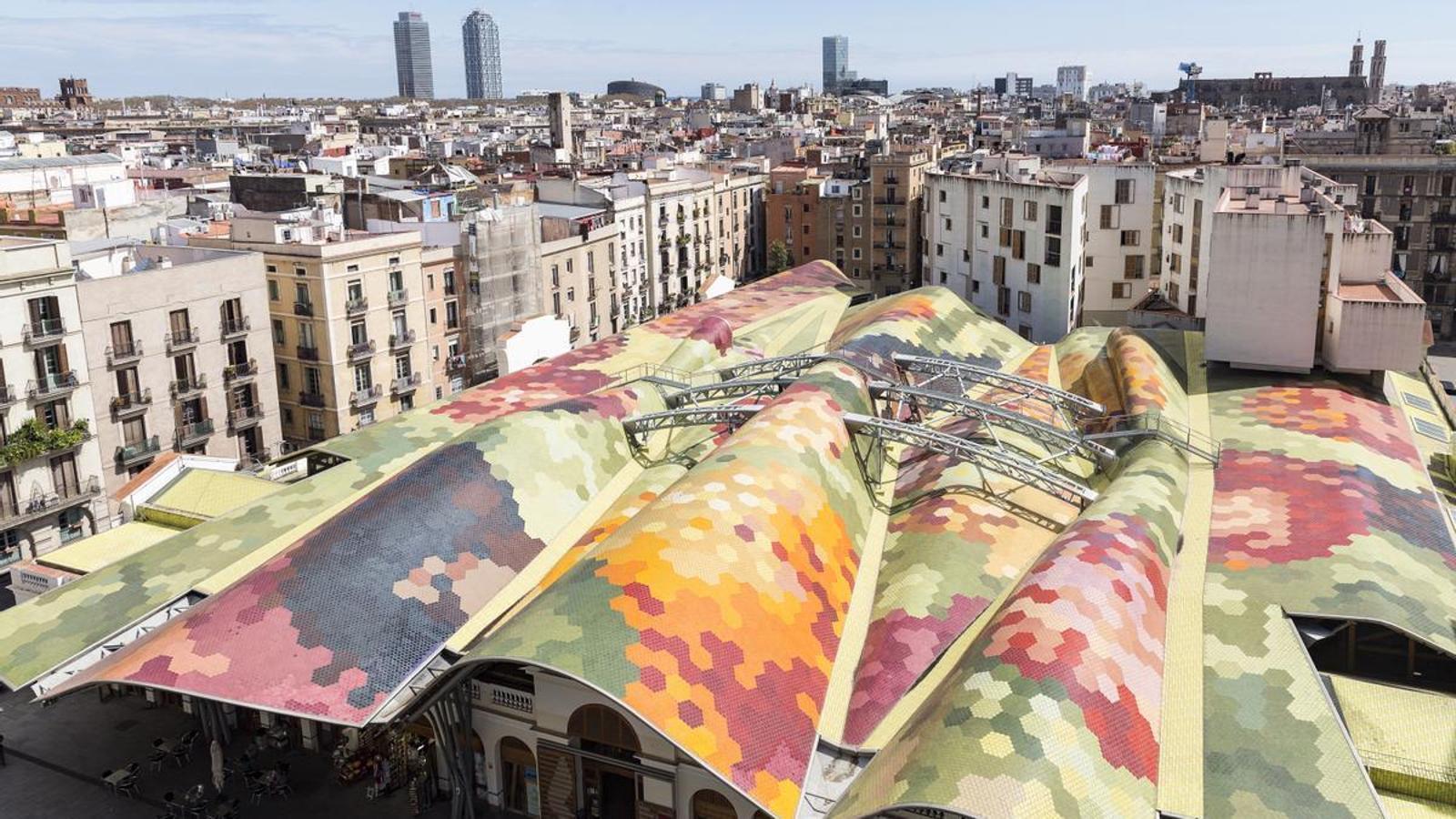
In Barcelona, it is not surprising that the roof of the Santa Caterina Market has a suggestive, colorful, wavy shape, because it is understood, as in the case of the Palau de la Música and the Hospital de Sant Pau, that there is a social function to the skin of the building that goes beyond having openings and windows. The buildings of Barcelona qualify their public space, and they have done so in a surprising way since the genesis of the Eixample. What is the Rambla de Catalunya if not a spectacle of spectacularly well-composed facades?
You might find yourself walking through the Raval and have a corner invite you to look at the building from afar and admire its setbacks. This happens with the buildings of Pep Llinàs, which, without breaking the continuity of the street, rise in the shape of a tower and create bright corners for pedestrians and residents alike, in operations where it is hard to tell where urban planning begins and architecture ends, because the solution is simply brilliant from every point of view.
You can go from home to the office passing by the Hospital Clínic, crossing the route of students, doctors, patients and family members, and buy delicacies at the Mercat del Ninot or enjoy the hustle and bustle that is created between the corridors of the wings of the old building and the hundreds of restaurants on the ground floors of the Eixample.
The interesting places in Barcelona draw from the best of traditional fabrics, and reinterpret them. Coderch made it possible for a certain middle class to find it attractive to live in blocks of up to seven floors but with the qualities of small houses with gardens, surrounding the balconies with greenery and creating a superblock on the border with old Sarrià.
Until the fifties it was customary for buildings to bear the name of the owner who had promoted them: the Rocamora house, the Sayrach house, the Thomas house, the Planells House... You can see their blueprints at the Municipal Archive. There was a consciousness regarding the legacy that would be left to the city. They could be limited-income buildings or blocks for a single wealthy family, but the commission often included instructions to the architects to create unique crowns, sgraffito facades, or impressive lobbies, even if they were made with poor materials. Small gifts to the city: decisions based on the trust, perhaps a bit daring, that people do not always have vandalistic attitudes. In fact, there are studies that show that permanence in a place helps the neighbors themselves take care of maintaining the common areas and improving them. Perhaps no one sits in the secluded gardens of the Tres Torres, but walking through them is pleasant even if you are not a neighbor.
In cities there have always been very expensive places and others that are more popular. But now “exclusive” buildings have opaque ground floors, gated communities, guarded enclosures, common areas with spa, swimming pools and private gyms: limits that are too rigid in contact with the city. Gardens are walled off, pedestrians are not allowed to enter, and open spaces on private plots are closed: they cannot even be seen from the street. There is a risk that Barcelona will begin to speak the language that the city's new operators have imported from suburban America or scattered Europe. If the youth do not see that they can stay to live in Barcelona or that what is being built anew is increasingly impenetrable, it will be difficult to add them to the engine of transformation. And, on the other hand, by looking at concrete examples, by visiting recognized projects, so many doors would open...
