The ARA Premium Club moves to the Barcelona of the late 19th century
The "club of the unconditional" of the ARA takes a journey through the Barcelona of Picasso guided by the journalist and historian Daniel Venteo

-
CAT -
CAST
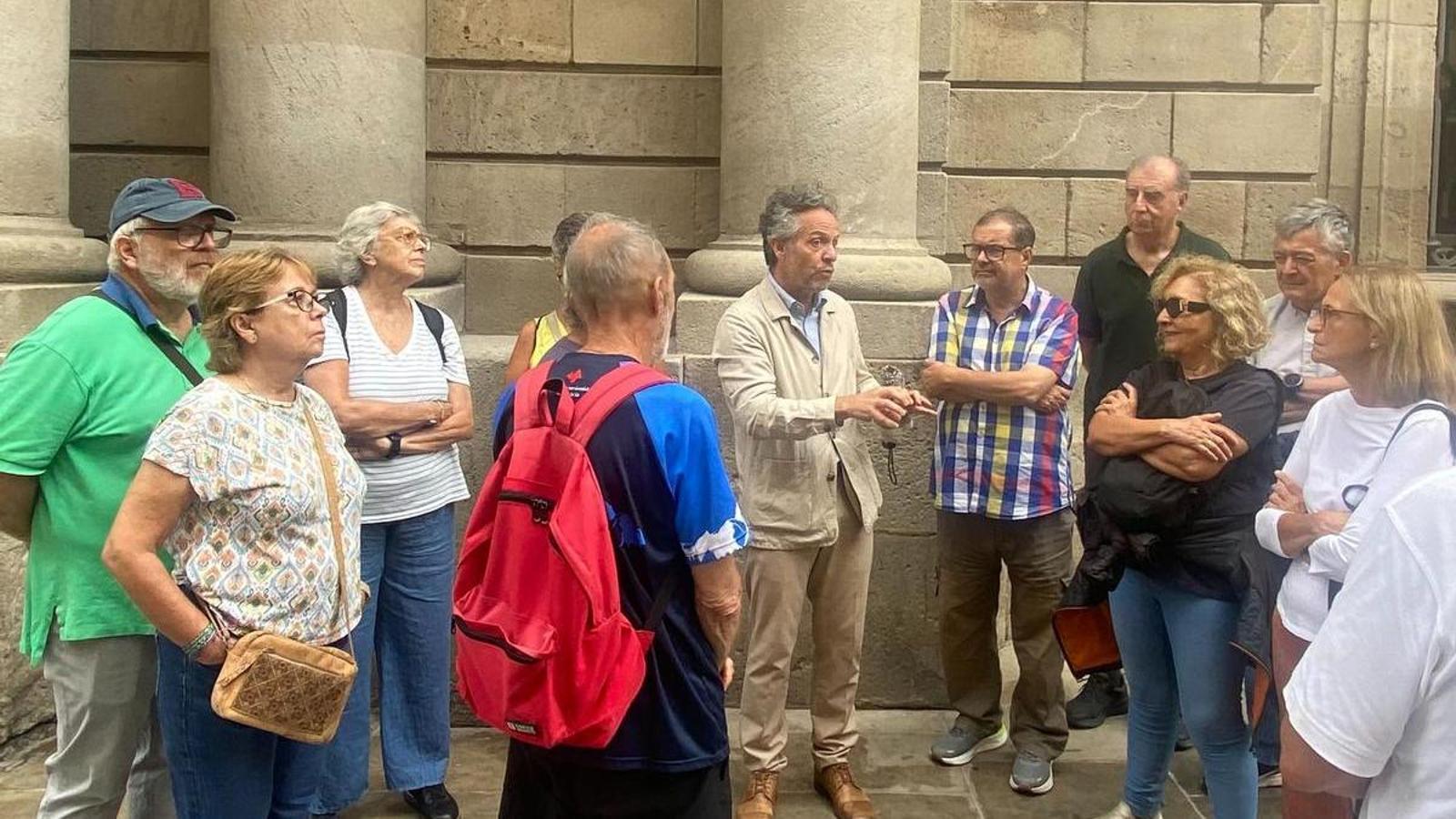
"Picasso arrived in Barcelona in 1895 from Malaga, when he was a child. He was 13 years old," explains historian Daniel Venteo to the members of the Premium Club who have signed up for the tour of Picasso's Barcelona.
We started the route at the Estació de França, which at that time had not yet been built (it dates from 1929). But there was the oldest station on the Peninsula, where since 1848 the train to Mataró had been running, and also to Granollers. From this station, Picasso left Barcelona for the first time in 1900, heading to Paris, a city that dazzled him.
In that same year, 1895, Picasso enrolled in the School of Fine Arts, created by the Board of Trade. Many of the Catalan artists or those living in Barcelona at that time studied there. Picasso's father taught drawing classes there. The teaching was eminently academic, which allowed young Pablo to perfect his mastery of the pencil and the brush. It was here that he made his first friendships.

Walking towards Pla de Palau along Avinguda del Marquès de l’Argentera, the Porxos d’en Xifré come into view. These are porches located on the ground floor of the building commissioned by Josep Xifré, a merchant from Arenys de Mar who made his fortune in Cuba. Next to this building was the first temporary residence of the Picasso family.
On the same Avinguda del Marquès de l’Argentera, we stop in front of one of the oldest properties on this street. The date it was built is written above the doorway: 1881. "Picasso surely noticed it, because it is the year he was born," says Daniel Venteo, author of the book Barcelona and Picasso (Editorial Efadós, in the collection The Disappeared Catalonia). Venteo lived in his youth in the same neighborhood where we are now, around Pla de Palau. It is the neighborhood that welcomed the child and young Picasso.
"There are not many photos of Picasso in Barcelona. One of the best known is of him and some friends at the house where he lived, in front of the church of the same name," explains Daniel Venteo at Plaça de la Mercè, pointing to an imaginary line of where the house reached. It is just a few meters from the facade of the church, so it was completely stifled, and with very little sun. "The building was demolished in the 1980s, as part of the Ciutat Vella urban renewal policy," Venteo underlines just as an electric scooter passes by—at an excessive speed—, which brings us back to the year 2026.

The walk with Picasso's eyes through the narrow streets of the Gothic Quarter—full of tourists from very diverse origins—has included not only the houses where Picasso lived—he moved a few times—but also the studios where he painted, located at the top of the buildings, where there was more light. Precisely under one of his studios, on Carrer de la Plata, there was a gallery with works by Picasso. It was the Taller de Picasso gallery, which the far-right group Guerrilleros de Cristo Rey set on fire in 1971. This is one of Picasso's footprints that have been erased. There are also Picassian places whose locations are unknown. Avinyó Street and its brothels have been linked to one of the brilliant painter's most renowned paintings, Les Demoiselles d'Avignon, which he painted in Paris in 1907. Venteo states that its location could not be identified.
The tour of Picasso's Barcelona is a journey to the late 19th and early 20th centuries (until 1904, when Picasso lived there intermittently). It also includes Els Quatre Gats, located on the ground floor of a beautiful building by Josep Puig i Cadafalch, where Pablo Picasso held an exhibition in 1900; the Sala Parés, where Picasso exhibited together with Ramon Casas in 1901, and the Picasso Museum, inaugurated in 1963, while the artist was still alive.
Remember that if you are a subscriber and you join the Premium Club you will be able to enjoy other advantages such as browsing Ara.cat without advertising or gifting a complete digital subscription to whoever you want.
