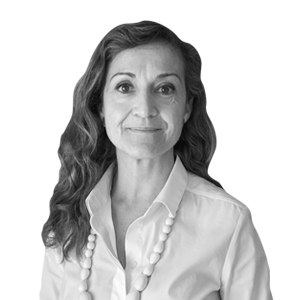
Sylvie Kauffmann: "Our social and democratic model is threatened, not just our security."
Journalist, former editor of 'Le Monde'
-
CAT -
CAST
BarcelonaJournalist Sylvie Kauffmann opened Enfoquem, the new forum held by ARA this Friday and Saturday with the aim of offering a positive and constructive perspective on some of the most pressing issues that concern us. An experienced correspondent and former director of Le Monde, reporter for the prestigious France Presse agency... Kauffmann has a long enough historical perspective not to be able to ignore its warnings: European values will have to be defended, sacrifices will have to be made.
If you had to summarize the main concerns when looking at the world, what would they be?
— On the one hand, there is the collapse of international multilateralism, of this entire highly regulated order with laws that no longer work and, therefore, give way to the law of the strongest. On the other hand, there is the decline of liberal democracy, that is, of our political system, in place since the fall of the Soviet bloc. Now we see that it was not only an extremely fragile system, but also limited to a handful of countries, some 30, that we can now call truly democratic.
How should we relate to this predatory leader, as defined by Giuliano da Empoli, who is Vladimir Putin?
— He has a very particular relationship with Ukraine. We'll see what comes of the negotiations, but I don't have much hope, because he won't be satisfied with what's being negotiated. He wants to prevent Ukraine from becoming another Poland, from being a European country and completely escaping his sphere of influence. Will he go further? I don't know. But we must bear in mind that he could: he might be tempted to lay his hands on Moldova or one of the Baltic states.
Is Europe prepared to defend its territory against Russia, given the current poor relations with Trump's NATO?
— They're not ready. Not even mentally. For years we turned a blind eye to Putin's evolving ambitions, which are becoming increasingly grandiose. And because we weren't mentally prepared, we weren't physically prepared either. So when Putin seriously invaded Ukraine in 2022, it was a huge shock. And we told ourselves: all right, it won't last long, the Americans are here... Until we finally understood Putin's ambitions, but we didn't take the necessary steps to prepare ourselves materially. I discovered then, for example, that in France we didn't have a stockpile of ammunition. I knew we had an army, like everyone else, but I thought it was a fully operational army. And it turns out we don't have ammunition! So now we find ourselves in a very complex situation that we're trying to manage. But if we're on our own—and we're pretty much on our own—things are going to be complicated.

You have studied the Franco-German axis extensively. Do you have any plans for the immediate future?
— Yes, of course. Europe exists and does many things. Look, there's no need to be defeatist. I tend to write that it's disheartening, that not enough is being done... but the glass isn't empty. And there's a political awakening, I would say. With Scholz as chancellor of the axis It didn't work at all. With Merz it's different. Now, all these leaders may be eager to work together to confront the situation, but then each one has very different political situations at home. The format of the Europe of 27 doesn't work, so we must find other ways, such as a Europe with a variable geometry format. However, we don't have the power of a federal government, of a central state like the United States or China, and this is our Achilles' heel.
Decisions in Europe are slow, and their counterparts are less democratic but considerably faster. How do we convince Europeans that our model is still useful?
— It's clear that no single country can pull through on its own. But it's also true that Europe's operating model isn't adapted to the crisis we're facing. There's a problem of time. We need time to evolve our European decision-making model, but we simply don't have that time. Current politicians in Europe should be doing a great deal of educational work, but I get the impression they're too far behind public opinion. They should step forward and say: ladies and gentlemen, we have a problem, and it's going to cost us money. Our social and democratic model is threatened, not just our security. Security can be addressed with military means, but our social and democratic model is something else entirely, and it's under attack because there's Trump attacking it and trying to dismantle and tear it apart. We need to work together, to move forward together. It will be difficult, and there will have to be sacrifices.
Do you recognize the United States of today? How did we get here?
— There's a president of the United States who's a very strange character, someone we struggle to understand, and sometimes we even wonder if he has some kind of mental illness. What disturbs and bothers me most are the people who support him, including members of the Republican Party who are supposed to follow rational policies. In Davos, in fact, I saw Secretary of State Marco Rubio in a surreal pose, seated on a kind of throne. At least there are still people who find this abnormal in the United States: judges too, who are doing their jobs, and the media, to the extent they can. But people are afraid these days. It's not that they necessarily agree with what's happening, but there's a certain fear that's palpable and prevents people from reacting or speaking out. And it's very unsettling for us too, because we tell ourselves: this could happen in our own country, as well.
And what is the origin of this increase in far-right forces?
— Our democracies are no longer functioning well. They are not effective enough. We haven't addressed people's everyday problems head-on. With the rise of the far right, we also need to take a critical look at our democratic forces.

What role does artificial intelligence play in this world we're talking about? I ask you this as a journalist. Because Trump tells us: truth is a matter of opinion.
— With artificial intelligence, the first thing we need to do is control it, to understand it properly. The rest is based on education, training, and pedagogy. But it's not about educating people; that needs to happen in schools. Therefore, it's essential that educators and teachers are trained in this area so they can train their own students. And here, I think we're at a very complicated juncture. Because people are starting to use artificial intelligence extensively, but in a haphazard way. Who should regulate it? Who should hold consumers responsible? I don't know, but technology companies should be held accountable. However, what we see on the other side of the Atlantic is not at all encouraging.
What should be the civic reaction to this?
— I am not a political figure, and therefore I speak with all humility and modesty, as a journalist and as a citizen. To begin with, we must stand firm in our values. What is happening in the United States—do we want it to happen in our country? Honestly, no. We must prevent it at all costs. And how do we prevent it? By standing firm in our values... and being prepared to defend them. We need to mobilize at all levels, starting with schools and children. We must tell our children everything that is at stake. We can do this through the media, but we must also try to convince our politicians. And I believe we have a problem of weakness among our politicians throughout Europe. People are completely disinterested in politics because they find it too complicated, partly due to the media landscape. Therefore, we need to help our politicians base themselves on their values and defend them in the public eye. They need to be braver and more proactive. This is the challenge of today.
