Salah Jamal: "Catalanists should be more afraid than immigrants of the far right"
Doctor and university professor

-
CAT -
CAST

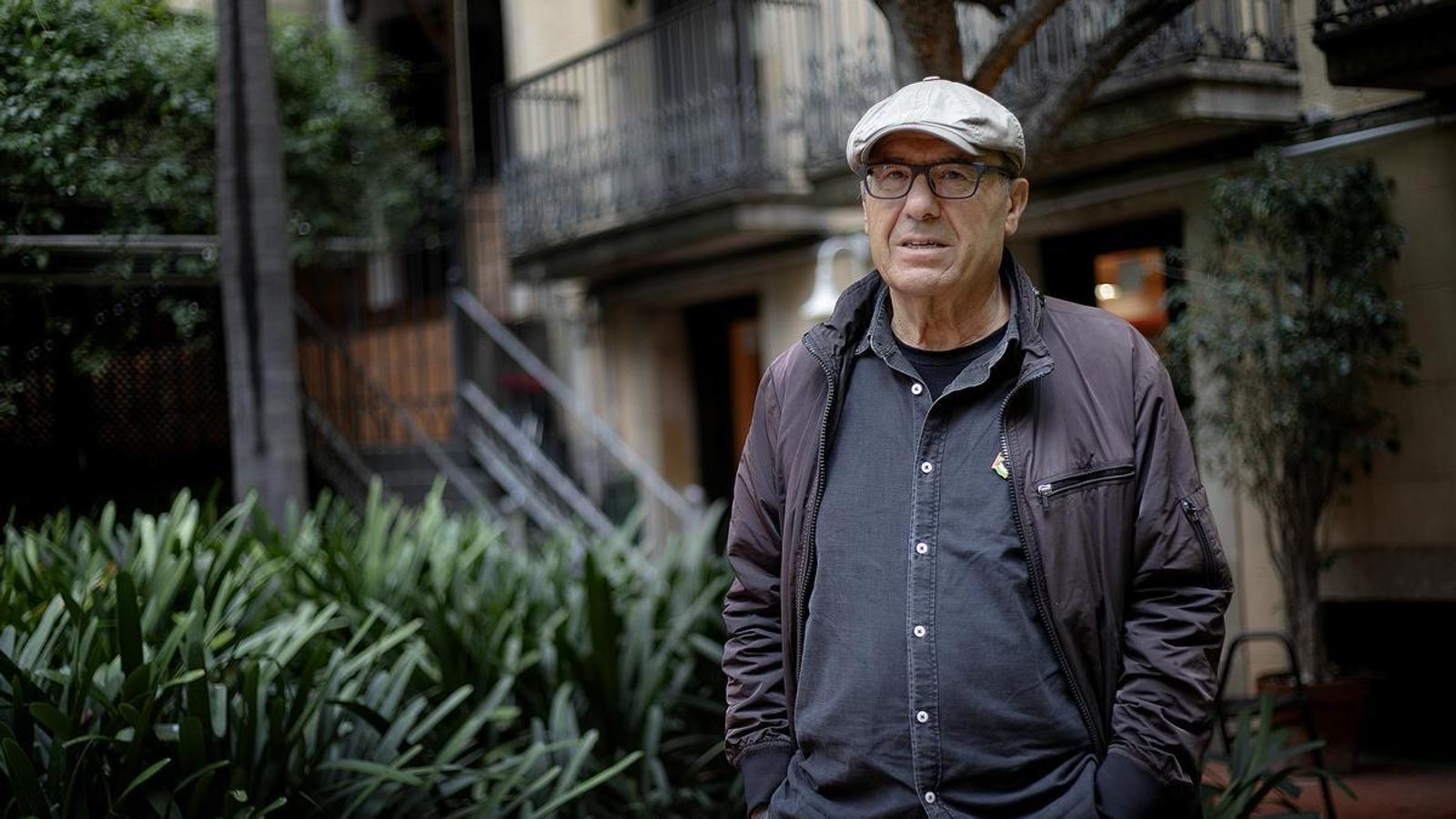
This October marked 57 years since Salah Jamal arrived in Barcelona to study medicine. Afterward, he was supposed to return to the West Bank, but he never left Gràcia, hence the photo on his WhatsApp with the bell tower of the Plaça de la Vila in the background. A dermatologist, writer, historian, and university professor of Arab culture, this year he received the Creu de Sant Jordi. With an affable demeanor and iron convictions, he is one of the protagonists of the documentary Arrelats, directed by Isona Passola, which will premiere during the Migrations congress organized by the Ateneu Barcelonès from November 19th to 21st.
What will he answer if I ask him: where are you from, Salah?
— Before the Gaza genocide it would have been hard for me to define myself and I cared very little. I am an amalgam of identities. But for the last three years I have been Palestinian again.
Why?
— Not for ethnic or political reasons: because the Palestinian cause is the cause of humanity. Today the Palestinian flag is identified with justice.
I suppose it is difficult to detach oneself from the place where we were born. Paint me a picture of your youth in the West Bank.
— It was a continuous suffering. You thought: will I finish high school or not? Will there be a war or not? Will the Israelis enter or not? Will I die or not? I don't know how we finished high school. I think about it when I see the schools in Gaza that are functioning despite the destruction, for survival.
We all have two or three moments that mark the course of our lives. What would yours be?
— The first time, at 9 years old: the first time they beat me up. The Jordanian police took me to prison for having gone to a demonstration like someone going to play marbles. For me, it was incomprehensible. I only knew that they had kicked us out of our home. That awakened my consciousness, and from 14 to 17 years old I got involved in the nationalist movement against the occupation. The Israeli army arrested me three times.
What happened at 17 years old?
— Our families convinced us that the Palestinian cause needed intellectuals. And this is the second moment: me leaving home to study in England, on the deck of the ship, watching Beirut get smaller and smaller as we enter the vastness of the sea. It was the first time I had ever seen the sea. I didn't know how to swim. I was terrified. The third moment is the first medicine class: I looked at the professor and didn't understand absolutely anything.
How is it that you came to Barcelona at a time when people were not coming, but rather leaving Spain?
— I didn't even know Barcelona existed. For me, it was a port where the ship stopped on its way to London. Since in the Arab world there were universities in Cairo, Baghdad, and Damascus and that was it, they required tremendous grades and I was an average student. But the embassy in Amman said that the Spanish were like the Arabs...
We can say that it is here thanks to the regime's propaganda!
— Yes, bullfights, flamenco, Royal Madrid and cheap living. Very cheap. When the ship stopped at Columbus I walked to the Plaça Reial. There were people playing the guitar, lying around there, and they invited me to a dark fruit juice. It was sangria. It was the first time I tasted alcohol. That atmosphere stayed in my head and, when I could not stand London, I returned.
I am sorry that he was baptized with sangria... Why has he only returned to his country four times?
— They make your life bitter, they put every obstacle in your way. Because I need a visa, and you don't. After leaving, they created a civil law that said that the hundreds of thousands of people who lived outside had to return every six months to renew their residency card. Imagine that! The State of Israel gave us a residency card to live in our own home, as if we were immigrants coming from Mars!
And what did he do?
— The first time I spent eight days on a boat to renew a paper. But when the UN announced that Israel would have to withdraw from the West Bank I thought it was no longer worth it. And look: they have been there for sixty years and they do not consider me a native Palestinian. They turned me into a refugee.
What rooted him in Catalonia? And what can root an immigrant who arrives today?
— When immigrants arrive here, they think of nothing but survival. Do you think a person from Mali or Nigeria walks across the desert just to change our values if they arrive in Europe alive? How many churches have been turned into mosques? One should read history and sociology: never in history has a migratory wave been able to change the values of the native people of a territory. Never.
Not intentionally. But it is evident that migratory waves change our society.
— The fact is that all societies change! They say that the immigrant does not integrate, but the fact is that some Catalans do not assimilate this new society either. And on top of that, they blame the most unfortunate ones. No one seriously opposes the Yankee nonsense that invades us...
Perhaps changes are more accelerated than mentalities can change.
— And why has this happened? Without euphemisms: the faster the Western elite steals from the Third World, the faster and more immense is the arrival of immigrants. Because you impoverish those people and they have to seek their own living. Stop stealing from the Global South and no immigrant will come! You will have to go and look for them, because this is an old continent.
I asked him what rooted him...
— I was exotic and had money, they thought I was a sheikh's son, it has nothing to do with now. But what I have always liked about the Catalans is that they live and let live. As an immigrant, I want your indifference and I will manage on my own. I learned Catalan because I did not understand my girlfriend's family. And my education about Catalonia comes from becoming a member of the Ateneu Barcelonès, and I did it because my landlady would not let me keep the light on for so many hours and here I could come all day to the library.
As a university professor specializing in the Arab world, what prejudices have you encountered? There is a belief that religion is the main obstacle to the integration of immigrants...
— This is a lie. An example: there are more and more Muslim girls who are taking off the hijab. Sometimes there is resistance from the first-generation parents, but no longer in the second. This is important and people do not want to see it.
It means it is a matter of time.
— Of course. Do you think the first generation will take off their veil and go around in a thong in Sitges? It doesn't work like that. Ask your grandparents, who emigrated to Belgium and Germany.
Are you afraid of the rise of the far-right in Europe?
— Catalanists should be more afraid of the far right than immigrants. You are the primary enemies. Perhaps they will put on a show and expel four immigrants, but the businessmen will stop them immediately. In Italy, Meloni hasn't expelled even one. They want to capture votes with racist discourse, but, if they win, they will go against Catalan culture and inclusive independence.
You are Palestinian and agnostic. What have you passed on to your children and grandchildren?
— I have never spoken to them about religion and I have tried to spare them the news from Palestine so as not to burden them with problems and not to pass on my trauma. But the news imposes itself and my face does not deceive. At fourteen or fifteen years old they already became politicized, like their father, and they are militant Catalans of both processes, the one over there and the one here.
Do you still feel like a foreigner, 57 years later?
— More than a foreigner, because I have never felt despised, I often feel strange. When I go somewhere new, to Pedralbes or to Sant Martí, it is as if someone knocked on the door and reminded you that you are not from here. But I return to Gràcia and everything goes away. When I return from a car trip and see a sign for Catalonia, I relax: "I'm home now".
