What do the initials of PANTERA mean? Everything that must be taken into account when verifying information
The Local Audiovisual Network and the entity Learn to Check launch a gamified media education project in secondary schools
-
CAT -
CAST
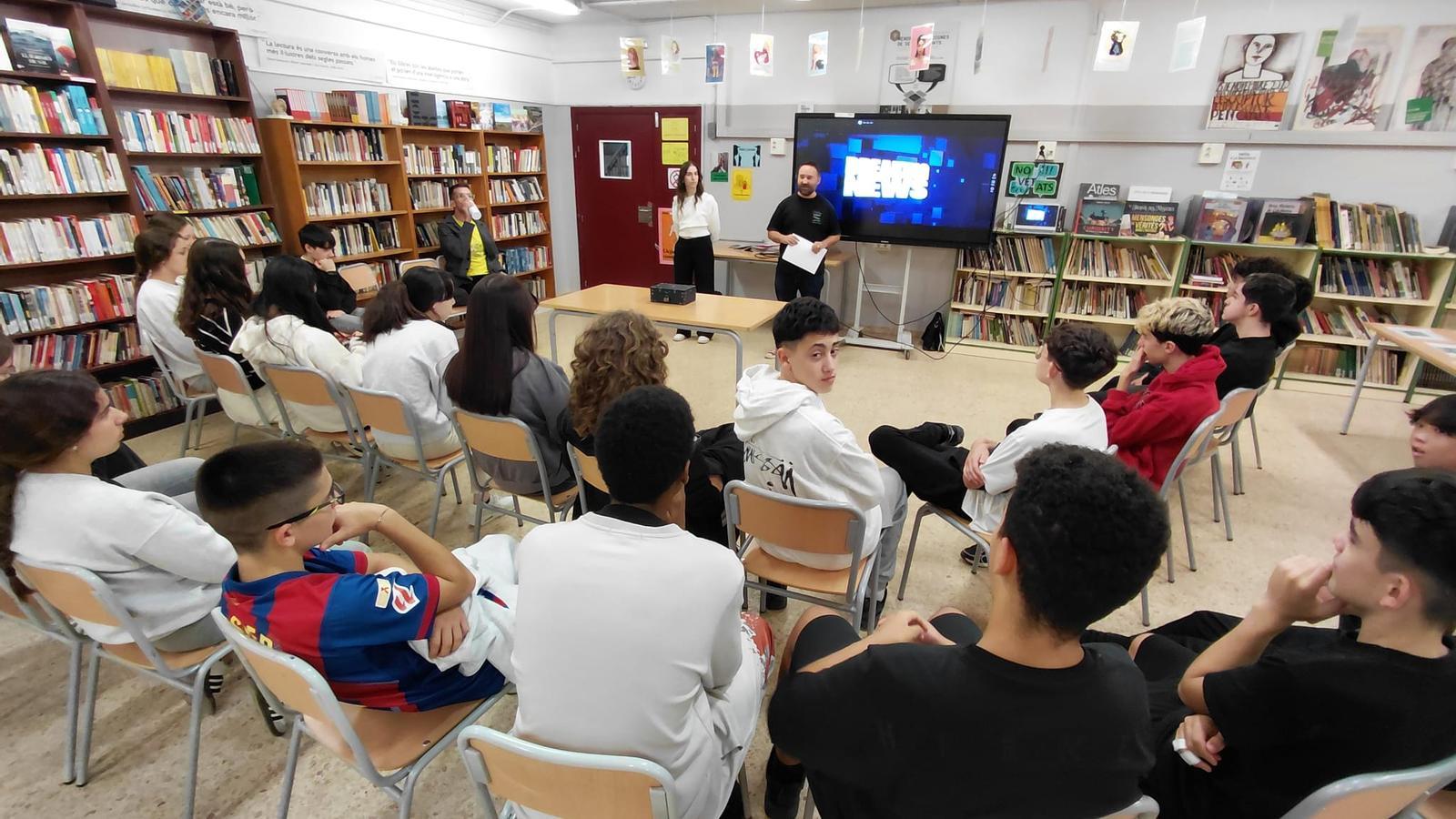
It is Wednesday morning at the Estany de la Ricarda Institute in El Prat de Llobregat. Today, groups of 3rd-year secondary school students are training in media and information literacy (MIL) with an activity that has them very intrigued: an escape room. These teenagers are part of the so-called alpha generation, characterized by being digital natives, having grown up surrounded by screens and having no analog frame of reference. Today, however, they are not accompanied by mobile phones, but by journalists from local media and Learn to Check, a non-profit association that promotes media education across different age groups.
The participating boys and girls have a mission: to solve The Truth Game. The escape room begins with the screening of a mock alert where municipal authorities warn that they have activated the Register of Adult Disinformers (RAD), as a flood of disinformation and fake news has been detected on citizens' social networks. To regain information freedom, they need to train verifiers, and the most suitable ones are precisely the youth. Just a recent report by the UAB and the IMANcorp foundation indicates that 74.2% of people aged between 16 and 25 have high digital skills. This percentage drops to 56.7% in the 56 to 65 age group and stands at 31.3% among those over 65.
To achieve this mission, the class is divided into groups and each will have to collaboratively solve challenges in different corners of the classroom. The key objective is to combat disinformation and promote critical thinking regarding information and new technologies. For an hour, they must find vocabulary about disinformation in a word search, classify different contents according to their informative format, identify real and fake images, and also act as journalists by searching in a reliable source for a news story from the year they were born, in this case, 2012.
The students are a bit disoriented at the beginning, but they quickly get into the role. The most reliable source for them is the journalists themselves who lead the activity, because today they are working in offline mode, but in other sessions they can also make queries via the internet on a classroom computer. One of them is Imanol Crespo Martínez, the managing director of El Prat Comunicació. “It is curious to see how they always focus more on the visual part than the written one,” he says with a smile, and he acknowledges that he really enjoys participating in this activity because it is a way to get closer to the young audience and make local media known.
As Nereida Carrillo, president of the Learn to Check association and journalism professor at the UAB, explains, “the beauty of this educational project is that we co-created it with journalists from different local media outlets of the XAL and that each medium can customize it for its municipality”. She adds: “Our intention was to provide preventive training, but right now it is more palliative, since adolescents aged 12 to 14 accessed screens prematurely”.
When the groups finish all the tests, each one is given a puzzle piece. Together, they put the pieces together to find the solution to disinformation. The result is the image of a panther, since its initials remind us what to keep in mind when verifying information: provenance, authorship, novelty, tone, evidence, replicas, and expansion. That is not all, because on the back there is a written code: 916. These numbers, which coincide with the local FM radio dial in El Prat, are the ones that open a small chest. Inside is the reward for their work: a gift from the local media and a card that certifies them as verifiers.

After a brief moment of excitement, it is time to share what has been learned and discuss which media outlets they use to get informed. The majority response is through mobile phones or television news; the radio is relegated to background noise at grandparents' houses or for listening to music in the car.
Before the end of the first term of this school year, 15 sessions of the XAL-A project will be held in high schools in El Prat and Sant Vicenç dels Horts (Baix Llobregat), Torredembarra (Tarragonès), and Torrefarrera (Segrià). And looking ahead to the second and third terms of the 26/27 school year, it is expected that this number of sessions can be expanded to more Catalan municipalities with local media outlets affiliated with the Xarxa Audiovisual Local.
The right to truthful information
This educational project was conceived during the Media Education and Local Communication conference, which XAL organized in March 2025 at the CCCB with experts and representatives from local media, universities, and public bodies. Núria de José, CEO of XAL, comments: “That meeting allowed us to share the relationships that local media, especially radio stations, have been organically and naturally weaving with educational centers for many years. But we wanted to go further, to enter the classroom in a more playful way.” The proposal is already underway, and now the challenge is how to give continuity to this learning, which is so necessary during adolescence. “Real media education is needed. It cannot depend on a motivated teacher or local media outlet. All students must be able to have someone equally who tells them not to believe everything, that everything that reaches them is not truthful information,” stresses De José.
In fact, within the framework of Media and Information Literacy Week (MIL), the Platform for Media Education (PEM) promoted a manifesto to call for strategic public policies on media and information literacy in Catalonia.
And this was defended by the Dean of the Journalists' Association, Joan Maria Morros, before the Parliamentary Study Commission on Fascism, Racism, and Hate Speech. In his appearance, Morros stated that the role of journalism is key to the defense of human rights and the quality of democratic debate. As he rightly recalled, journalists have a duty to report on reality with honesty, independence, responsibility, and a critical spirit, while the large technological dissemination platforms are not held to any accountability. That is why he requested that "there be transparency regarding the ownership and financing of all journalistic media."
For seventeen years, the Journalists' Association has also been promoting the educational program EduMèdia, which has already reached more than 27,500 students, but this training must be incorporated in a stable manner into schools and reach all citizens to combat disinformation and promote critical thinking with stable funding, territorial reach, and evaluation mechanisms.

