Àlex Sastre Prieto: "I thank my mother that she stopped my feet when it was time"
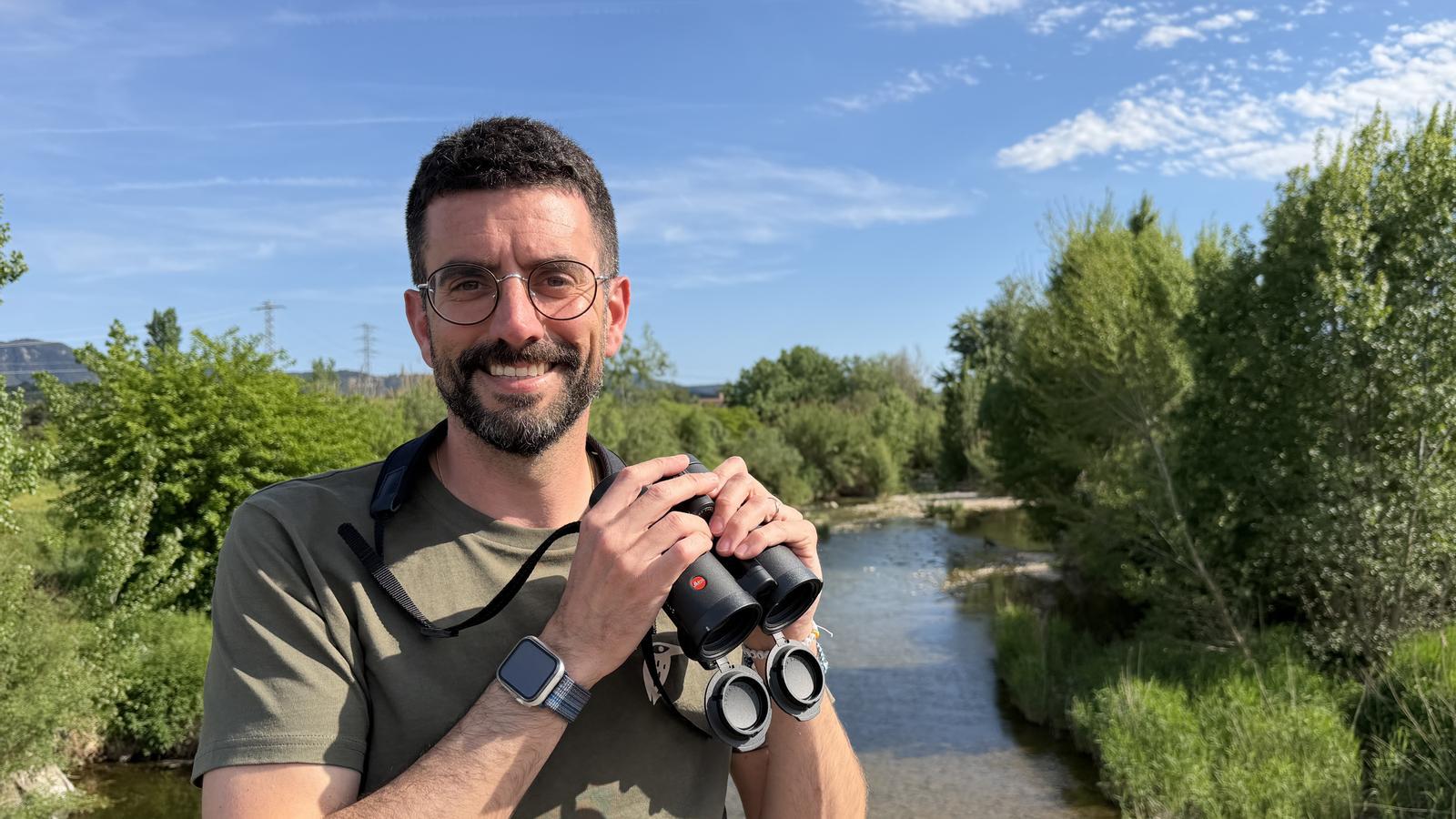
Chemist, teacher, politician, passionate about ornithology and father of Elna and Arnau, 8 years old. He publishes 'Pardalejar. Els ocells de Catalunya al teu abast' (Rosa dels Vents), an enthusiastic manual of introduction to bird watching, a book that invites parents and children to leave the house with binoculars and with their ears wide open

-
CAT -
CAST
Parenthood came to me at a time when I was beginning to go birding quite a lot. But when you are a parent, and of twins in an augmented way, you have to put aside, even if only temporarily, certain things. This meant that for a few years I went out into the field less to see birds, but it has also made me develop a passion for explaining birds to my children, to my friends, on social media and in the book.
Is being a father at all like birdwatching?
— My children are the bimbos of my life, which in ornithological language means that they are my most prized observation. I will never be able to observe, be enthralled by, and know a form of life more exciting than them, and that requires more intensely all of our capacity to accompany and guide.
Explain this to me about bimbo.
— It means seeing a bird for the first time. On a trip to New York, in Central Park, one morning I saw 35 new birds. But what surprised me most was seeing how several dozen more birdwatchers were joining me and realizing that in America it is a much more popular hobby than here.
To be able to observe, patience is required.
— And yet another more useful quality: knowing how to fail. Watching birds is more exciting because the observation is not certain. It may be that the bird does not appear. The birth of my children was not easy at all, and no one had warned us that things might not go in an idyllic way.
What happened to you?
— My wife's preeclampsia, the death of her gynecologist in an accident two days before the birth, an emergency cesarean section, prematurity, and a rare disease of my son, congenital hyperinsulinism, which fortunately reversed after a year. We really must be prepared for things not to turn out as we imagine them.
Can birds teach us anything about parenthood?
— It is really better not to take some birds as examples of parenthood. The cuckoo parasitizes the nests of others so that they raise its chicks, which, when they hatch, eliminate the other eggs or hatchlings by throwing them out of the nest. Male ducks completely disassociate themselves from rearing. As a general rule, however, there is extreme care for the offspring until they are able to fly, and then they do disassociate themselves.
What are you worried about?
— We are constantly receiving deterministic messages of the type: if you yell at your child you can cause them a lifelong trauma. This puts a lot of pressure on parents, who seem to have a very narrow margin of error. My way of fighting against this sword of Damocles is to think that my mother, who was always present and loving, may also have been abrupt at some point and did not cause me any insurmountable trauma. Now I am grateful to her for having stopped me in my tracks when it was necessary. I try to explain my human condition to my children, so that they understand that I make mistakes, that I am not capable of doing everything. I believe that accepting this can be good for all of us.
In what aspect is parenting twins different?
— I suppose the intensity of the first 5 to 7 years is incomparable to any other parenthood. Sometimes I have the feeling of not having been able to enjoy these years because I have had to divide my time. The easy part is that they are in sync in the growth process and the needs we have to solve are not very different. Besides, they play a lot together and that gives us breathing room. The hard part is not comparing them, not thinking that their growth must be absolutely even. There are differences in the rhythms of many things and one must accept them.
For example?
— The daughter is stubborn and has a fiery temper, and the son is a saintly person and very easygoing. Between them, very often disputes ended with one giving in and the other imposing their will, and this is an issue we have had to work on a lot with them so as not to function in this way.
What makes you laugh?
— Phew! An endless pile of things. Being a parent also means laughing a lot. There are thousands of photos and videos of children in extremely funny everyday situations: dancing in the living room, painting their faces like a tiger or a unicorn, putting their feet in the washbasin in a frustrated attempt to learn to pee on their own, tickling them. They laugh a lot watching them and we do too, savoring the nostalgia of how fast time passes.

