The Islamic Revolutionary Guard Corps of Iran already charges a toll for crossing the Strait of Hormuz
Ships from "non-hostile" countries are forced to navigate a corridor between the islands of Larak and Hormuz
BarcelonaIran's regime is defending itself from the joint attack by the United States and Israel with a weapon that is not military, but economic: choking the transit of oil in the Strait of Hormuz, through which a fifth of the world's gas and oil transit passed. But it is a selective closure: instead of mining the strait to block the passage of all ships, Tehran allows the passage of its own vessels and those it considers "non-hostile," while blocking those from countries it considers "enemies." It has established a selective toll with a physical corridor in the sea, through which it forces ships it is interested in to pass. Those that do not do so risk being attacked with drones, missiles, or speedboats.
Since February 28, when Benjamin Netanyahu and Donald Trump initiated the war, transit through the strait – which, at less than 50 km wide, is a real bottleneck – has fallen by 90%. According to the International Maritime Organization, the UN body that oversees maritime traffic, there are about 2,000 ships trapped in the Arabian Sea, which is accessed through Hormuz. The few who dare to navigate through the strait do so after obtaining prior authorization from the Islamic Revolutionary Guard, the regime's praetorian guard. They navigate, however, through a corridor between the islands of Larak and Hormuz, on the Iranian side of the strait.
According to navigation data registered through AIS communication systems (a type of maritime GPS), two oil tankers operated by Oman, a French container ship, and a liquefied natural gas vessel from a Japanese company have crossed the Strait of Hormuz in recent days since Thursday. These are the first vessels from countries "hostile" to Iran to have left Hormuz, as far as is known. The French container ship, owned by the company CMA CGM, did so on Thursday after President Emmanuel Macron stated that only a diplomatic solution and not a military one would allow the strait to be reopened. The vessel modified the destination indicated in the AIS system to "Owner France" before entering Iranian waters, which can only be explained if it wanted to make its nationality clear to the authorities in Tehran. Afterwards, the signal disappeared from tracking systems. According to data from MarineTraffic and LSEG, two supertankers operated by Oman Shipping Management and a liquefied natural gas transport vessel co-operated by the Japanese company Mitsui OSK also left the gulf on Thursday.
A toll island
The usual route for ships was further south. But, since March 15, none have been sailing, according to the prestigious British publication specializing in the maritime sector Lloyd's List, a reference source in the sector. "According to three sources with direct knowledge of the new system, operators are asked to first contact intermediaries who have connections with the Revolutionary Guard, they are asked to present complete documentation, including the ship's identification, its chain of ownership, the cargo manifest, the destination, and the crew list," explain the researchers. Then the intermediaries transfer the information to the provincial command of the Revolutionary Guard navy, which is the one that makes the decision to authorize or not the passage of the vessel. It is a geopolitical toll in accordance with the body's interests. Vessels that, due to their cargo or origin, overcome the veto receive an access code and a route to follow. Always according to the sources of the specialized publication, when they approach the area they must transmit the codes by radio and wait for a military ship to escort them.
- If you want to investigate the infographic in more detail, open the high-resolution version in another tab.
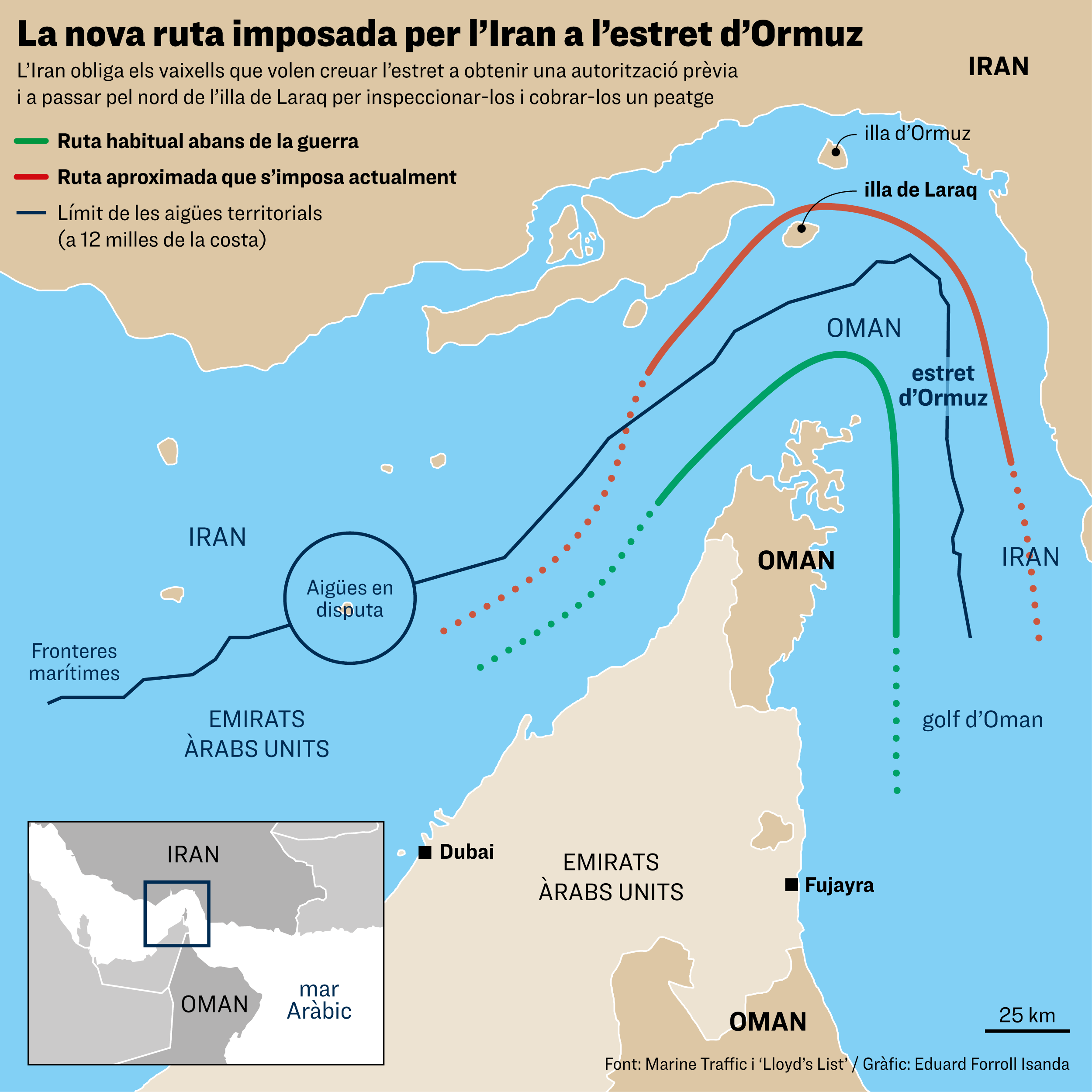
From here it is not clear whether Tehran is forcing authorized ships to pay a toll. The Iranian Foreign Minister, Abbas Araghchi, has spoken about the status of Hormuz with his counterparts from several countries: as far as is known, with Malaysia, China, Egypt, South Korea, and India. It is not clear, however, exactly what they have agreed, beyond that as "non-hostile" countries they can continue transiting the strait "in coordination with the Iranian authorities." New Delhi has explicitly stated that it does not pay any fee, which suggests that the passage of its ships is the result of diplomatic negotiation and not payment. In contrast, Lloyd's assures that several companies have already contacted security firms to ask for their help in negotiating the toll.
The International Maritime Organization (IMO) has confirmed in this newspaper that the Iranian government itself informed all its members by letter last week that the strait remains open to ships that are not "hostile" to Tehran and that it had taken "all necessary measures to prevent aggressors and their allies from using the Strait of Hormuz to advance their hostile operations against Iran." The IMO admits, however, that it has no official confirmation of a toll payment.
Legal implications
Jaime Rodrigo de Larrucea, professor of maritime law at the UPC, explains to el ARA that the establishment of a toll by Tehran would be totally contrary to international law and the UN Convention on the Law of the Sea, which sanctions freedom of navigation and peaceful transit passage in international straits. The Strait of Hormuz is shared by three countries, which have territorial waters: Iran, Oman, and the United Arab Emirates. It is so narrow that the 12 nautical miles (22.2 kilometers) corresponding to the territorial waters of each of these countries overlap in some places (see infographic). Iran justifies that they have not started the war, and to this is added the aggravating factor that the United States are not signatories to the Convention. "But imposing a toll is prohibited and, moreover, it would establish a very dangerous precedent: imagine if Spain and Morocco did the same and charged a toll to all ships wishing to cross the Strait of Gibraltar," adds the professor.
In maritime law, straits do not have the same consideration as canals, which are artificial waterways built by societies or countries, as is the case with the Suez or Panama Canals. Rodrigo de Larrucea explains it thus: "It's like going on a national road or a highway. Nobody forces you to use it, it's just a work that allows you to go faster and, to do so, requires a toll." This is not the case with the Strait of Hormuz, which is the geological result of tectonic plate movement. Larrucea describes Iran's policy as "mafioso" but also recalls that "we live in a world run by men who violate international law" and that Tehran claims moral legitimacy from being subjected to aggression that has no legal basis. In fact, in its conditions for negotiating a hypothetical ceasefire, the Iranian regime has added a new threat: the recognition of its sovereignty over the Strait of Hormuz, something it had never put on the table.
The prospects of a military intervention: Larak Island
This route passes through the territorial waters of the Persian country, between the islands of Larak and Hormuz, which are next to the Iranian coast, and which Iran presents as a "safe corridor". In reality, however, it is a euphemism because Tehran attacks vessels in the strait. The island of Larak is a strategic base for Iranian control of the strait. In fact, it acts as a physical toll. It is where the port facilities are located to inspect ships. Historically, it has been one of the key points for the export of Iranian oil and was already bombed by Iraq in the war against Iran in the eighties. Now it is where the Revolutionary Guard inspects ships previously authorized to cross it, their origin, their content, and their crew. In this way, Iran can continue exporting its own oil and engaging in economic diplomacy with its allies while economically strangling its enemies. Thus, if Donald Trump finally decides to carry out a ground military intervention in Iran, for which he is accumulating troops in the Middle East, Larak is an option that would allow him to snatch control of Hormuz from the hands of the Iranian regime.
In the long run, however, petromonarchies may find alternative routes, investing in other routes and in terrestrial pipelines, but, for the moment, as Dina Esfandiary, a specialist in the Bloomberg region, points out, "Iran is now earning more money selling its oil than before the war: Tehran did not want this war, but now it has reasons to continue it."