Putin takes advantage of the fracture between Trump and Zelensky to harden peace conditions
The USA wants to soften Russia with economic proposals, but the Kremlin will not make concessions to Ukraine

-
CAT -
CAST
Moscow“We must seize the opportunity to plunge Ukraine into the Stone Age.” This phrase from a columnist for the pro-government newspaper Moskovski Komsomolets summarizes Russia's approach to Donald Trump’s new turn. While the President of the United States tries to be indulgent with Vladimir Putin to the point of adulation, the Russian leader interprets the tension between Washington and Kyiv as a window to increase his peace demands and press the accelerator on the front. The White House intends to bring the Kremlin to the negotiating table with offers of economic cooperation, which Moscow gladly accepts, but decouples from the talks to end the conflict.
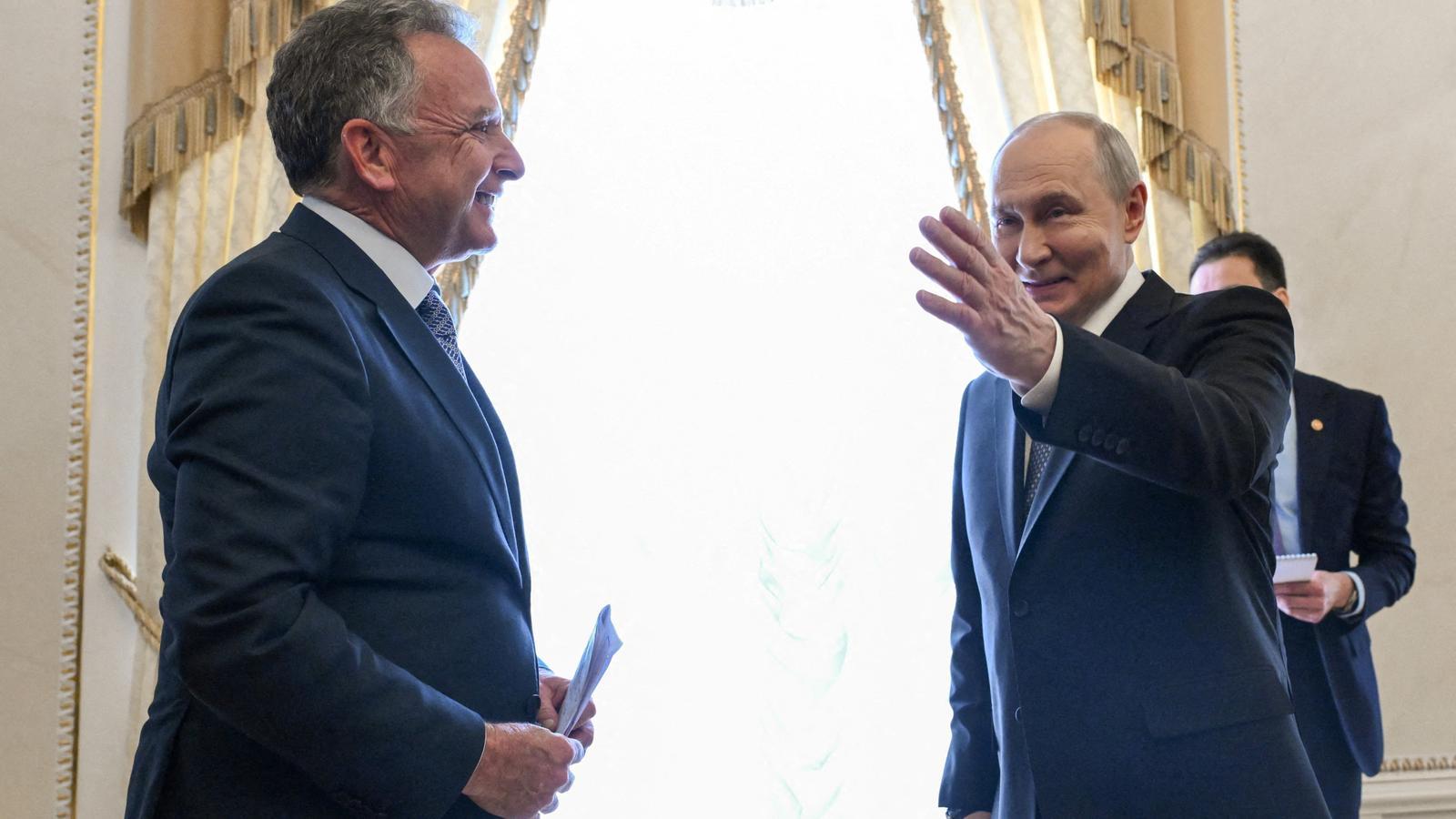
The choreography of this Wednesday's meeting in Saint Petersburg between Putin and Trump’s special envoy, Steve Witkoff, has highlighted the sweet moment that relations between Russia and the United States are going through. The American envoy thanked him, on behalf of his president, for the deal to sell Russian diesel. “It is an example of how we are all working together and I want to thank you deeply for that,” he said. In response, the Kremlin leader offered his interlocutor new perspectives for economic cooperation such as, for example, the export of fertilizers for American farmers.
Aware that gestures are important to Trump, Putin has accepted the request to release Stephen Hubbard, a 73-year-old American citizen who was living in Kharkiv at the start of the invasion and whom Russia imprisoned on charges of having participated in Ukrainian territorial defenses. The President of the United States has highlighted that the release took place without the need for an exchange and Witkoff applauded his host’s act of goodwill. “You speak a lot about my president as a humanitarian; you are also a humanitarian, sir, I thank you and I congratulate you,” the envoy expressed at the beginning of the meeting.
But all these praises and displays of calculated mercy have not softened the Kremlin's negotiating position. As reported at the end of the meeting by the Russian presidential advisor, Yuri Ushakov, the new proposals from Kyiv and its allies contained “nothing very profitable”. Volodymyr Zelensky wants to revive the idea of a summit with Putin and Trump to break the deadlock on the territorial issue, but Moscow has always dismissed it because it finds no point in it unless it is to sign a definitive peace agreement on Russian terms. Russia, on the other hand, is betting on a meeting with Putin, Trump, and Xi Jinping in November, coinciding with the Asia-Pacific Economic Cooperation forum in China. A milestone that the Russian government would like to project as a reissue of the 1945 Yalta Conference, with the great world powers dividing up their zones of influence. For the moment, however, neither Washington nor Beijing has confirmed it.
The only concession from the Kremlin has been to accept the resumption of talks between Russia, Ukraine, and the United States, interrupted by the war in the Middle East. This trilateral format was useful for polishing technical aspects regarding a possible ceasefire and post-war security guarantees, but it proved insufficient to resolve the territorial obstacles. Furthermore, Ushakov has pointed out that the next round could be held around November 10, just after the US midterm elections, from which it is possible that Trump will emerge weakened and with less capacity to pressure Ukraine.
Putin wants more than the Donbas
Putin, therefore, wants to take advantage while Washington pressures Kyiv to increase its demands. If until now the Kremlin had set the withdrawal of Ukrainian troops from all of Donetsk as a starting point, a few days ago the Russian president expanded his claims. Now he asserts that he does not want to return the strips of territory he controls in the regions of Sumy, Kharkiv, and Dnipropetrovsk, which the United States trusted to use as a bargaining chip in the negotiations.
Faced with this entrenchment, Zelensky has made a move to show flexibility to Trump. In an interview with Fox News, the Ukrainian president has opened up to "freezing" the current front lines as a first step towards a definitive ceasefire. This proposal has been on the table for months and Moscow rejects it because, without the surrender of the entire Donbas, it does not even want to start discussing a peace agreement.
According to Ushakov, Witkoff has been informed "objectively" of how Russian troops "are advancing non-stop in all directions". A claim that does not align with the facts, but which the recent American restrictions on the Ukrainian army's Starlink network threaten to turn into reality.

