Open war between the US and the EU over Big Tech
Brussels is holding its own in Washington and continues to enforce digital regulations against Google, X, and WhatsApp.

-
CAT -
CAST
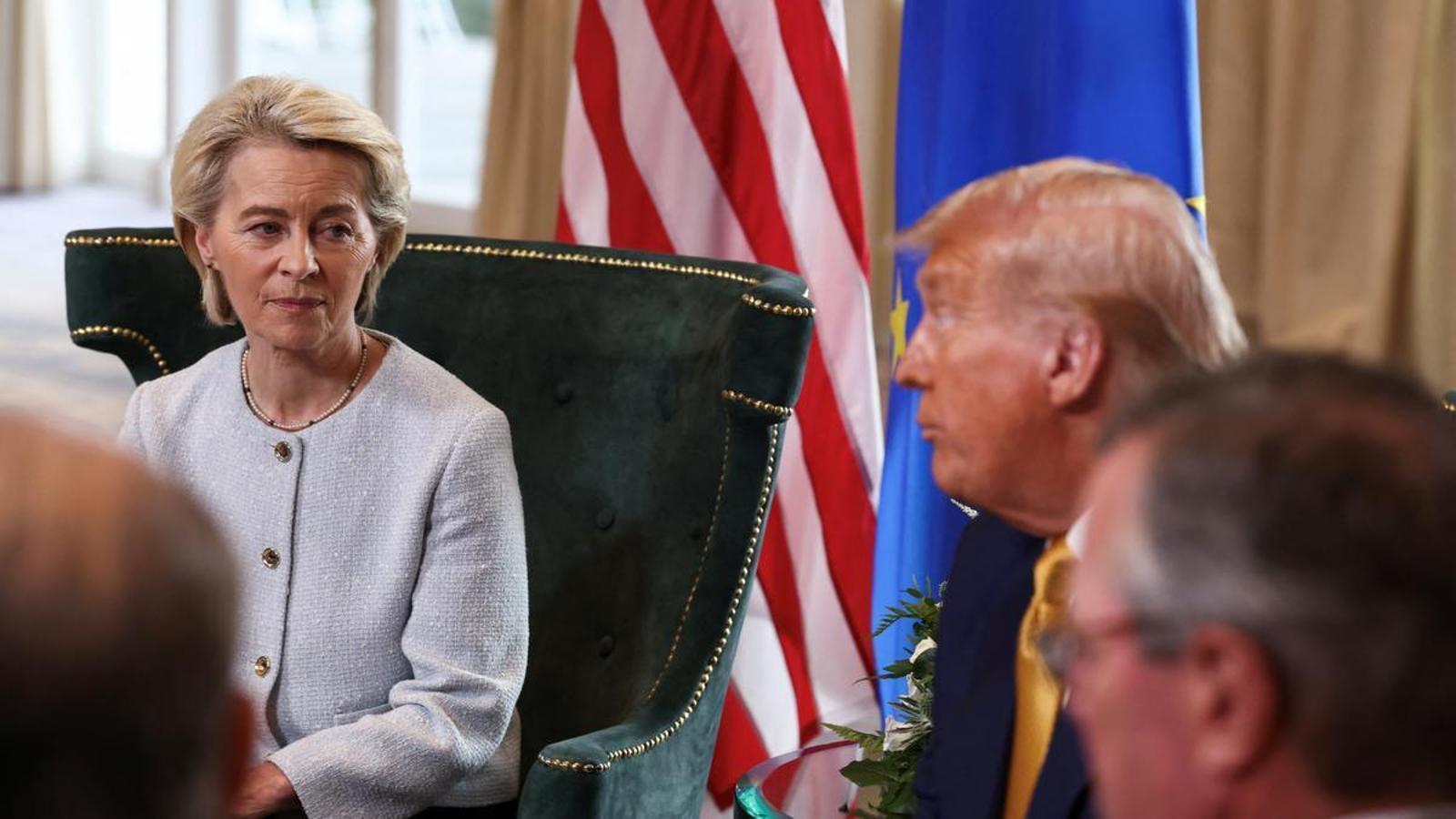
BrusselsThe Trump administration is obsessed with EU digital sector regulation. Since returning to the White House, it has insisted that it sees it as a direct attack on Big US tech companies, which are raking in profits in the EU market, and has demanded that European leaders weaken competition and transparency regulations affecting these large corporations. While the European bloc has yielded in other areas, such as military and trade, it has stood firm in Washington on this issue and refused to back down, infuriating the New York tycoon and prompting him to... tensions between the two powers escalate againThe US president even threatened to restart the tariff war against all allies that, like the European Union, regulate the digital sector and impose fines on large tech companies that violate the law. Similarly, White House officials, such as the Trade Representative, who participated in the last EU Finance Council meeting, conditioned tariff reductions on deregulation of companies like Google, Meta, Apple, and Microsoft. However, the European Union has always refused to give in on this matter, and, for example, the Vice-President and Commissioner for Competitiveness of the European Commission, Teresa Ribera, has warned on more than one occasion that they do not intend to accept the "blackmail" of the US. Just last week, Brussels opened an investigation into WhatsApp's artificial intelligence services and fined the social network X, owned by Elon Musk—a former collaborator of the Trump administration—€120 million for lack of transparency and misinformation.

The fine opened a Pandora's box. The Tesla owner has dedicated dozens of tweets to insulting the EU and has even accused the European Commission of being Nazi, although it is Musk himself who supports the far-right Alternative for Germany party and gave the Nazi salute at Trump's inauguration. While using a very different tone, the other owners of major American tech companies, especially Mark Zuckerberg, also frequently criticize the European Commission and constantly pressure the White House to force the European bloc to deregulate the digital sector.
Beyond Musk, who routinely attacks the existence of the European Union without scruple, US Secretary of State Marco Rubio also reacted to the fine against Musk, calling it "an attack on the American people" and labeling it an act of "censorship." And, early this morning, Trump called Brussels' sanctions against X "nasty" and He took the opportunity to once again criticize the community blog.He has even insulted its leaders, calling them "weak" and "too politically correct." "Europe is in decline," the US president stressed in an interview. Political.
The EU doesn't back down
The European Commission maintains that it does not want to engage in a row with the President of the United States and escalate tensions with what has been its main ally since the end of World War II. "Not responding is a form of responding," the spokesperson for the European Commission, Paula Pinho, simply stated at the daily press briefing. Thus, Brussels denies that the opening of the investigation against Google Brussels announced early Tuesday morning that this was a response to the words of Trump, Rubio, or Musk, and they assure that the EU authorities are simply applying European regulations, regardless of the timing or sensitivity of the case.
However, the European Commission's gesture is a clear statement of intent and cannot be separated from the context of tension between the transatlantic allies. The announcement came just hours after the US president's latest attack on the EU and contrasts with other moves the European Commission has made against major US tech companies in recent times. For example, last September, in the midst of negotiations between Brussels and Washington over the final details of the trade agreement, the Commission delayed issuing a fine against Google of almost €3 billion to avoid derailing the talks. It finally issued the fine on a Friday afternoon, a time when there is little progress in implementing economic sanctions of that magnitude. Thus, although it has toned down its stance on military and trade matters, the European Union remains firm in applying EU legislation in the digital sector against US companies, even the day after Trump's insults. More and more European leaders are raising their voices—albeit quietly—against the Trump administration's attacks on the European Union. First, it was Polish Prime Minister and former President of the European Council, Donald Tusk, who reminded the US who its main ally was "if nothing had changed," followed by a string of ministers and diplomats from other member states, such as France and Italy. Leaders of all the main parliamentary groups in the European Parliament, except for the far-right, have also come out to challenge the Trump administration's policies. The far-right is precisely the group Trump's security plan aims to promote in order to prevent the "disappearance of European civilization."
On Tuesday, German Chancellor Friedrich Merz also defended the EU, and specifically the role of the European Commission, in ensuring compliance with digital regulations. "It is Europe's legal framework and it applies to all companies, without restrictions and equally to everyone," stated the leader of the bloc's largest country. Similarly, the EU's High Representative for Foreign Affairs and Security Policy, Kaja Kallas, for the first time raised her voice against the United States. In an appearance before the European Parliament, she accused the Trump administration of trying to "provoke" European leaders and warned that the European Union is already working to "free itself from dependencies."
