Neither the United States nor Denmark: Can Greenland be independent?
Greenland's economy depends almost exclusively on fishing and subsidies from Copenhagen.


-
CAT -
CAST
Barcelona"Greenland for Greenlanders." "Greenland is not for sale." "Land of the Greenlanders." "Neither Americans nor Danes, we arekalaal cama"In recent months, but especially in the last three weeks, cries like these have been repeated, probably more insistently than ever. Polls confirm that the vast majority of the population of the Arctic island don't even want to hear about becoming part of the United States, and a similar majority states that the goal is independence for the region. ~BK_SLT_L Denmark achieved a high level of autonomy in 2009. The self-government law passed in the Danish Parliament established a guide for Greenland's independence, stipulating that if the Greenlandic people decide to opt for independence, negotiations must begin between the governments of Copenhagen. Regarding defense, security, and foreign policy
But this autonomy is only political. In 2024, Copenhagen allocated some 5 billion kroner (670 million euros) to Greenlandic public finances."
As for the private sector, there is an undisputed leader: fishing, which accounts for more than 95% of Greenland's exports. "Furthermore, it is a highly specialized sector: basically, shrimp, cod, and Greenlandic chartered fish are caught. Prices are determined by the global market, and quantities by biological factors, so there isn't much room for maneuver in the island's main economic sector," notes Torben M. Andersen, a Greenlandic economist.
Natural resources, the great potential to be exploited
"Greenland has a huge surface area, but most of it is uninhabitable, covered in ice, and very difficult to access. The population is very small (56,700 inhabitants) and scattered across this vast area. Furthermore, the island is a great distance from European, American, and Asian markets. So, having an industrial sector is not feasible.
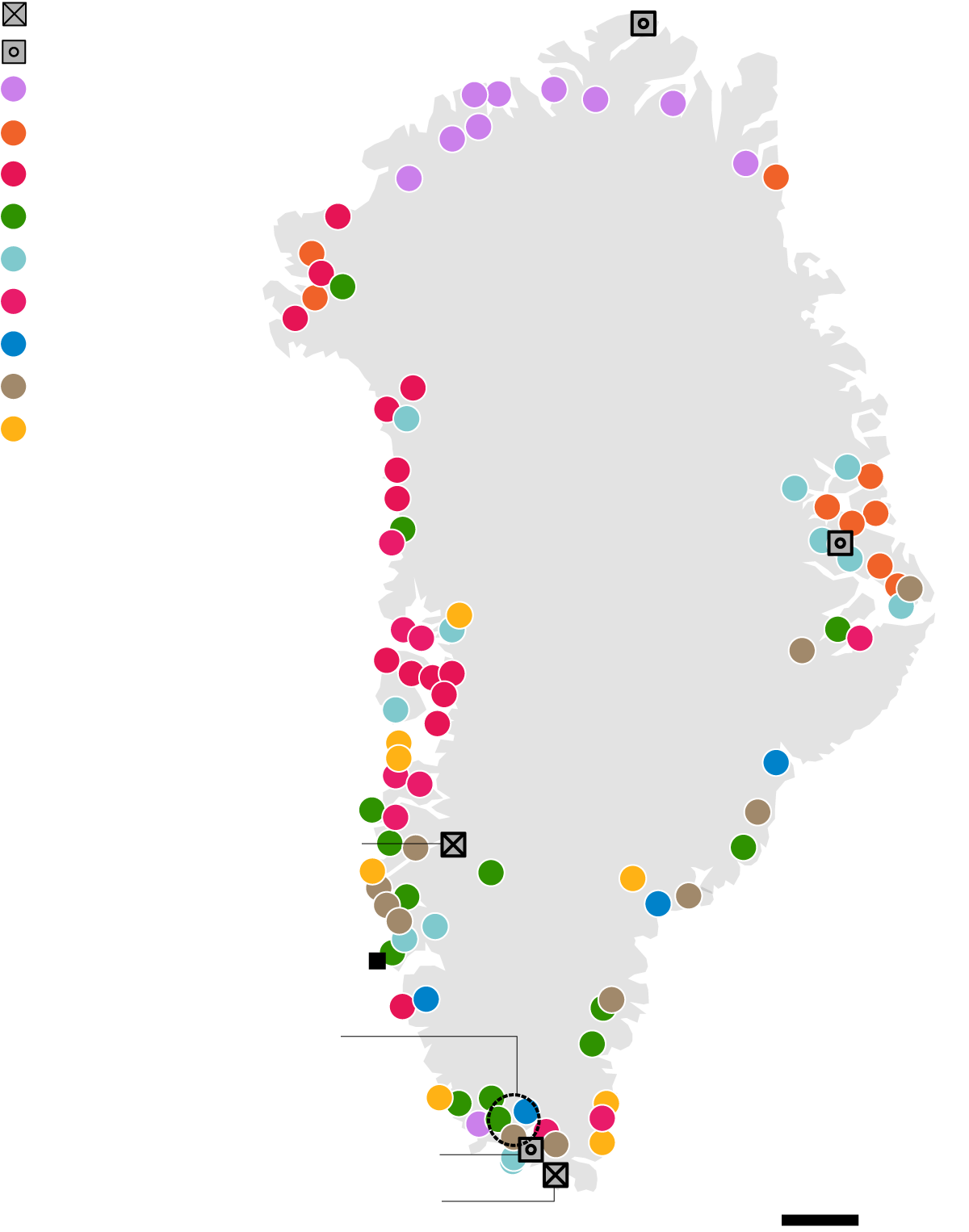
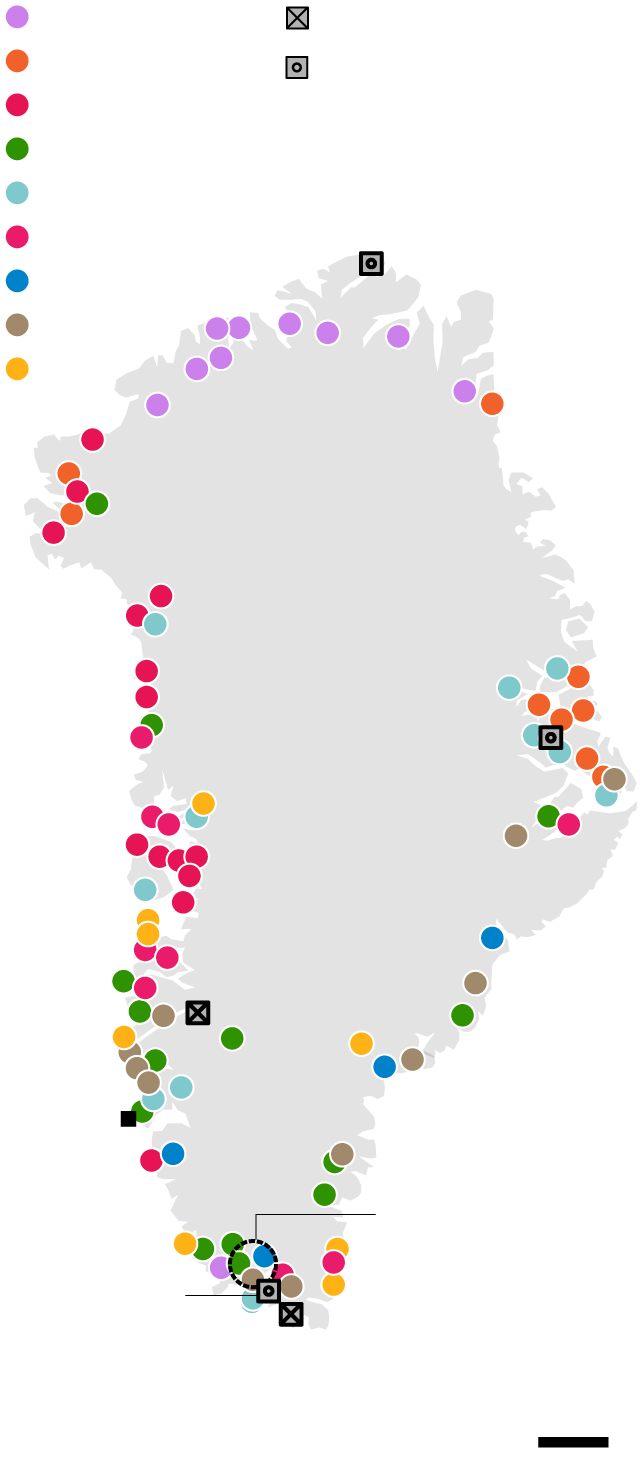
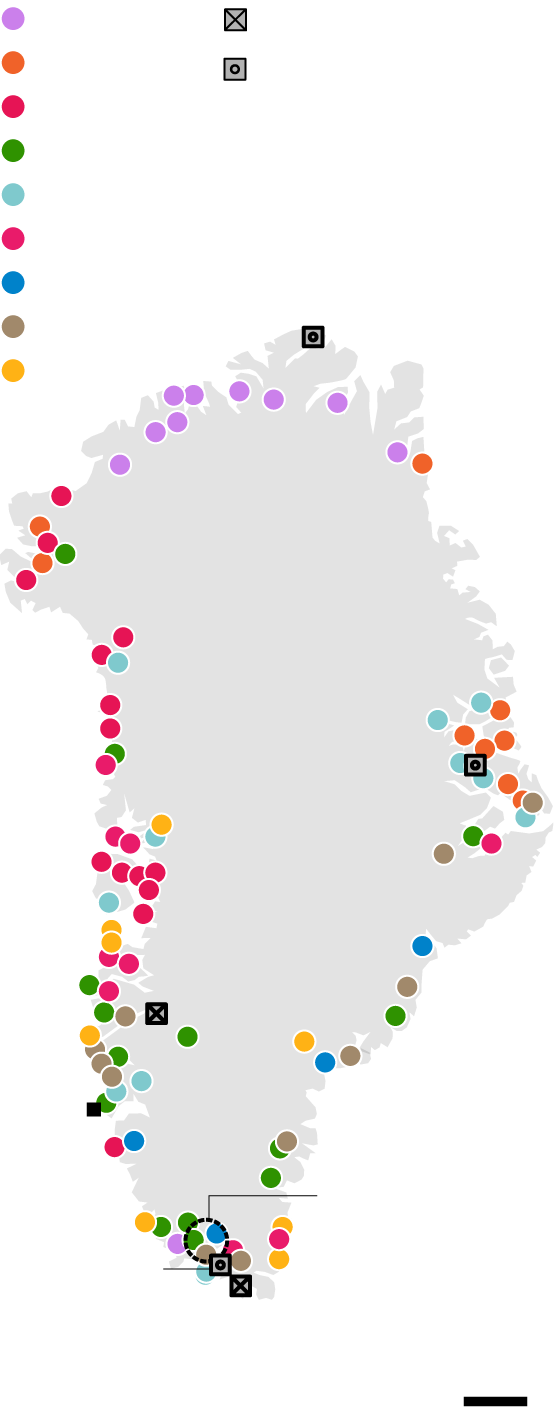
However, Greenland has a potential treasure trove beneath its surface: a wealth of natural resources, especially critical metals such as gold, zinc, iron, and... highly coveted rare earthsUntil now, their exploitation has been hampered by the high costs involved, but climate change could make access to these resources more affordable. Currently, there are only two active mines: a gold mine in the south and a mine in the west of the island extracting anorthosite, a type of rock rich in feldspar, which has various industrial and construction uses.
Mina
Citronen Fjord /Zinc
Llicència d’explotació
Zinc
Coure
Ferro
Terres Rares
Tungstè
Diamants
Titani-Vanadi
Níquel
Or
Piiaaffik Høstakken / Tungsté
Qaqortorsuaq / Anortosita
Nuuk
Kuannersuit
Dipòsit important de terres rares
Killavaat Alannguat / Terres rares
Mt. Nalunaq / Or
200 km
Zinc
Mina
Coure
Llicència d’explotació
Ferro
Terres Rares
Tungstè
Citronen Fjord /Zinc
Diamants
Titani-Vanadi
Níquel
Or
Piiaaffik Høstakken
Tungsté
Qaqortorsuaq
Anortosita
Nuuk
Kuannersuit
Dipòsit important
de terres rares
Killavaat
Alannguat
Terres rares
Mt. Nalunaq
Or
200 km
Zinc
Mina
Coure
Llicència d’explotació
Ferro
Terres Rares
Tungstè
Diamants
Citronen Fjord
Zinc
Titani-Vanadi
Níquel
Or
Piiaaffik Høstakken
Tungsté
Qaqortorsuaq
Anortosita
Nuuk
Kuannersuit
Dipòsit important
de terres rares
Killavaat
Alannguat
Terres rares
Mt. Nalunaq
Or
200 km
But Greenland has many other documented deposits of valuable minerals. In particular, there are two enormous reserves in the south of the island containing different types of rare earth elements, a group of seventeen elements crucial for the development of green energy, electronics, and weaponry. Some of the population supports mining as a source of economic development to eventually achieve independence, but there are also those who warn that the price to pay would be too high, especially due to the environmental impact and the potential harm to the burgeoning fishing and tourism sectors. One of these two mines, the Tanbreez project, has had an operating license since 2020, although the US company managing it, Critical Metals Corp., has only just completed its preliminary economic assessment. The other large mine is Kuannersuit (Kvanefjeld in Danish), located a few kilometers away. It is the third largest known rare earth deposit in the world. Exploration began in 2007, but the project was blocked in 2021 by political opposition to its exploitation, as it would also involve extracting enormous quantities of uranium. The public campaign against the mine forced early elections, which were won by the Inuit Ataqatigiit party on a promise to halt the project. Parliament subsequently passed a law prohibiting the exploration and mining of deposits with high concentrations of uranium. It also banned new oil and gas exploration projects.
The Kuannersuit project has been embroiled in litigation ever since. Energy Transition Minerals, an Australian company whose main partner is a Chinese firm, argues that the legislation constitutes expropriation and is demanding $11.5 billion in compensation, equivalent to about four times Greenland's GDP.
Andersen believes there is growth potential in the mining sector and says development is likely, but warns that "it will take a long time, especially before it has a real impact on the Greenlandic economy." "Building a mine and starting operations is much more expensive here than anywhere else in the world," he says. He points out that, in addition to the mine, logistical infrastructure such as ports, airports, and roads needs to be developed.
The Inuit, the most disadvantaged
Although Greenland is part of Denmark, the economic situation of Greenlanders is, in general, incomparable to that of the Danes. Poverty affects the indigenous community, the Inuit, who make up the vast majority of the population, and this is linked to very high rates of alcoholism, mental health problems, and domestic violence, all of which are tied to a high unemployment rate. In Greenland, there is a major problem regarding the population's level of education: approximately 50% only complete compulsory education because, in many cases, to continue their studies at the age of nine or ten, children must travel to a village far from their place of residence. "There are what are known as small-scale disadvantages: everything is much more expensive when you have such a small and dispersed population," explains the professor. "The cost of running a school or a health center is much higher, which means that the quality is not the same everywhere," he adds.

