Leo XIV and Macron clash over secularism at the start of the Pope's visit to France
The pontiff asks to seek solutions to "humanitarian crises" like that of Ceuta
-
CAT -
CAST
BarcelonaSecularism and euthanasia have dominated the first day of Leo XIV's visit to France. From the Élysée Palace, the Pope called for a "fair secularism" that does not exclude religion from the public sphere, while French President Emmanuel Macron defended French secularism. Macron claimed that "it is, by no means, the denial of religion," but rather the freedom to believe or not to believe and the separation between the state and religious denominations. The other controversial point of the visit, in addition to sexual abuse within the French church, was the advancement of the right to euthanasia in France, after the country definitively approved the law legalizing it in July. The pontiff's reaction was swift, and he reiterated the Church's firm opposition to this law.
"I reiterate, firmly, that the protection of the right to life constitutes the essential foundation of all other human rights," he stated in a speech before Macron and other politicians at the Élysée. For the Pope, "trends that risk science and technology in for-profit ventures that promote genetic manipulation, surrogacy, the trade of human organs, or the possibility of organizing one's own death" are concerning. During the first day of his visit to France, the Pope also appealed for dialogue and coexistence among people of different origins, and warned about the risk of the proliferation of nuclear weapons.
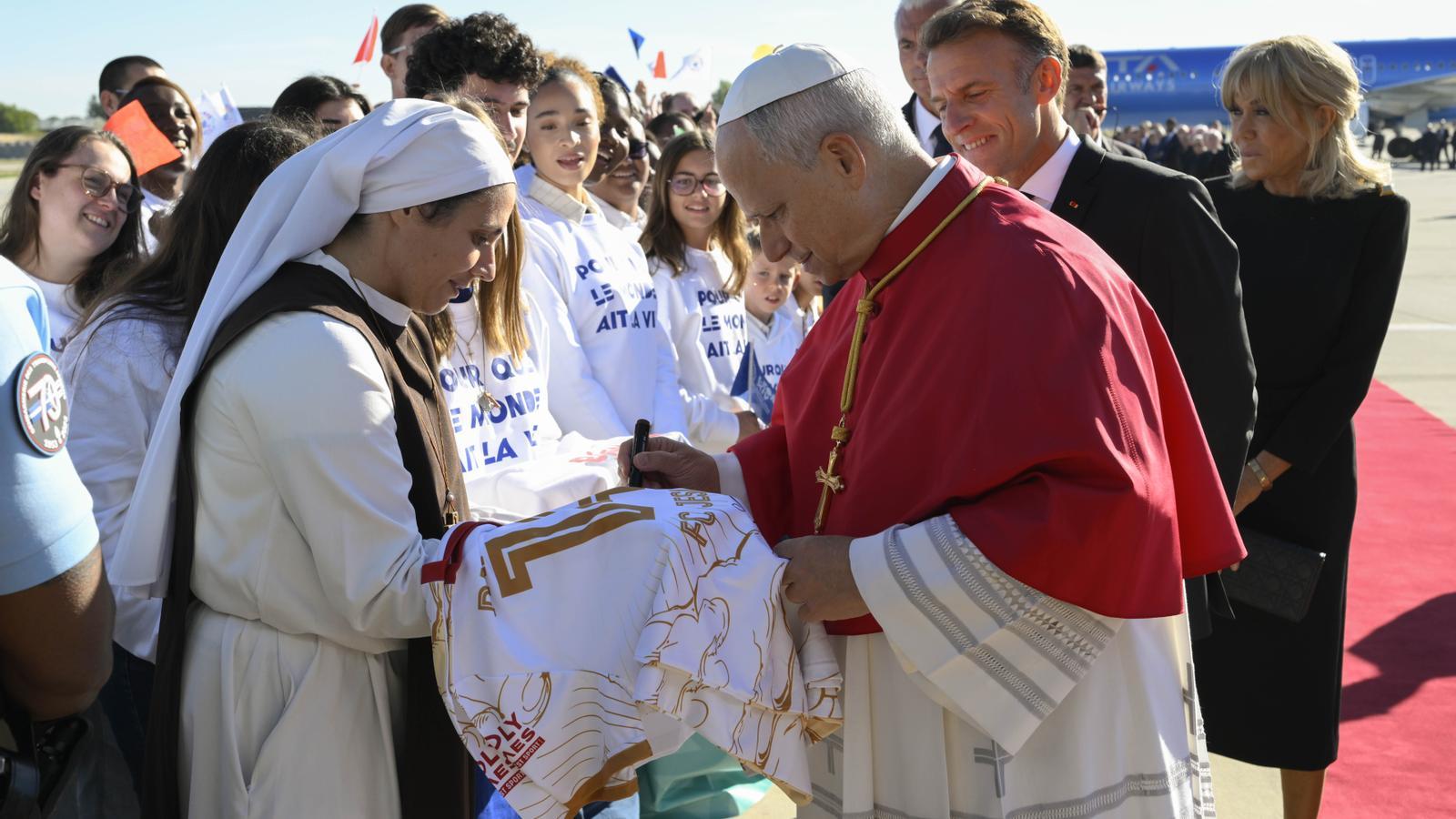
Leo XIV began a visit to France this Friday that will take him to the sanctuary of Lourdes and the municipality of Metz. The President of France, Emmanuel Macron, received the Pope upon his arrival in Paris and, after the protocol reception, they held an initial meeting in the authorities' lounge at Orly airport.
Responses to crises such as the one in Ceuta
Before arriving in France, in a meeting with journalists during the flight to Paris, Leo XIV called for seeking responses to "humanitarian crises" like that of Ceuta and assured that he has followed the crisis "from the first day". He also added that the crisis has been caused by "different causes". The Pope had already referred to the situation in Ceuta during the Sunday Angelus prayer on August 2 and noted that he was following the situation with concern.
In the same meeting, the pontiff also referred to the veto by the President of the United States, Donald Trump, on some media outlets. "Media coverage of everything and for everyone is very important," he said regarding the controversial exclusion of CNN, MS NOW and Politico from accessing the White House. Finally, the journalists from the three media outlets have returned to the White House, even though the Trump administration wanted to maintain the veto despite the court order to have their credentials restored. "I am very happy that you are all here," said the Pope.

The pontiff's first visit to France has aroused great expectation in the country, to the point that the bells throughout the country rang for seven minutes to welcome him. The visit has two key moments: the meeting of Leo XIV with young people at the Stade de France, where 80,000 people are expected to attend, and the mass that will be held on Saturday at the Place de la Concorde, for which more than 600,000 faithful have registered, who will fill the Champs-Élysées and the surrounding streets.
Multitudinous mass in Paris
The visit of Leo XIV to France comes almost three years after the one made by his predecessor, Francis I, to Marseille to participate in a conference on the Mediterranean. "I am going to Marseille, not to France," specified the then Pope, who prioritized trips to the periphery. Francis I also visited Strasbourg and Ajaccio, but they were lightning visits for specific events. Leo XIV has recovered the great visits to European countries and, as he already did in Spain, the pontiff's agenda in France aims to revive Catholicism there, which is at a low ebb in a country that prides itself on secularism.
Apart from the meeting at the Élysée with Macron, Leo XIV will also meet with civil society and visit the UNESCO headquarters. He will also take a trip in the popemobile from the church of Notre-Dame des Champs to the cathedral of Notre-Dame de Paris, where he will preside over a religious service. From there, he will go to the Stade de France, on the outskirts of Paris, to hold the massive event with young people. Saturday's agenda will be the most social with a visit to a support center for refugees and immigrants in Paris, and then he will hold mass in the center of the French capital.
In the afternoon, the pontiff will move to the sanctuary of Lourdes, one of the most popular points in the country for Christians. On Sunday he will meet at the sanctuary with bishops from all over the country and will officiate a mass. He will also receive, in a personal capacity, seven victims of abuse by the French Church, and the organization that investigates them will deliver to Leo XIV the official report on the victims of sexual abuse. The results of the investigation were presented recently and indicate that, of the 330,000 cases of victims identified in 2021, just under 2,000 had turned to the organization and had been recognized and compensated.
The Pope's visit will acquire a European dimension on Sunday with the visit to Metz, land of the French politician Robert Schuman, one of the fathers of European construction, in the process of beatification. Macron will not attend any religious act, but will be present at the speech that the pontiff will deliver and to which the Élysée has invited the heads of state and government of the EU. The mass at the cathedral of the French capital and an interreligious meeting will close the acts of the visit to France of Leo XIV, who will leave for Rome on Monday night.
