Keys about the Strait of Hormuz: why will it not reopen overnight?
The choking of this key maritime passage is one of the factors threatening potential peace talks from Islamabad
Barcelona / LondonOne of the key points of the fragile ceasefire established between the United States and Iran on Wednesday is the free movement of maritime traffic through the Strait of Hormuz. A key passage for tankers, fertilizers, and dry goods, the strangulation generated as a result of the war threatens the entire world economy. The volume of ship passage has fallen from between 150 and 200 daily on February 27 to less than ten in the last forty-eight hours.
The ongoing crisis already has a global economic impact due to the disruption in the supply chains of gas and oil, fertilizers, or helium. The big problem in achieving its normalization is that politico-diplomatic, military, economic, and geographical factors of two countries with very different agendas intersect, who have a meeting this Saturday in Islamabad, where the delegations of the United States and Iran will meet. This Thursday, Iran reiterated that it only allows ships to pass through its territorial waters via an entry and an exit corridor north and south of the island of Larak, where it controls each vessel. And it has even included it in a nautical chart.
¿Does international law guarantee passage through the Strait of Hormuz?
Beyond the war, the current passage crisis is underpinned by a complex legal vacuum: neither Iran nor the United States have ratified UNCLOS (United Nations Convention on the Law of the Sea of 1982), a fact that allows Tehran to question "transit passage" and attempt to apply the more restrictive "innocent passage". The international community invokes customary law and the jurisprudence of the Corfu Channel case (1949) to argue that no state can prohibit transit in international straits. Iran takes advantage of its position of strength to consolidate a control that could be irreversible, challenging the right of ships to navigate without interference through this vital artery.
Formally, international straits are protected by the principle of freedom of navigation. But this principle is difficult to enforce in a context of war or high tension. In practice, effective control over territory and waters weighs more than legal norms. This allows Iran to limit passage without formal recognition. Although the waters of Hormuz belong to the jurisdictions of Oman, the United Arab Emirates, and Iran, free navigation has always been permitted without tolls or prior permits.
Why can't the strait be reopened overnight?
Because the blockade is not just military or visible. Iran has built a control system that combines armed pressure, administrative control of passage, and an indirect economic effect through insurance risk. This means the problem is not simply opening a maritime passage, but restoring an entire ecosystem of trust. Consequently, even if there were a political announcement of reopening or even the announcement of a ceasefire that occurred on Wednesday, maritime and financial operators need real security guarantees. Without this, transit does not resume because the risk remains too high. In the last 24 hours, as far as is known, only one oil tanker and five bulk carriers have sailed through the Strait of Hormuz, according to data analysis from ship trackers Kpler, Lloyd's List Intelligence, and Signal Ocean.
Is the strait really closed, then?
Not completely, but effectively. Iran applies a selective closure that allows it to maintain some activity while punishing its adversaries. This gives it an instrument of economic pressure without having to completely block the route, allowing only the passage of vessels linked to countries it considers "non-hostile." In practice, transit volume has plummeted. The contrast with the situation before the conflict —when between 150 and 200 ships passed daily— shows that, although not formally closed, its operation is severely altered. The global economy is suffering.
Who controls the passage right now?
The Iranian Revolutionary Guard exercises direct and operational control over transit. It has established a system in which each vessel must be authorized in advance, with detailed information about its cargo, ownership, and destination.Why does geography make it so difficult to reopen it militarily?
- If you want to see this map in more detail, open the high-resolution version in another tab.
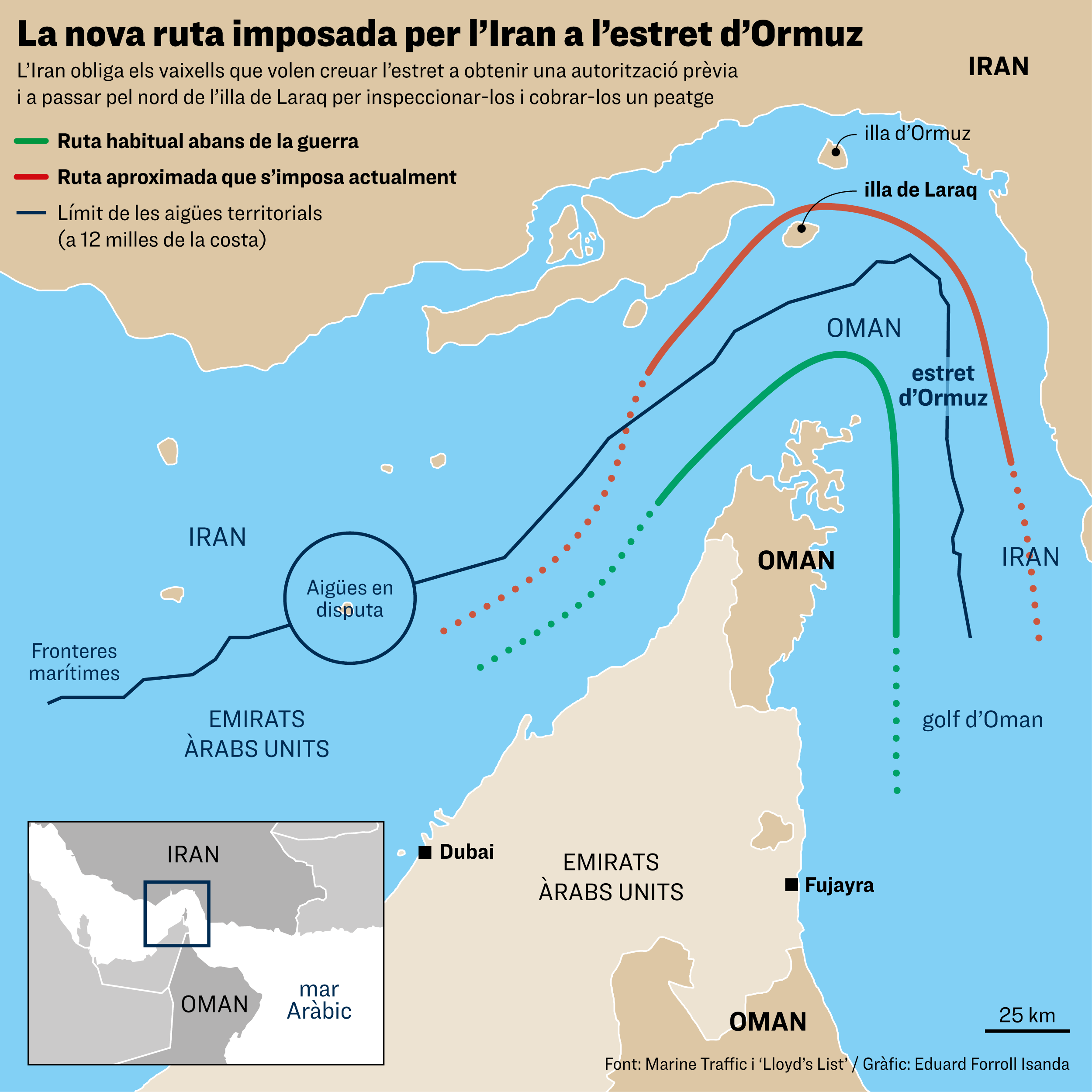
Why does geography make it so difficult to reopen it militarily?
The strait is a real bottleneck: less than 50 kilometers wide, shallow, and surrounded by Iranian territory. This forces ships to navigate very close to the coast, reducing maneuverability and reaction time to any threat. Furthermore, the terrain of the coastal territory —with mountains, caves, and cliffs— allows Iran to deploy asymmetric warfare tactics. Relatively simple weapons can be hidden and activated quickly, making it very difficult to neutralize them all. All of this makes a military operation extremely complex and costly. It would be necessary to eliminate or neutralize this large number of mobile weapons systems, which could also be fired from almost any point in Iran. An armed operation would not be a one-off, but sustained: escorts, air surveillance, and constant control of the area would have to be maintained. This implies a high military commitment, with a great risk of casualties and escalation. Warships, moreover, can offer partial protection, but they do not solve the problem. The usual transit volume is too large to be fully escorted, and each naval convoy, usually enormous vessels loaded with oil and very exposed, requires significant resources. Furthermore, the military vessels themselves are vulnerable in such a restricted environment.
Why are insurance key?
Because maritime transport depends entirely on the financial system. Without insurance, no shipowner can assume the risk of losing a vessel valued at tens or hundreds of millions of dollars which, under normal conditions, are mortgaged to large banking corporations. With the conflict, war risk premiums have soared to levels that make the profitability of the business unviable. This causes many ships to prefer to remain anchored rather than operate with losses or unmanageable risks. In large part, it is the international insurance market that decides. It is the insurers who set the price of risk and determine whether a route is viable or not. Until they consider the situation safe enough, transit will not normalize. It is an economic decision, as much as a political or military one.
What is the real solution?
Most experts agree that there is no military solution. Even if Iran's attack capacity were reduced, the residual risk would continue to affect transit. For the situation to return to normal, political de-escalation and credible security guarantees are needed. Only then will insurance premiums be reduced and operator confidence be restored, and even then it would take months to re-establish the usual pace. There are about two thousand vessels trapped on the other side of the strait and before the war about 120 circulated every day.