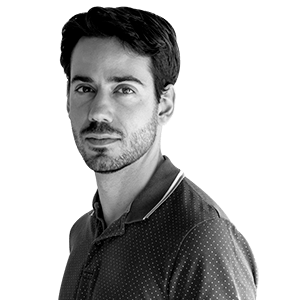
Oriol Fontdevila: "Art alone cannot address the serious problems of society; alliances with social movements are needed."
Director of the Bòlit Center of Contemporary Art of Girona

-
CAT -
CAST
GironaOriol Fontdevila i Subirana (Manresa, 1978) is the new director of the Bòlit Centre for Contemporary Art in Girona. A curator, professor, and art critic, he has combined the management of cultural centers throughout Catalonia, such as the Sala de Arte Joven (Young Art Gallery) of the Generalitat (Catalan Government), with a solid academic career at the university. This autumn, Fontdevila has taken over the Ingrid Guardiola's replacement at the head of the three rooms of the Girona contemporary art museum, inaugurating the first exhibition Woman, Life, Freedom by the artist Tere Recarens from Arbúcies. The exhibition, which can be visited until February, respectfully addresses, with community involvement and a global perspective, the struggle of Iranian women for gender justice, featuring extremely powerful pieces, such as the painted carpet on the floor of the Rambla headquarters. It's a clear statement of intent that encapsulates the key principles of the new management: promoting local artists, education in democratic values, and alliances with social actors, all aimed at establishing Bòlit as a vibrant, accessible space committed to the realities of its surroundings.
How does a manager from Manresa end up applying for a position at a museum in Girona?
— I've known Bòlit since I was young, through the Fundació Espais and the magazine Art PapersThese were a very important reference point for me, especially in the 1990s, when many of the major institutions didn't yet exist and the art scene was sustained by spaces rooted in the local area. Being from Manresa and having always worked in small contexts, I've always been interested in these models, which advocate a more qualitative and decentralized culture of production and socialization.
She has entrusted the first exhibition to Tere Recarens' work on the feminist liberation movement in Iran. Why did she choose this topic?
— It was a project I was already familiar with and which was in a very advanced stage, having been a finalist for the Catalan Pavilion at the 2023 Venice Biennale, for which I was a juror. It's a project I consider very honest and necessary, based on international solidarity rather than identity politics, with a clear focus on avoiding any cultural appropriation, incorporating Iranians in the diaspora, and explicitly stating the artist's starting point. At Bòlit, it has been developed with extraordinary commitment, working with the local Iranian community, facilitating outreach and activities, and understanding that the project's value lies not only in its exhibition scale but also in its capacity to engage the public beyond the gallery walls.

Is making the residents of Girona feel involved in everything that happens in Bòlit a fixation that you're obsessed with?
— Yes. I understand social transformation and democratic education as two fundamental pillars of an art center, especially in the case of Bòlit, which doesn't have large galleries but rather small spaces scattered throughout the town. It's not just about attracting audiences, but about embracing the presence of non-public and counterpublics...to open the center to misunderstandings, friction, and mediations with non-artistic spheres. That's why the exhibition of Woman, Life, Freedom It places great importance on workshops, the involvement of schools and groups, and participatory processes that activate the space as a place for meeting, exchange and democratic experience beyond the traditional exhibition format.
To achieve this, do the proposals need to reach young audiences and also connect with children?
— Yes, Bòlit is not very well identified as a family space. It has often catered to a university or postgraduate audience, which makes it difficult for Bòlit to become part of Girona's social consciousness and requires constant, painstaking work, communication efforts, and a redefinition of what a cultural and family activity can be. We held banner-making workshops related to the exhibition, which might not fit the typical family activity, but it's our commitment. We talked about death? Yes, of course, but don't families die?

Activities like these help break down the prejudice that contemporary art is unintelligible and only for intellectual and economic elites.
— It is true that art has historically been allied with elites and needs capital to exist, but public art centers have a responsibility to approach art democratically, as outlined in the Charter of Cultural Rights, recognizing citizens as producers and creative agents, and establishing channels of communication between professional and non-professional creators. This means not leaving artists alone in community projects and strengthening the role of the center, working continuously with local associations, and generating projects with a social and creative agenda that have real and lasting cultural value. I don't believe that art alone can address the serious problems of the current context; we have a responsibility to work on social issues through alliances with social movements, associations, and institutions.
How will the programming continue from February onwards?
— The upcoming exhibitions at Bòlit will be structured into two major cycles of three exhibitions each, based on newly created projects by a single artist. The first cycle will be curated by Bernat Daviu, while the second cycle, coinciding with the Girona's bimillennialThe festival will explore the concept of legacy and heritage through exhibitions such as Sara Ouhaddou's, which addresses the erased memory of al-Andalus in our culture. We will also have Miguel Ángel Rosales and Yinka Esi Graves, with a review of the case of the Negro of Banyoles, and Irene Visa, with a reinterpretation of the Empúries excavations.
