The Government establishes seven poles to install data centers in Catalonia
The Generalitat identifies 26 projects of 2,000 MW
-
CAT -
CAST
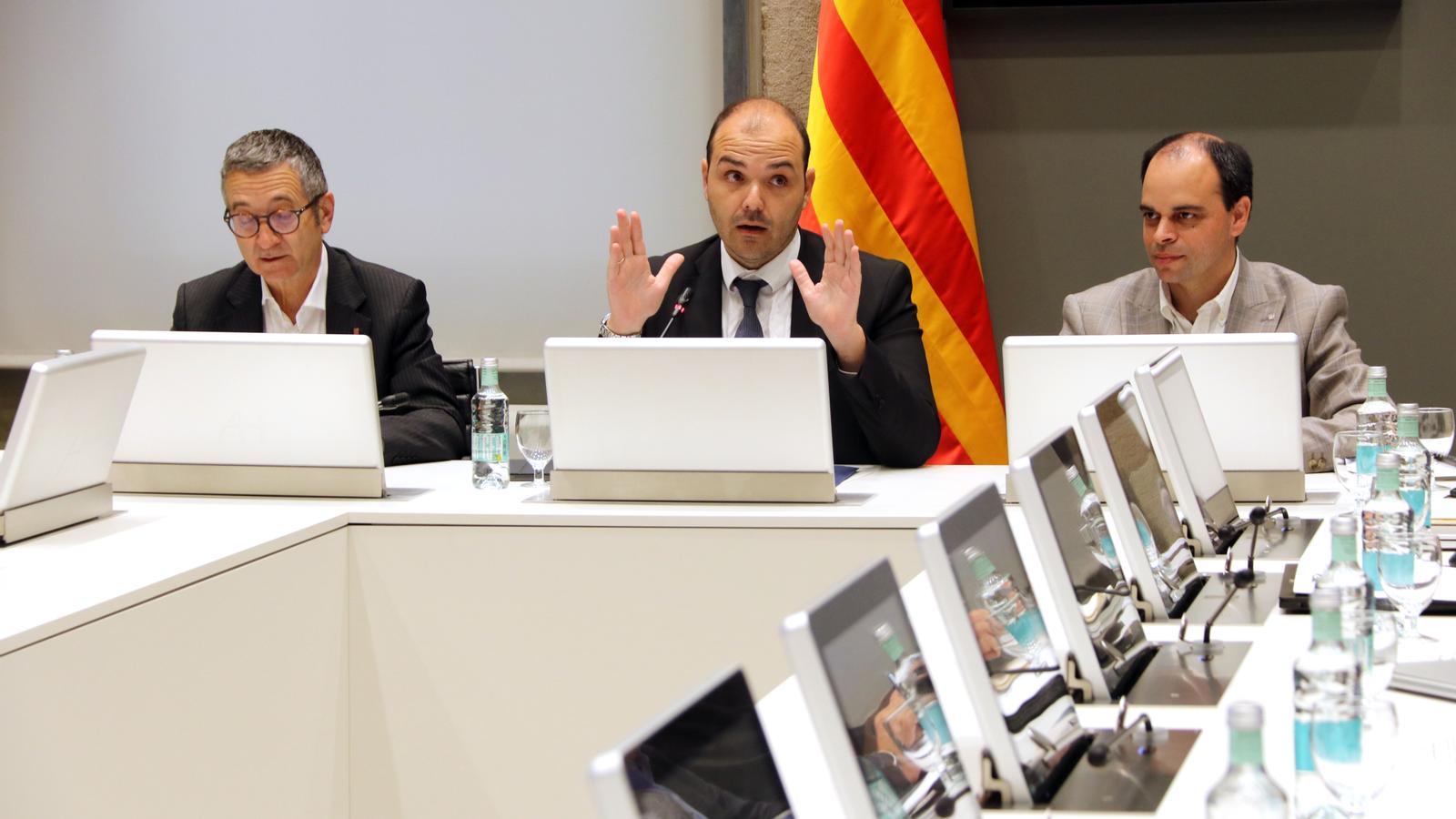
BarcelonaThe Government has taken a new step to promote the implementation of data centers in Catalonia and has identified 26 potential projects that would sum up to nearly 2,000 megawatts (MW) of power. "More specifically, there are about ten of these projects that have a high degree of maturity that could reach a power of between 300 and 500 MW progressively between 2030 and 2035", stated the Minister of the Presidency, Albert Dalmau, who this Tuesday chaired the second meeting of the Institutional Board for the Promotion of Data Centers. In parallel, the Generalitat has established up to seven poles for the implementation of data centers in Catalan territory: Parc de l'Alba, Sant Adrià-Barcelonès, l'Anoia, Metropolitan South area, Tarragona, Lleida, and Terres de l'Ebre.
"We need to recover lost time and Catalonia needs data center installations if it wants to be technologically sovereign", made clear Dalmau, who also recalled the importance of data being increasingly on European soil. "If we don't want our data to be outside the EU and to gain in terms of cybersecurity and strategic autonomy, we must bet on data centers", insisted the Minister of the Presidency, according to the ACN, which pointed out that the thirty or so projects will advance "at their own pace, maturity, and adaptation to technical and territorial requirements".
Vallès Occidental, with seven potential projects; Barcelonès, with 5 projects, and l'Anoia, with 4, are the three counties with the most identified data center initiatives.

It is estimated that Catalonia currently has more than fifteen data centers between 1 and 16 MW. "These 26 new projects represent a leap in scale. Catalonia cannot be closed off to having runways for the economy of the future," Dalmau stated. "Nowadays, being able to enjoy infrastructure means having roads, energy, water, and also data centers," enumerated the Minister of the Presidency, who also remarked that the establishment of seven implementation hubs in Catalonia for new data centers is an essential step for the projects located there to be declared strategic.
These seven hubs group factors such as land availability, energy capacity, digital connectivity, the technological ecosystem, sustainability, or reindustrialization opportunities. "They are dynamic and adaptable hubs that will be reviewed and modified when necessary, based on the evolution of market and citizen needs, given the rapid evolution of the sector and technologies," pointed out the head of the Presidency.
Project validation
. Ecologistes en Acció considers that "a traditional data center contributes little to the territory in terms of employment; a megadata center contributes equally little, but extracts a large amount of water and an enormous amount of electricityFor her part, the executive director of Barcelona&Partners, Montse Puig, has specified that the data centers interested in establishing themselves in Catalonia are those "of data inference or last mile". "They are data centers that are usually located around large poles or cities with large populations, which are the large consumers of this last mile of data centers", Puig has detailed, who has also revealed that they are data centers that do not require as much electrical power as those dedicated to training models might need. The executive director of Barcelona&Partners is convinced that Barcelona and Catalonia are already a relevant pole in the European and global AI arena.
"Barcelona is the third city in artificial intelligence matters after Singapore and London. Therefore, it is already a reality", Puig has put on the table. "But for this to be consistent and continue in the future, we need these digital infrastructures as relevant as data centers are", concluded the executive director of Barcelona&Partners.
Environmental opposition
This data center plan, however, has already met with opposition in the territory, especially from environmental groups, who consider that they consume a lot of water and energy to create little employment. Ecologists in Action considers that "a traditional data center contributes little to the territory in terms of employment; a mega data center contributes just as little, but extracts a large amount of water and an enormous amount of electricity, which causes a serious problem of electrical gentrification, as has already been found in cities like Marseille".
This group recalls that the state of Maine, in the northeastern United States, is seriously considering halting the construction of mega data centers with a power greater than 20 MW to prevent electricity prices from rising due to the increased demand that their enormous electricity consumption would cause, which would affect not only the pockets of the population but also those of industries, which would see their electricity bill multiply.
