The employers' associations speak of low incidence of the general strike and the unions of success
The strike affects large industries more and the employers' associations complain about the difficulties to get to work
-
CAT -
CAST
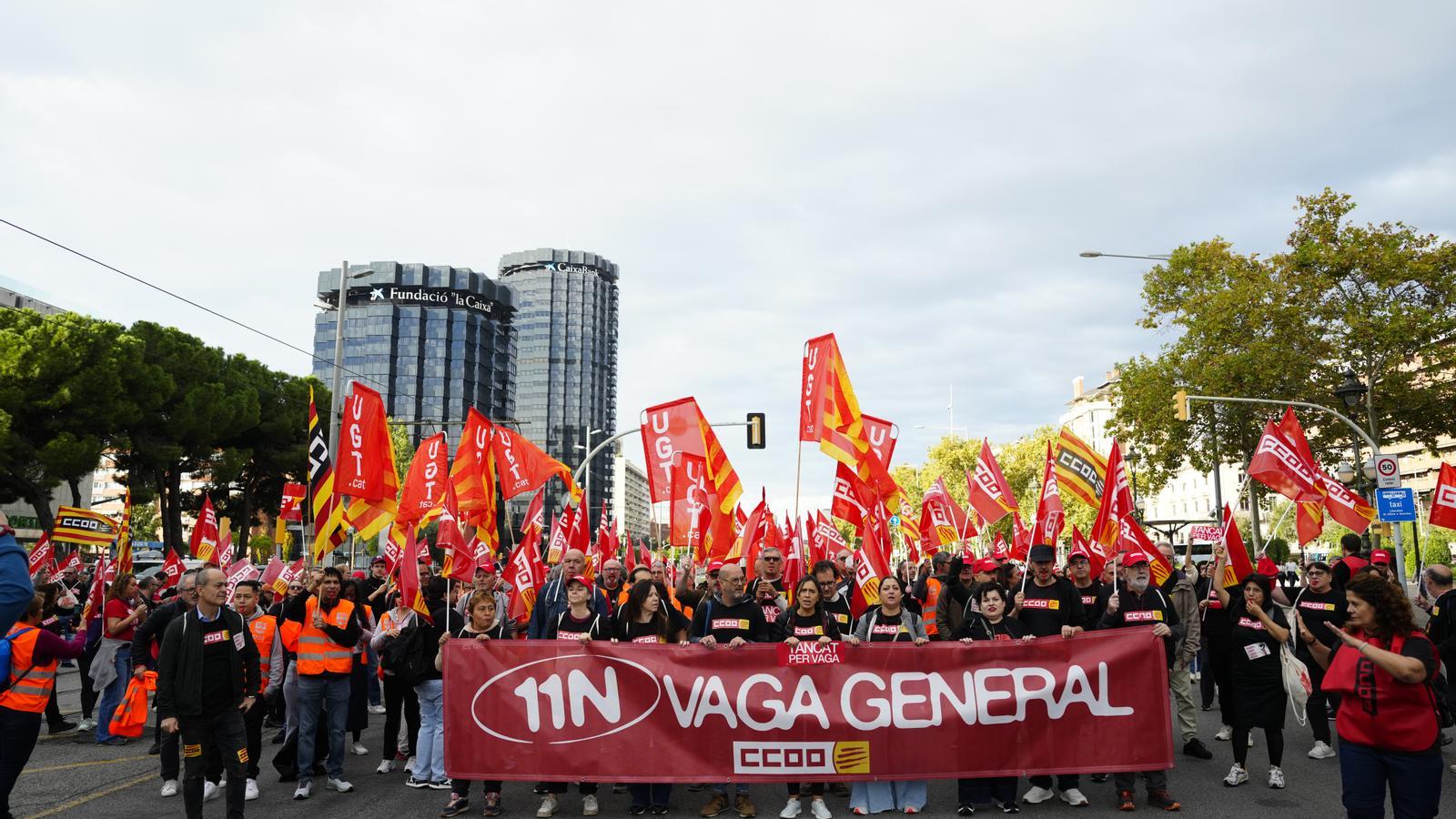
BarcelonaDiscrepancy between employers' associations and unions regarding the support for this Wednesday's general strike. While unions and organizing bodies speak of a successful work stoppage, employers' associations downplay the support, although they highlight the impact of picket lines and mobility difficulties as one of the factors that makes the impact greater than the support from the workers.
The mobilization began on Tuesday night with picket lines at key sensitive locations, such as Mercabarna and the main industrial estates, and major industries already stopped during the night shift, such as Seat. In fact, large companies are where there has been the most production stoppage, according to the union CCOO, which drew up an initial list of companies that stopped working.
Among these, in addition to Seat, there were Almirall, in Sant Andreu de la Barca; Cobega, in Martorelles; Damm, in Prat de Llobregat; Ficosa in Viladecavalls; FlexNGate, in les Franqueses del Vallès; Hartman, in Mataró; Grifols, in Parets del Vallès; Maxion Wheels, in Manresa; Motherson Sas, in Martorell; Nestlé, in Girona; or Repsol Fuels, in la Pobla de Mafumet. It should also be noted that the large meat companies, which have a five-day strike called, are also stopped: Guissona, Grupo J. Juan, Matadero Avinyó, Macoba, General Carnia and Mafrica.
CCOO and UGT estimate the support for the November 11th general strike in Catalonia at 84%, according to initial data released by the union this Wednesday, which include night and morning shifts, once minimum services have been discounted. The union asserts that support reached 100% in public and private universities, 92% in automotive and industrial transport, 80% in the meat sector, 90% in road services, 80% in services and hospitality, and 72% in local administration.
The employers' view was totally opposite. Pimec has substantially lowered the strike's support to 8.9%, according to data collected up to 08:22 hours. This employers' association pointed out that this difference between the strike's support and its impact on economic activity—29% of companies with reduced or stopped activity—is explained, in part, by mobility difficulties and incidents that prevent activity from being carried out normally, even in companies where no worker has supported the strike.
Specifically, Pimec maintains that 46.4% of the companies with activity affected by the strike did not have any employee on strike, while 31.8% of the monitored companies have registered at least one person who could not reach their workplace due to mobility problems. Pimec also asserts that 14.2% of the companies consulted have reported the presence of pickets at their workplaces or at the access points to their facilities.
The Vallès-based employers' association Cecot lowers the impact even further, stating that the general strike's adherence rate stands at 7.5% of the workforces represented by the companies that provided data. In total, they have collected almost 200 forms with information. These are companies of different sizes, located mainly in Terrassa and other municipalities in the Vallès, but also in different parts of Catalonia. Industry and manufacturing have an especially significant weight in the sample and represent 45.6% of the participating companies.
According to the data collected up to this moment, 75% of the companies claim to have been able to maintain their productive activity normally, while 22.1% have been able to maintain it partially and 2.9% indicate that they have not been able to maintain their usual activity.
Regarding operational incidents associated with the day, 51.5% have not registered any; 35.3% report minor incidents, such as punctual delays or limited absences; 4.4% report moderate incidents, with partial operational difficulties; and 8.8% report serious incidents, related mainly to access impediments, shutdowns of certain operations, or mobility difficulties.
Strictly regarding adherence, 67.6% of the companies consulted do not register any person on strike in the analyzed shifts; 19.1% place the adherence between 1% and 10% of the workforce; 10.3% between 11% and 25%; 1.5% between 26% and 50%; no company places it between 51% and 75%, and 1.5% communicate an adherence higher than 75%.
Based on this first cut, Cecot observes, therefore, "a limited and uneven impact, with low general adherence among the workforces, but with broader operational effects motivated mainly by mobility problems, road blocks, logistical difficulties, and preventive measures adopted by the companies".
Drop in electricity consumption
One of the main indicators of a strike's impact is the drop in electricity demand. According to data from the system operator, Red Eléctrica, at 12 noon, electricity demand in Spain was 31,444 MW. To compare, last Wednesday, which was also a working day, electricity demand at that time was 36,027 MW. That is to say, 12.72% less electricity demand.
The figure, however, is also used to support the positions of both unions and employer associations. Thus, the general secretary of CCOO, Unai Sordo, highlighted on TVE that energy consumption in Spain is at levels "closer to what is used on a Sunday than what was used last Wednesday," a fact which, in his opinion, represents an "unequivocal sign that there is a significant stoppage" during the first hours of the strike day.
In contrast, the president of the major Spanish employer association CEOE, Antonio Garamendi, has asserted that the drop in electricity demand is 10%, "well below the 14% of the last general strike." Furthermore, he qualified the call for a general strike as a "political and official strike" due to the call made by the government. He expressed this during an interview on Tele 5. "The data we have is, above all, when you see a little bit what the effect of energy is, that we are bordering on a 10% drop compared to what would be the demand of a normal day," he specified.
That said, he compared it with the last general strike, pointing out that the drop in electricity consumption is "well below that of the last strike, which was above 14%." In this sense, he pointed out that the data he has is that "there is normality." He also took the opportunity to "condemn all those instances of violence, of blocking streets or roads" that are seen on the part of "some pickets" that "are not informative." In this sense, he made a call for anyone who wants to work to be able to do so, since "they have every right to work."
