Xavier Albertí: "Knowing or not knowing your biological family can never be a trauma"
Premiere of 'Innocència i desig' at the Sala Flyhard, a show about stolen babies with Mont Plans, Montse Esteve and Manel Barceló
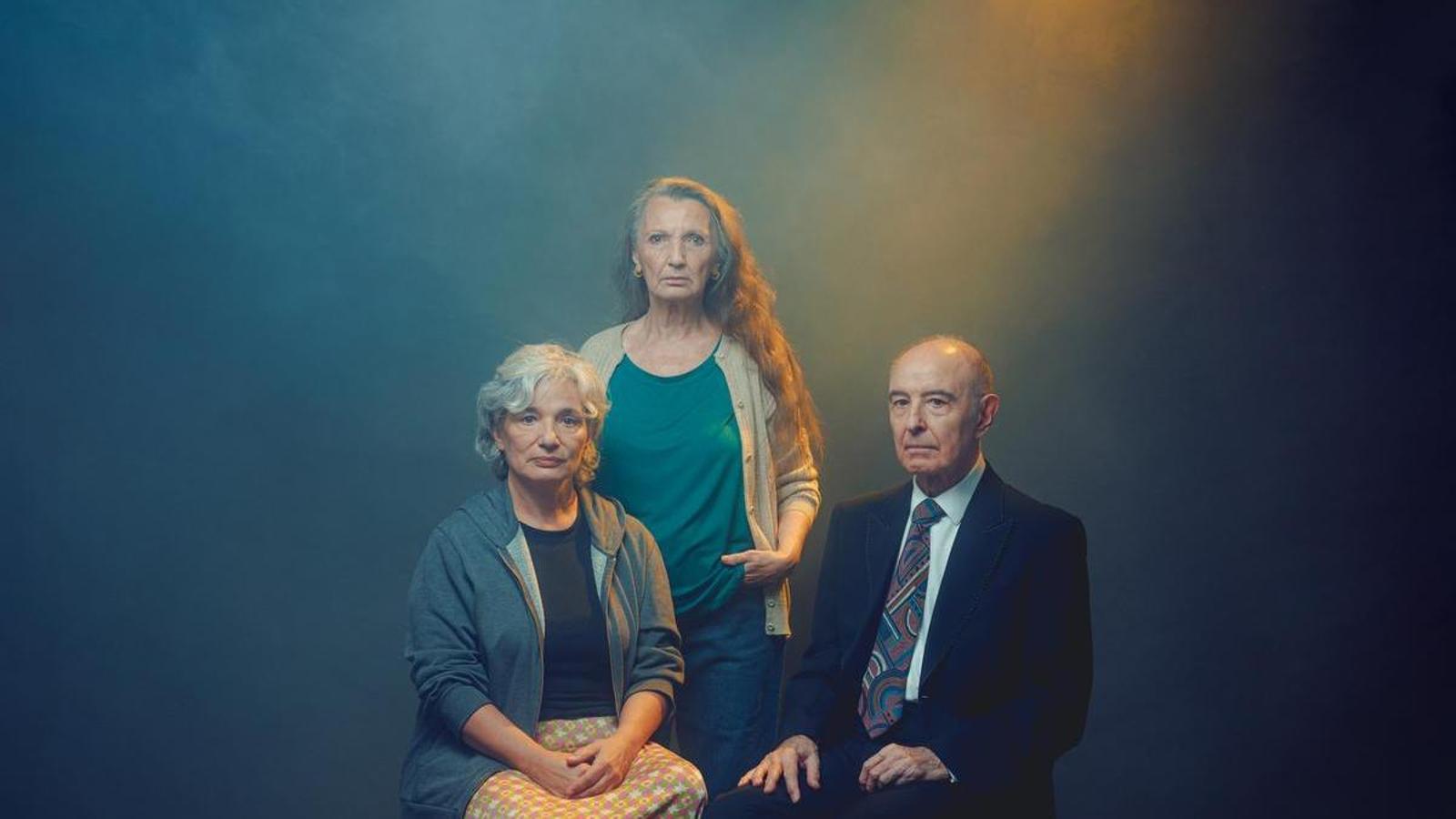
BarcelonaStage director Xavier Albertí (Lloret de Mar, 1962) has stepped on dozens of stages throughout his career, but until now he had never worked at the Sala Flyhard. The space in the Bordeta neighborhood is one of the smallest in Barcelona, one of the hubs of the city's independent scene and an opportunity to see the actors' performance work up close. "I had a crazy desire to do something there," emphasizes Albertí. The project that brought him there is titled Innocence and Desire and is a text by Òscar Constantí about the babies stolen from the Civil War to the 90s. It stars Mont Plans, Montse Esteve, and Manel Barceló and runs from this Thursday until December 27th.
"The whole text is based on real events, it is much closer to political theater or documentary theater than to stage fiction. It is a chilling document about how children have been stolen and the desperation of all those who have tried to find them," explains Albertí. To convey the events and the pain—both of the mothers whose children were taken and of the children who do not know their origins—the play moves forward through three characters: Lola, whose son was stolen during the war (Plans); Adelina, whose child was taken in the 80s (Esteve), and Eduardo, a lawyer dedicated to the cause of stolen babies who has reunited with his biological family (Barceló).
The show explores this profound injustice and also invites reflection on identity, especially when suddenly some family or childhood certainties collapse. "I am an adoptive father and I have also had the need to talk many times with my son about his origins, about whether he wants to know his biological family or not, because this can never be a trauma. It is a reality that we must assume with coherence and honesty, never with deception and extortion," explains Albertí. On stage, Manel Barceló's character relates that in the Spanish State there are two million adopted people, of whom more than 300,000 have been adopted fraudulently.
The impossibility of knowing the truth
Through the struggle of Adelina and Lola, the audience will learn firsthand about all the legal and bureaucratic obstacles that prevent victims from knowing the truth. "Every legal attempt to clarify the facts has been blocked and futile. There is something in our society that does not want to know the truth, and it is important to ask ourselves why," says Albertí. The play points directly to the collusion of doctors and the Church and also cites one of the few trials that have taken place regarding the theft of children. "We must all be aware that the political state still needs to lift many rugs. It is a symptom that we have not yet cleaned up the long night of Francoism," points out the director.
Although the story of these three characters takes place in different settings, Albertí has opted for an austere staging, placing them directly in a rehearsal room. The Flyhard has about forty seats on each side, and they have added a row with five more chairs on a third side. "The actors work from a place where theatrical conventions are made evident, especially regarding the stage space," explains Albertí. "It is a very simple show, made with all the love in the world and with exceptional interpretive quality."
