The fairy tale house hidden in the heart of Barcelona
Built in 1956 and covered in trencadís, the Putxet kiosk reopens to the public this weekend

-
CAT -
CAST
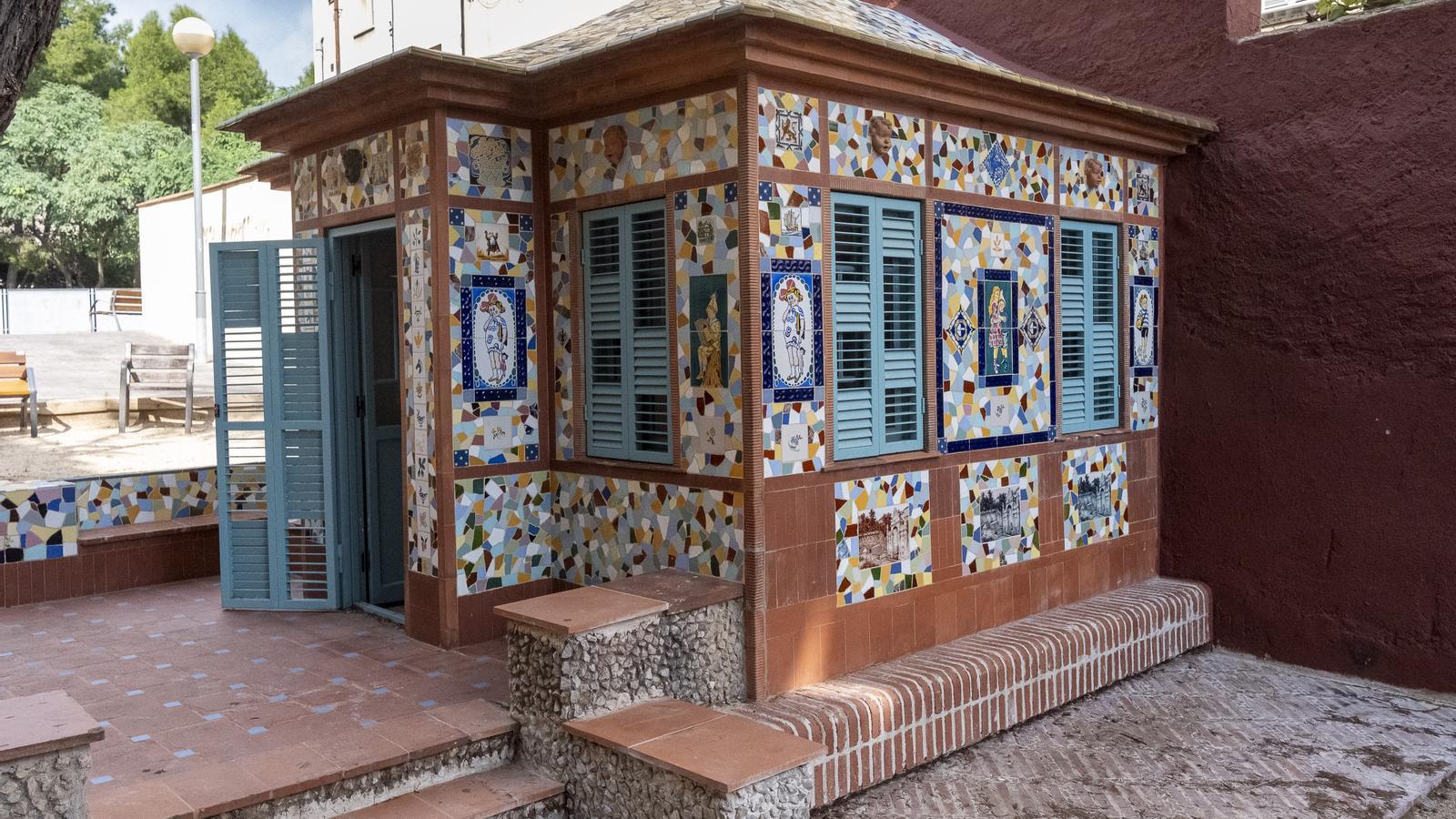
BarcelonaSometimes, behind a door that has nothing special about it, an unexpected architectural treasure is hidden. One must go to number 81I of Carrer Costa in Barcelona and go through the door of the interior courtyard to find the Putxet playhouse, a small dwelling covered in 'trencadís' mosaic with a lot of history behind it. It is now back in the spotlight because it will open its doors this weekend as part of the new edition of the 48h Open House Barcelona, after the restoration carried out by architects Jordi Planelles and Mariona Genís commissioned by the Municipal Institute of Urban Landscape of the Barcelona City Council.
The interior courtyard is a somewhat narrow strip between two buildings that is managed by the Parks and Gardens department. The landscaping could be lusher, but the narrowness of the place recalls the neighbors' efforts to save it. "It is known as a dollhouse, but in reality it is not, rather it is a symbolic playhouse," points out Mariona Genís. More specifically, this playhouse has many of the features of historical playhouses, often with a moralizing touch, inspired by the character of Wendy from the story of Peter Pan. In the Putxet one there is no reference to Peter Pan, but there is to the story of Hansel and Gretel. During the 48h Open House Barcelona, the house will be open on Saturday from 4 p.m. to 7 p.m.

The restoration carried out by Planelles and Genís has two sides. On one hand, they have replaced the damaged ceramics, only about 10%, and, inside, they have repaired the small kitchen and the bathroom, which had running water. Regarding the surroundings, they have removed a planter attached to the small house that was causing dampness. On the other, perhaps the most important part of their work is conceptual: since the small house cannot be open because it does not meet regulations, they have moved the notion of play to the outside: they have built a bench attached to the small house and have camouflaged the grilles into half-open windows, so that children of different heights can look through the window into the house, as if they were spies. Furthermore, in the evening the interior lights turn on, which creates a certain mystery. "We didn't want the small house to have no use," say the architects.

Modernist due to a historical misunderstanding
The history of the small house has many corners. It was known as modernist, but in reality it was built in 1956. On the other hand, the trencadís is indeed from that period. This is explained because the owner, the builder Delfí Guinovart, took advantage of old tiles and test pieces from different moments that he had stored. "When we received the commission, they spoke to us about the modernist small house, but in reality, it is a historical misunderstanding," explains Genís. "We think that, since he was a builder, Guinovart went around collecting tiles from different works: there are some of trades, floral ones, with images of children," says Planelles. "The variety of tiles was a distraction when dating the small house," explains the architect. One of them, that of a doll with a teddy bear, draws attention because different variations can be seen, as if they were samples with different colors.

On the other hand, the house had been linked to the neighboring Villa Matilde, whose owner was a lover of ceramics, but the historical study carried out for the restoration confirms that this is not the case, and connects it to a modernist house that Guinovart bought to settle in with his family. Guinovart's widow, Núria Comas, is currently 102 years old and attended the inauguration of the restored small house. The previous owner had sold it to them because he had not obtained the license to convert the modernist house into a small hotel. But, unfortunately, the Guinovart Comas family did not spend much time there, because Guinovart died about ten years later and they ended up selling it to build apartments.
