'The rose of seven petals': an opera about the memory of the women of Sant Andreu
The work, which the Liceu will premiere in June 2027, has a libretto by Blanca Bardagil and music by Tomàs and Lucas Peire
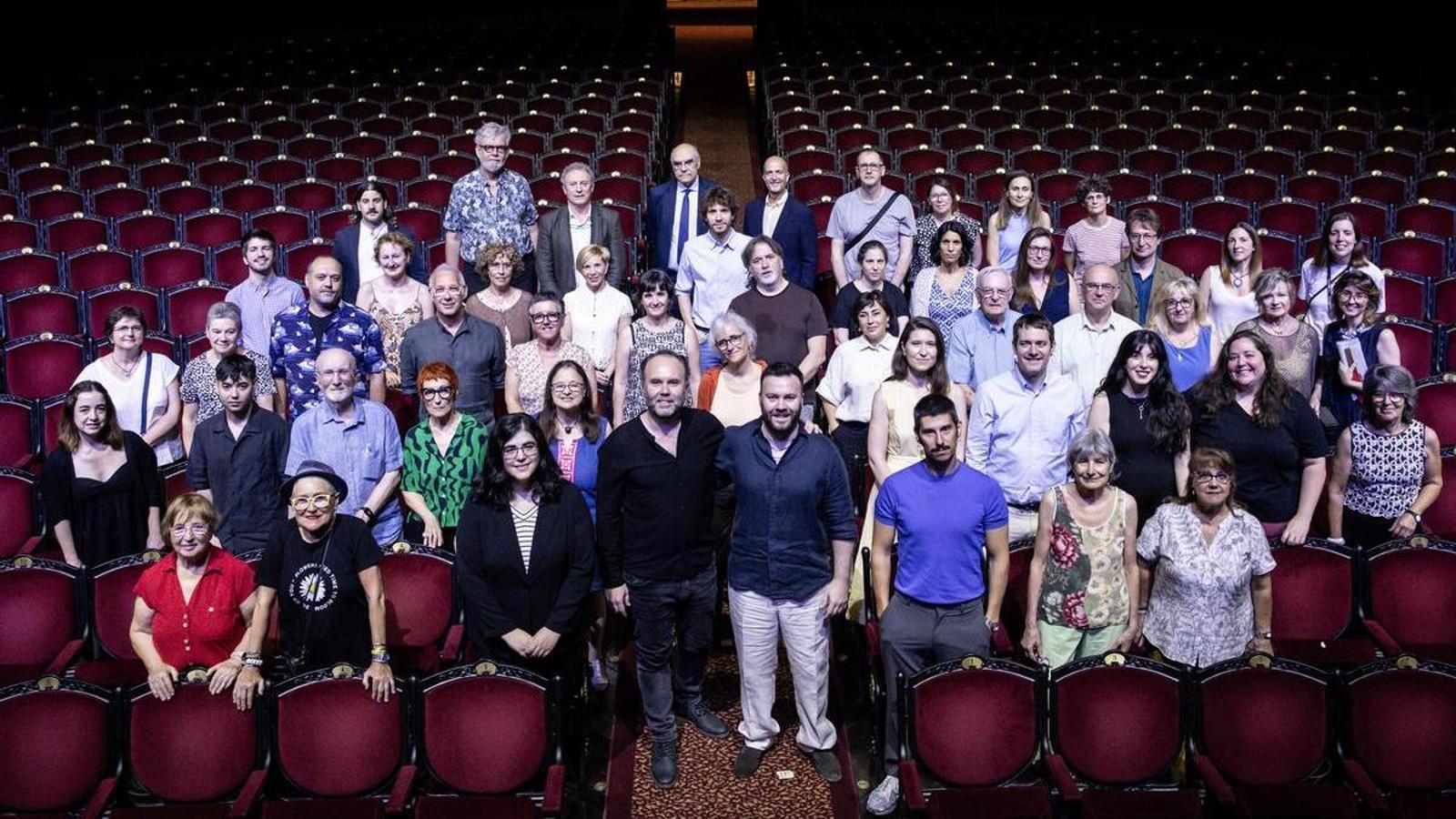

BarcelonaThe Francoist repression and the workers' struggle are two of the axes of La rosa dels set pètals, the new community opera that will be performed at the Liceu on June 4, 5, and 6, 2027. It is the second work of the Òpera Prima project promoted by the Rambla theater, following La gata perduda (2022), set in the Raval. The seven petals in the title refer to the seven neighborhoods of the Sant Andreu district of Barcelona: Navas, la Sagrera, el Congrés i els Indians, Sant Andreu del Palomar, la Trinitat Vella, el Bon Pastor, and Baró de Viver. And the rose evokes the plastic flowers that the prisoners of La Trinitat Vella were to make, a scene of penitentiary repression against women in Catalonia during the last fifteen years of Francoism and where the re-educative role imposed by the nuns of the Cruzadas Evangélicas de Cristo Rey was particularly sinister. "Freedom, women, identity, and memory" are the concepts that link the work done by Blanca Bardagil in the libretto and also permeate the musical composition of the brothers Tomàs and Lucas Peire. Similarly, this will be transferred to the staging directed by Israel Solà.
Currently, the opera is entering its decisive phase, which includes the scenic development by Solà and the coordination, by Buia Reixach, of the singers from different choirs and musical groups in the Sant Andreu district. As for the cast, it will feature Lídia Vinyes-Curtis, Mercedes Gancedo, Dolors Aldea, Laura Vila, Laura Brasó, and Marc Sala. And the musical director, Manel Valdivieso. Talent from the country in service of a "very ambitious" opera, as the artistic director of the Liceu, Víctor Garcia Gomar, said this Friday at a crowded press conference on the Liceu stage.
La rosa dels set pètals tells the story of Amèlia, a woman repressed by the dictatorship who, in prison in 1965, gives birth to a baby girl, Llibertat, who is taken from her. The libretto covers different time periods, between Amèlia's stay in prison and her last days in a residence where her memory fades as she shares memories with the caregiver. "I started doing fieldwork by talking to people from different backgrounds," explains Bardagil, who immediately saw that she wanted "the Trinitat Vella prison to be important in the libretto."
In this sense, the conversations with former prisoners like Pilar Rebaque, who was arrested in 1970, at the age of 18, during a protest against the Burgos trial, have been very eloquent. "Thank you to the Liceu for thinking about this women's memory project. As political prisoners, our individual memory has been weaving a collective memory that, with music, has become universal memory. We hope that The Rose of the Seven Petals will be performed all over the world, because it is a memory of the Francoist repression against women," says Rebaque, an activist for democratic memory at the Dignity Commission, one of the entities that has fought for a part of the old Trinitat Vella prison to be preserved as a memorial space.

The music of memory
The composers Tomàs and Lucas Peire have been in "constant dialogue" with Blanca Bardagil and have participated in different meetings with the Liceu and the cultural and associative fabric of Sant Andreu. "All this has stimulated the creative part, the imagination," assures Tomàs, who celebrates that the structure of the libretto, which moves between the sixties and the present, suits his way of musical conception. And he celebrates the challenge of musically translating both the memory of the district and the disintegration of the protagonist's memory. "And the choir has a very important role, because it represents the spirit of Sant Andreu, but also different characters throughout history, with musical moments of great impact and emotion," says Tomàs. "There are moments when the choir sounds very popular, and others more atmospheric," Lucas advances. The spirit of the district recalls the memory of the Trinitat Nova prison, but also an industrial past linked to factories such as Fabra i Coats in Sant Andreu, Pegaso in Sagrera, and Maquinista Terrestre i Marítima in Bon Pastor. It is the context that accompanies La rosa dels set pètals.
The choice of Sant Andreu to host the second edition of Òpera Prima became effective after receiving "several candidacies from Barcelona and the metropolitan area", as explained by the president of the Liceu, Salvador Alemany, who highlights the capacity of community operas to create "bonds and a sense of belonging".
