The pain of giving a voice to the executioner: the Nuremberg interpreter who lost his parents in Auschwitz
An exhibition at the Goethe Institute recovers the stories of the young people who made possible for the first time a trial in four languages
BarcelonaPatricia Jordan was 21 years old and had just graduated from the Geneva School of Interpretation when she was selected to work as an interpreter at the Nuremberg trials. It was the first time in history that simultaneous translation was used. "Speaking into a microphone while simultaneously hearing a disembodied voice through headphones was something deeply unsettling. It was my first job and the most important one. I went there with the innocent enthusiasm of my 21 years. When I returned home four months later, I had aged ten years, and yes, I was already an interpreter," Jordan wrote.
Between November 20, 1945, and October 1, 1946, at the Palace of Justice in Nuremberg, the first international trial for crimes against humanity was held. With four official languages (English, French, Russian, and German), traditional consecutive translation would have extended the process by more than four years. Thanks to simultaneous interpretation, it lasted only eleven months.
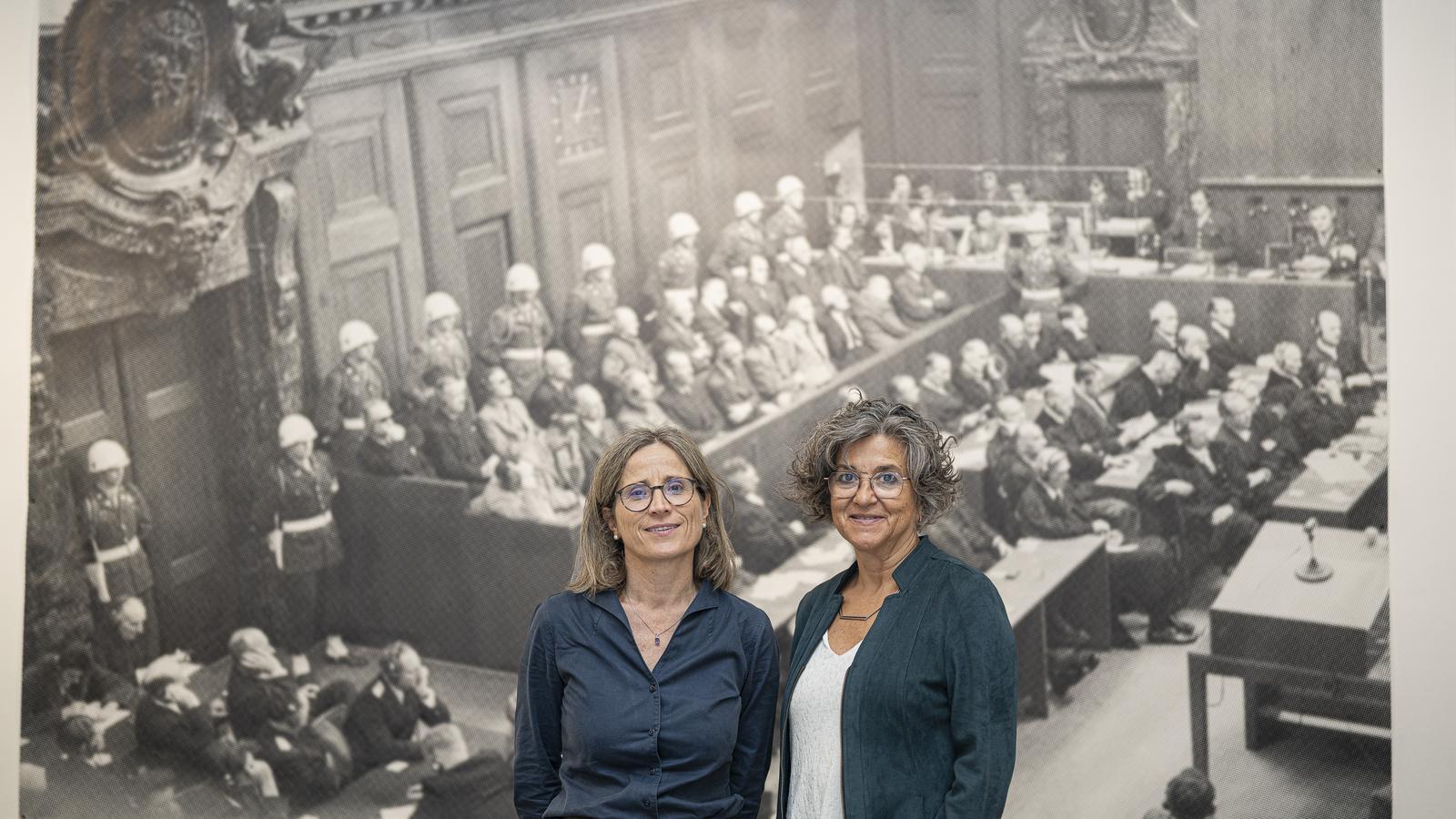
"Very little is known about all these men and women who saw a new profession born and who had to give voice to such atrocious crimes. It was difficult to find the words in the different languages, and not to break down while giving them voice, because an interpreter has to put themselves in the shoes of the person they are translating," highlights interpreter Emma Soler, who, together with fellow interpreter Waltraud Hofer, has brought to the Goethe-Institut in Barcelona the exhibitionA trial, four languages, promoted by the International Association of Conference Interpreters (AIIC).
Until December 15—there are also guided tours—the exhibition commemorates the feat and puts a face, names, and surnames to those pioneers who, in teams of three and from booths improvised with the technology of the time, started a new profession. "Without them, the impact and consequences of the trial would have been quite different," highlights Soler.

The selection process
At that time, there was practically no one who had experience or had been trained in simultaneous interpretation. The recruitment of the pioneers had to be improvised through advertisements in the press and by requesting personnel from the Allied armed forces, especially Jews who had fled Nazi Germany and were part of the United States Army. There was not much time, and many doors were knocked on. There were also Russians who had been living in exile since the 1917 Revolution and translation students from the Geneva School. No German who was not Jewish was recruited. Everyone had the right to leave the trial if they did not want to continue, except for the Russian interpreters who had been recruited by the Soviet Union.
Hofer remembers the peculiar selection filter: "All candidates were given a test: they had to be able to name, in their mother tongue and in their working language, ten terms for car components, ten for agriculture, and ten for trees or birds. Then, a mock trial was held in the attic of the Palace of Justice to familiarize them with the terminology." There were 500 candidates, of whom 36 booth interpreters were finally selected.
Working from the first improvised booths with pioneering technology meant living with constant interruptions and immense pressure. For many, it was the first time they had encountered certain legal or military vocabulary, and there was quite a lot of ignorance of Nazi jargon—such as the term for the SS—. All of this complicated the daily work. A warning light alerted witnesses and defendants when they spoke too fast, but the stress and the importance of what was being said could be distressing. "One of the interpreters even manipulated the cables with a hair clip to cause a technical breakdown and gain time to recover," Hofer details.
Göring's complaints
Furthermore, the defendants themselves intervened directly when they detected nuances in the translation with which they did not agree. And certain nuances were controversial. "Hermann Göring complained to prosecutor Robert H. Jackson saying that it should not be translated as final solution to the Jewish problem, but rather complete solution", details Hofer. Göring alleged that when he signed the order in 1941 he was referring to a "global/complete solution" to the problem through the emigration or evacuation of Jews out of Europe, and not to physical extermination. One of the most difficult challenges for the interpreters was having to translate in the first person statements such as "I ordered" or "I executed" and then detail all the horrors committed by the Nazis.
Interpreter Stefan Priacel wrote to his wife in March 1946: "The work of an interpreter at the hearings is undoubtedly the most difficult thing I have ever done in my life". Priacel explained how terrible his experience had been while translating for more than an hour Julius Streicher, director of the antisemitic magazine Der Stürmer: "Through a phenomenon of depersonalization of which I was not even aware, I had identified myself in a certain way with a person against whom everything in me rebelled. When Streicher finished, I knew that I was an interpreter", he asserted.
This mental distance could not always be maintained. Hofer recounts the episode experienced in the Russian booth during the interrogation of the Nazi Fritz Sauckel by the American prosecutor Thomas J. Dodd: "Tatiana Stupnikova, who was translating for the Nazi defendant, and her colleague, who was translating for the American prosecutor, got so intensely into the role that they stood up from their chairs. He grabbed her arm with such force and physical pain that the girl was moved to tears. The judge had to stop the session upon seeing that something serious was happening in the Russian booth", explains Hofer.
An interpreter with parents who died in Auschwitz
Having to listen for hours to the crimes committed by the Nazis and translate them in the first person left deep wounds. The parents of interpreter Armand Jacoubovitch were deported and murdered in Auschwitz in 1942. Jacoubovitch was 30 years old when he had to translate aloud the crimes committed against his own family and he fainted in the courtroom during Göring's testimony. As his granddaughter wrote in A fifty-year silence, the trial marked him for the rest of his life and turned him into a lonely person. His wife left him and took their two children shortly after Nuremberg.
He was not the only interpreter who had experienced the Nazi hell firsthand. Genia Rosoff had fought with the French Resistance and had been deported to the Ravensbrück concentration camp. Liberated by the Red Cross in the spring of 1945, she captured her testimony about the terror of the camps in the text Durer (To Endure). When she was preparing to resume her life as an English teacher, the French Ministry of Justice recruited her to work at the Nuremberg trial. From the French booth, translating from Russian and English, Rosoff became one of the most prominent voices of the tribunal. "She is one of the best interpreters I have ever known," recalled her colleague Marie-France Skuncke, who highlighted her extraordinary mental strength. Despite her courage, her daughter explained that her mother never wanted to talk about the trial.

