The Liceu sings against the hate that separates Romeo and Juliet
Riccardo Frizza conducts 'I Capuleti e i Montecchi' with Lisette Oropesa and Raffaella Lupinacci at the head of the production

-
CAT -
CAST
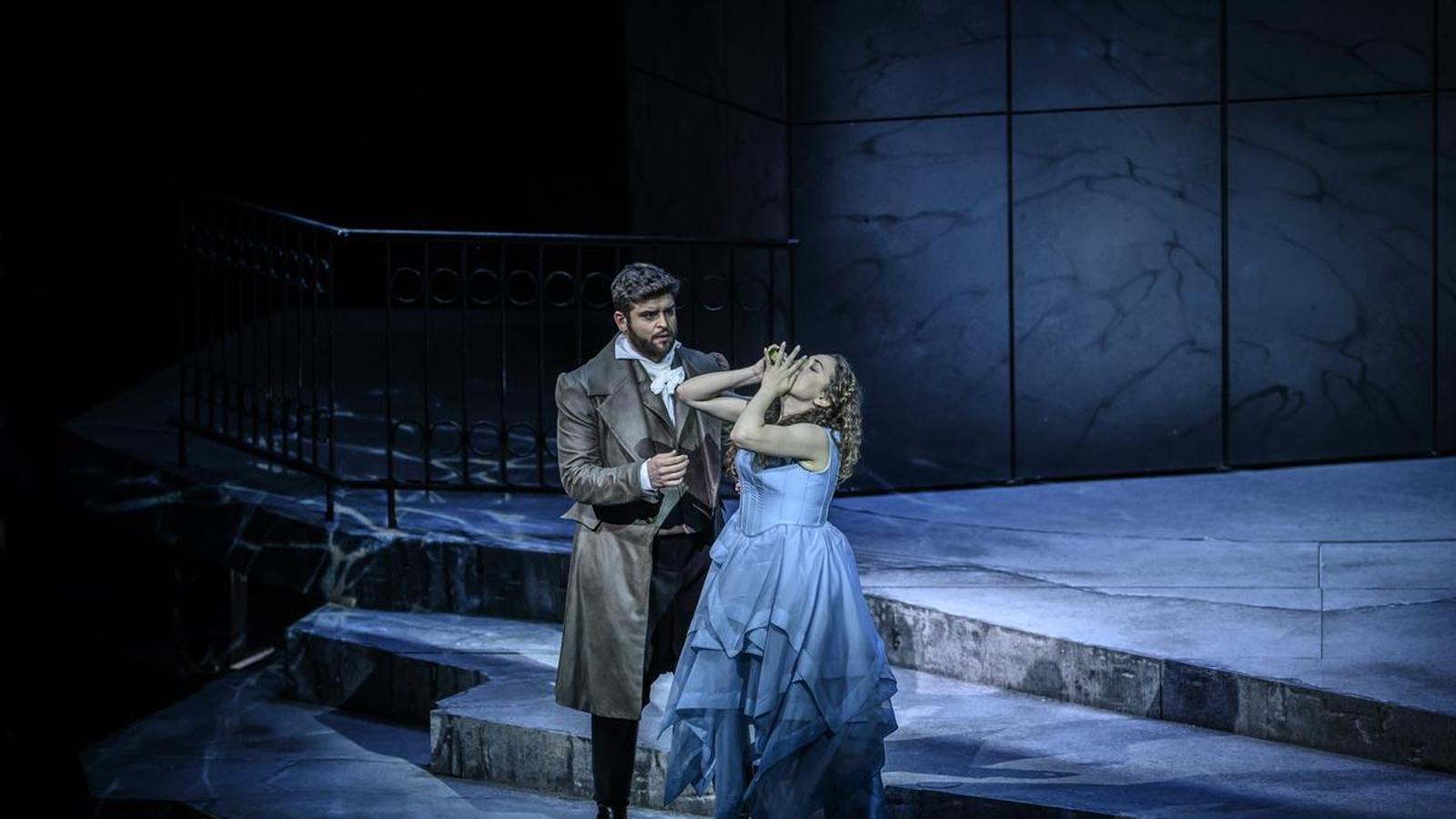
BarcelonaThe audience attending the performances of I Capuleti e i Montecchi at the Gran Teatre del Liceu will encounter a stage led by two large walls, a stone staircase, and a majestic river in the center. The opera by Vincenzo Bellini (Catania, 1801 - Puteaux, 1835) returns to the Barcelona theater under the direction of Riccardo Frizza—who already led it in the last version, seen on the same stage 10 years ago—, with stage direction by Allex Aguilera and soprano Lisette Oropesa and mezzo-soprano Raffaella Lupinacci in the roles of the two great protagonists, Juliet and Romeo. Considered one of the jewels of Italian bel canto, the work will be performed at the Liceu from October 30th to November 11th.
Written in 1830 and with a libretto by Felice Romani, I Capuleti e i Montecchi is based on one of Shakespeare's great stories, that of Romeo and Juliet, but its creators were not so much inspired by the English Bard's tale as they were based on previous Italian sources, which spoke of a pair of lovers and an impossible love that had led them to suicide. Here, the protagonists are not two young people who have met at a party and are experiencing a first passionate love, but rather a mature Romeo and Juliet who have married in secret and are living their relationship in hiding. "Bellini proposes a great renewal of the myth and turns love into a sacrilegious gesture in the face of hatred and violence that surrounds the two characters, who have no other outcome than a tragic end," explains the artistic director of the Gran Teatre del Liceu, Víctor Garcia de Gomar.
The opera beats through the impossible love of the two protagonists, but projects a different look at its outcome. "Here, hatred is seen as a destiny and not as a circumstance. Theirs is a love that defies norms, that calls into question the values that sustain the environment and family honor," points out Garcia de Gomar. In this sense, one of the great questions that the artistic team has asked itself during the creation process has been what is the most important part of the opera, whether it is the love or the political act of the story. "It was written in the 30s and premiered in Venice, where the Austrian Empire ruled. The theme of the homeland was very present there, even if it is camouflaged here through the love story. We have tried to give weight to this facet of the opera," stresses Frizza.
Tears in the eyes
One of the particularities of this piece is that the character of Romeo is intended to be performed by a mezzo-soprano. "Juliet embodies fragility, the ideal of purity, fidelity, and sacrifice. Romeo is a passionate, brave man, who moves between heroic ardor and intimate vulnerability. The timbral fusion of the two voices brings great delicacy to the performance," points out Garcia de Gomar. For Frizza, this score contains "some of the best melodies in the Bellinian repertoire" and "very important solos for instruments such as the harp, the horn, and the clarinet, which were the composer's favorites".

The performers have experienced the impact of the score firsthand. "In rehearsal, before singing, when I heard the harp solo, I was about to cry. The music is so beautiful and so moving that, inevitably, tears come to my eyes," explains Oropesa. For both protagonists, the great challenge of the production has been learning to contain their emotion. "We need the emotion to use it in our singing, but we cannot let it take our voice away. I have to sing the dramatic conflict while always maintaining purity," says the soprano. "This is the most beautiful Bellini role I have ever done." Lupinacci, who is debuting at the Liceu, encountered the same difficulty. "Luckily, I have had a teacher who understands the vocality of each artist and helps us, and an excellent partner. Together we have achieved a communion between the two voices, because here it is not about standing out," highlights the mezzo-soprano.
Water on stage
Allex Aguilera did not want to set the stage in the middle of the Middle Ages, but he was also not in favor of placing the story in contemporary times. The artistic director has opted for a middle ground that is perceived, above all, in the costumes. While Romeo dresses in a more classic way, Juliet will move around the scene in three dresses that approach current fashion. "At the beginning she appears in a wedding dress; later she appears in street clothes with a hope-blue outfit, because she is looking for Romeo after the war, and at the end she wears a dress that will be her funeral one," highlights Aguilera.
When conceiving the scenography, the director has played with symbols. The two opposing walls represent the fate of the two lovers, who will have no escape, and water is a fundamental element for the character of Juliet. "She has a very close relationship with water. She is the only one who relates to it, who touches it. She returns there to meet her love, while Romeo goes to the river to take the poison. Everything converges there," says Aguilera. The most observant spectators will also find symbolism regarding the lighting design, which avoids warmth and only uses cold tones. According to the director, "the use of chiaroscuro is a way of pointing out that we are facing a drama, a great love story in which, despite all its passion, there is something that does not work well".
