Palau Robert vindicates the most combative Pau Casals
The exhibition 'Pau Casals, music for peace' remembers the cellist's commitment to freedom and democracy
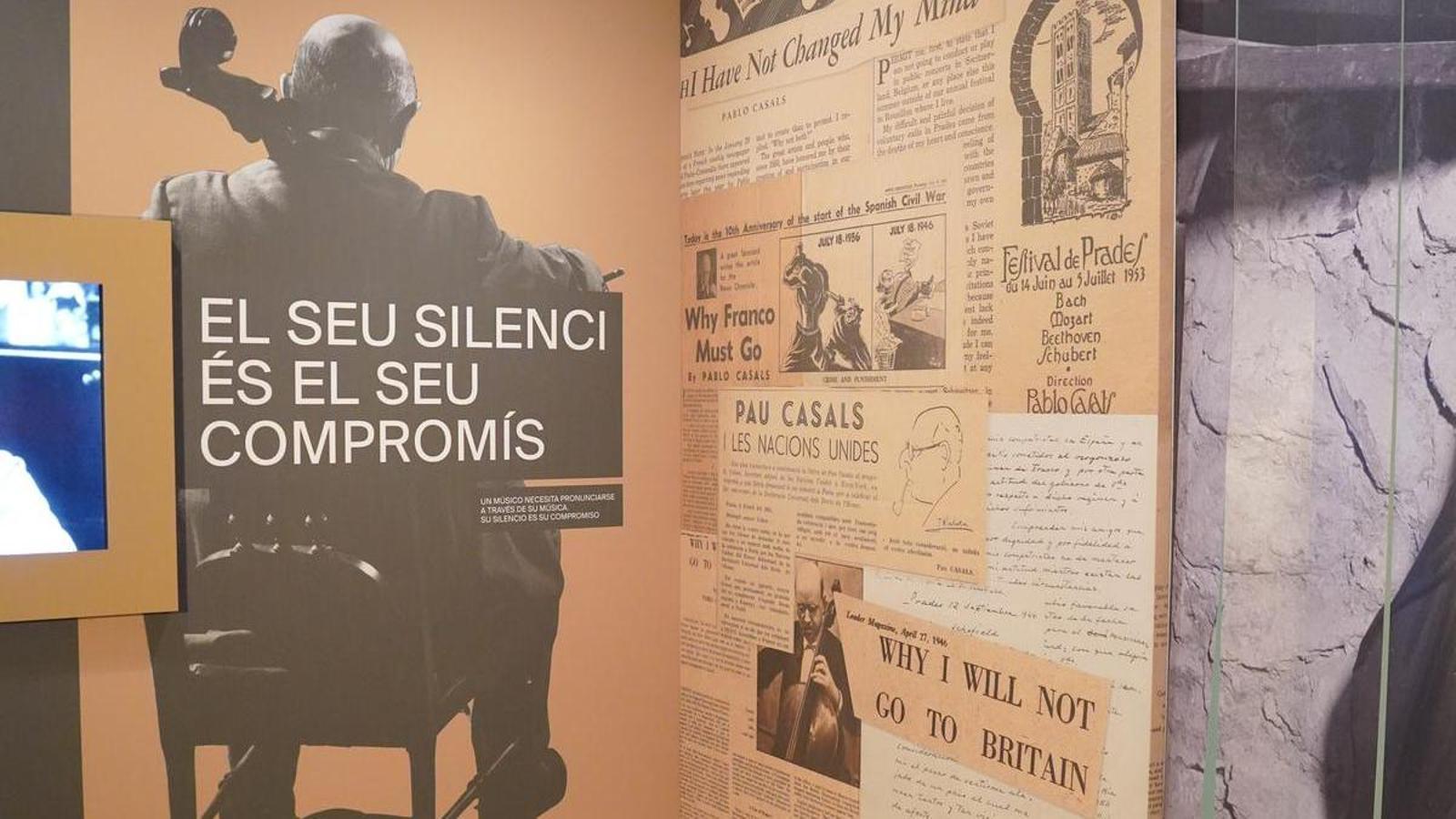
BarcelonaThe Palau Robert in Barcelona hosts starting this Wednesday Pau Casals, music for peace, an exhibition that vindicates the figure of the cellist from El Vendrell and his legacy as an artist committed to freedom, democracy, and peace. Curated by the director of the Pau Casals Museum, Núria Ballester, the exhibition can be visited until January 10th and is part of the Pau Casals Year, which commemorates the 150th anniversary of the musician's birth. It will later travel to CaixaForum Madrid, starting in February, and to the Pau Casals Museum in El Vendrell, from June to August. In statements to the ACN, Ballester highlights that today Pau Casals' legacy is "very relevant".
The exhibition is structured into five areas. The first reviews the musician's biography with photographs and objects. The second treats music as an art of communication and includes a space dedicated to the Cello Suites by Bach that Casals recovered and popularized at the end of the 19th century. The third focuses on music as a tool for protest, and the fourth, on music as a message of peace. Finally, the last area gathers opinions about Casals from different personalities, such as Albert Einstein, Thomas Mann, and Jean Sibelius, and interviews with musicians like Antoni Ros Marbà and cellists Miklós Perényi, a student of Casals, and Pablo Ferrández, in addition to activist Òscar Camps, founder of Open Arms.
"It is an exhibition that presents the most combative Pau Casals, the Pau Casals who put his art, his music, at the service of peace," explains Ballester to the ACN. The curator remarks that they wanted to create a "very communicative" exhibition, with original documentation, but above all with audiovisuals, phrases, and thoughts from the musician, such as the speeches he gave at the United Nations.
For Ballester, Casals' word "is still very much alive" and his legacy is "very relevant" in a moment "of conflicts, of wars". "His testimony is not an exercise in nostalgia," defends the curator, who vindicates the role of the artist: "Casals was very clear that the artist should not stay in his ivory tower, but had to act".
The exhibition recalls that Casals refused to play in Soviet Russia, Nazi Germany, and Francoist Spain, and that he helped thousands of republican refugees. One can also see his nomination for the 1958 Nobel Peace Prize or the letter from John F. Kennedy thanking him for the concert at the White House in 1961, and one can listen to El cant dels ocells.
The years in Puerto Rico
Also within the Pau Casals Year, the Music Museum and L'Auditori will inaugurate this Thursday the exhibition Pau Casals in Puerto Rico. An unpublished archive, which can be visited until February 14th. Curated by Vicent Minguet, the exhibition explains, through unpublished documents, the last eighteen years of the musician's life on the island, between 1955 and 1973, where he developed much of his artistic and intellectual activity.
