"Living in El Born is what must be most like hell"
Marc Artigau publishes the book of short stories 'This will be our well', which has received the Mercè Rodoreda prize

-
CAT -
CAST
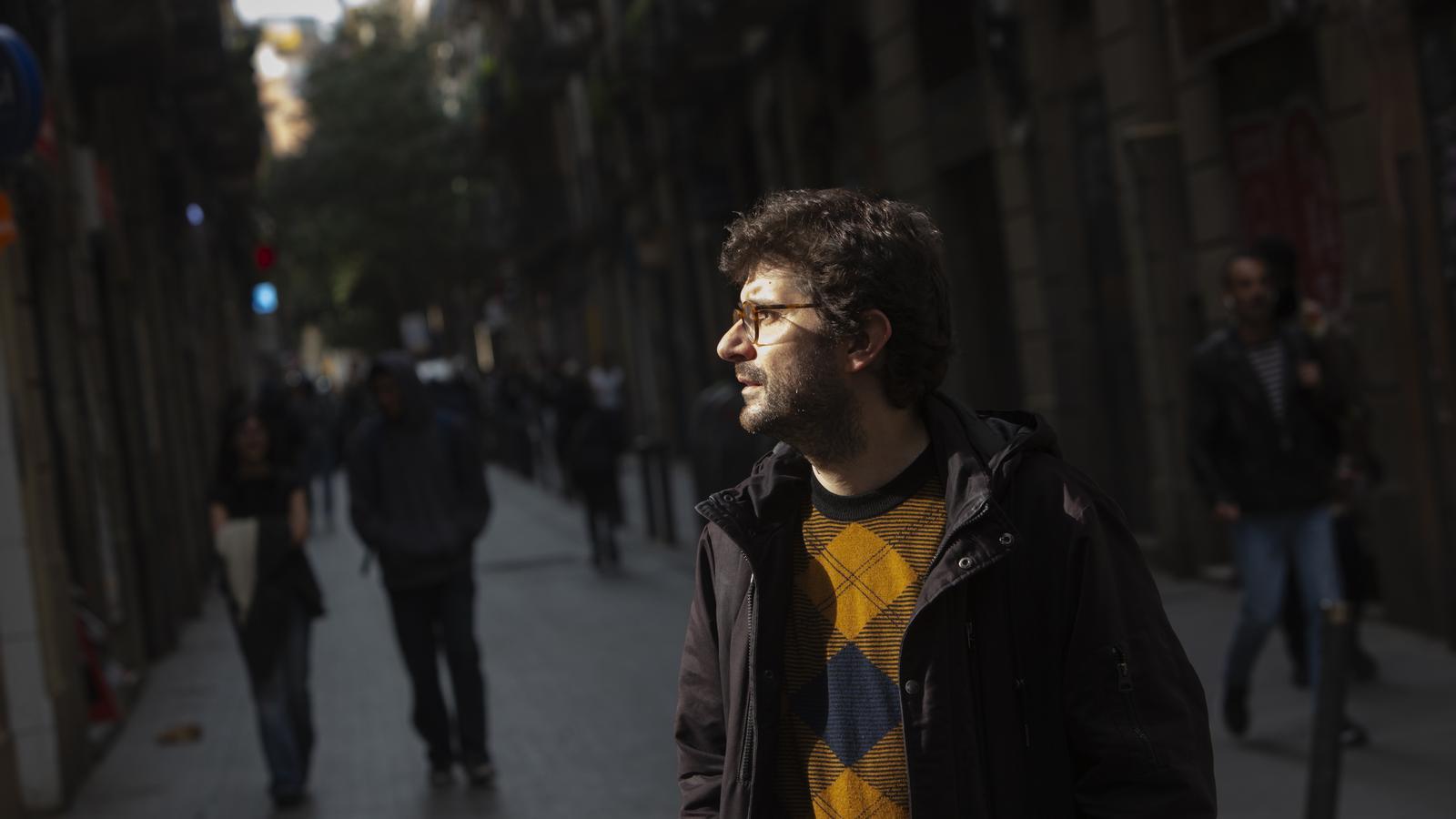
BarcelonaIn the first quarter of the year, Marc Artigau (Barcelona, 1984) donned the playwright's hat and premiered the comedy about Alzheimer's Una festa a Roma, directed by Clara Segura at the Teatre Lliure. In the second quarter, for Sant Jordi, the playwright puts on the narrator's hat and presents the collection of short stories Aquest serà el nostre pou (Empúries), which has just won the Mercè Rodoreda prize at the Catalan Letters Night.
Artigau is an all-terrain writer: he has published novels such as Aurora (Destino, 2023) and La vigília (Premi Josep Pla, 2019) and a trilogy of thrillers with Jordi Basté, collaborates on El món a RAC1 by creating a one-minute story daily and is a regular presence on the city's theatre scene – in June he will premiere the comedy El meu germà at the Maldà. If in theatre he shows his most benevolent and luminous side, in his short stories a darker and more stark vision of the world appears. "Short stories are more intimate and feel like a confessional, where I can say what I think. Here I am more wicked," he admits.
A stoning with a child's eyes. A youthful revenge in a retirement home. A family cruise with an ending worthy of Supervivientes. Artigau is playful with the form of his stories and wild with their content, as he pushes the protagonists of the tales to the extreme, acting as if no law or external judgment exists, as if no one were watching them. What would happen if human nature were allowed to run wild? "I believe we have left things related to individual responsibility to collective responsibility," he opines.
This will be our well digs into the idea of a system that apparently works but is actually exhausted. In Mr. Antònio's Stain there is an old man bleeding to death while his neighbors keep him company waiting for an ambulance that never arrives. "The other day I read [in ARA] that there is a direct correlation between the places where more bars close and the far right, because the bar is a meeting space. There is trust in people, yes, but not in the system," he reflects.
The characters in some stories show an almost psychopathic lack of empathy. "It is the new global paradigm towards which we are heading: Trump's politics is the law of the strongest. This makes me think about language. We have a minority language, and we don't have the power or the resources to preserve it: let's see how we're going to do it, because we've also seen that not dropping a piece of paper on the ground hasn't done any good," he points out. It is a concern that he portrays in Holiday City, where he imagines a couple evicted from their home for not being tourists: it turns out that by the coast it is illegal to live there, you can only be there on holiday, happy, speaking English or Spanish.
"We have stopped being citizens to become consumers. Or a burden, if we are a person who falls in the street. We are in a system where if you don't contribute, you subtract and, therefore, you don't deserve to be here – he continues–. I lived in El Born, and it's what must be closest to hell, because you go down to the street and everyone is on holiday and you're in a hurry to get to the metro. All gentrified... That's why I live in Sants. I read in ARA that someone said that Gràcia is no longer cool and Sants is. I deny it: Sants is not cool at all, it's shit, don't come, we occupy houses and burn people, I don't recommend it at all."
A not so distant dystopia
The twelve stories breathe a classic air and draw from a tradition that will be familiar to Catalan readers. Artigau cites Quim Monzó and Sergi Pàmies, but also Julio Cortázar, J.G. Ballard and Mariana Enriquez. The thread that links the stories, in addition to deaths, is "the sensation of perplexity." Whether it's the narrator's point of view, the setting, the theme, or the genre, the author plays with dislocating reality as if we were in an episode of a Black mirror-style dystopia.
One of the protagonists of the story that gives the book its name, This Will Be Our Well
, discovers a man who has fallen into a hole and, instead of saving him, strikes up an intense and fleeting friendship with him. "Everything extraordinary eventually becomes ordinary –reflects the author–. If you admire an artist, you shouldn't meet them. In the end, it's the same for all of us. You can idealize a footballer and then you hear them speak and... oh dear! But they're very young kids." He writes it this way in the story "Shipwrecked": "Many believe that loving is truly knowing someone; quite the opposite, the people I know deeply always end up disappointing me."
The immorality of Marc Artigau's stories makes them, by opposition, moral tales. In "Mamadou
", he poses the question of what rights we have to ask immigrants –like the protagonist, whose name is suggestive– to do in exchange for a job and a roof over their heads. The collection addresses contemporary concerns, but always from fiction. "I hate therapy literature, I don't need to know that it's true. Fiction allows you to be freer, more analytical, and to give more depth to issues that are on the street without being dogmatic. Anyone with a discourse can start a church. I claim the right not to have an opinion on many things. Writing is understanding that it's about shades of gray, not black and white."
