Estopa will bring 'La maketa' to the Olympic Stadium
The Muñoz brothers gather in a double disc the songs that they recorded thirty years ago before making the first album

-
CAT -
CAST
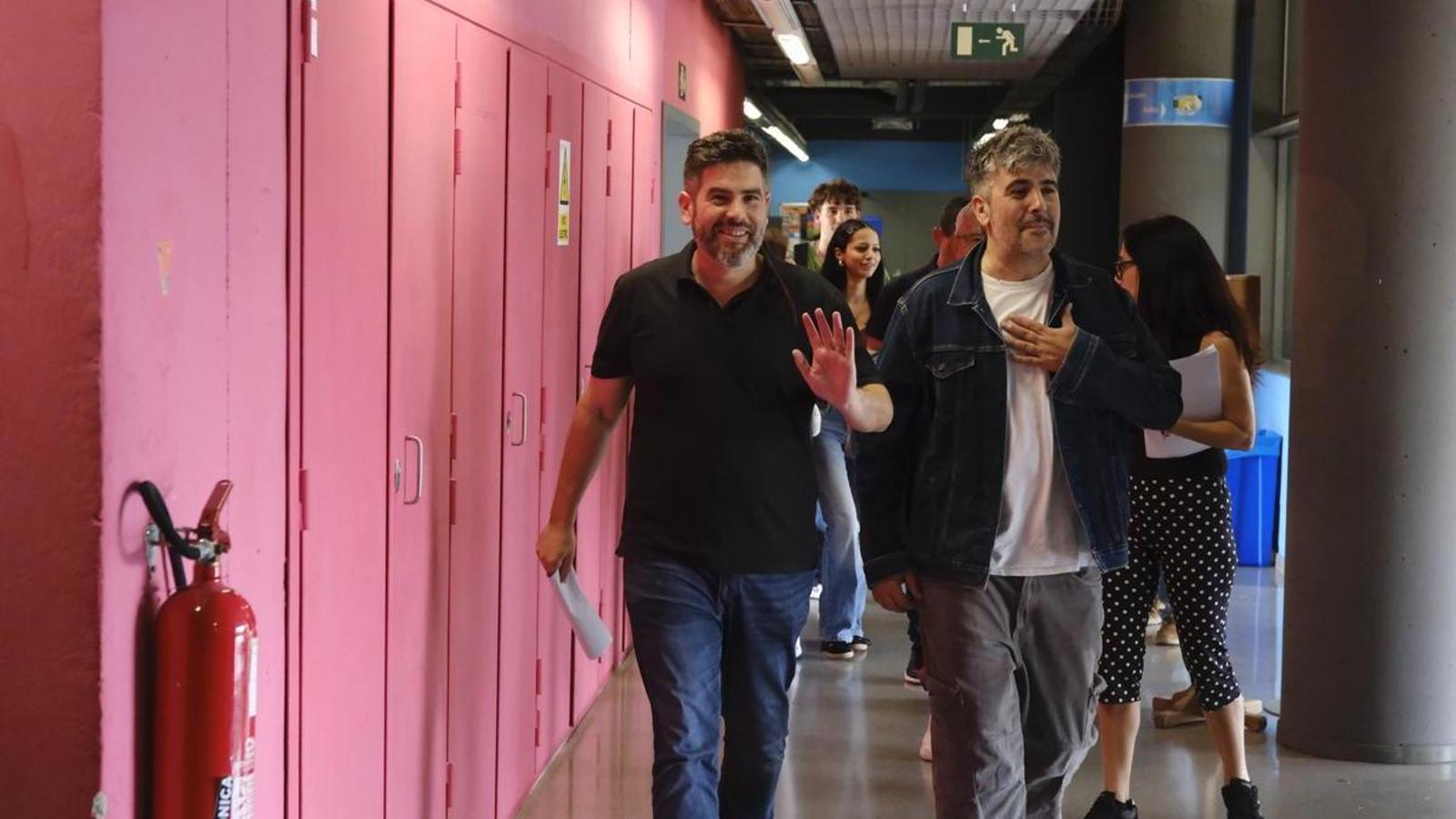
"It is a project that talks about our prehistory, when before being Estopa we were David and José", the Muñoz brothers explained this Tuesday at the Aula Magna of the Faculty of Geography and History of the University of Barcelona, where David is studying the second year of history. The project in question is a double album that recovers the thirty songs they recorded with two guitars and vocals in the years 1996 and 1997, before releasing their first album with Sony. It is what is known as La maketa and which until now circulated illegally on the internet. "These are recordings that were not registered; therefore, we were not paid. I regret being so materialistic", say the Muñoz brothers.
That repertoire will nourish the corresponding tour that in 2027 will pass through the Estadi Ciutat de València on June 12, the Estadi Olímpic Lluís Companys in Barcelona on June 18, the Estadi de la Cartuja in Seville on June 26, and the Riyadh Air Metropolitano in Madrid on July 9. Tickets for the concerts will go on sale on November 17 at 10:22 PM. There will also be a presale on October 18 for people who have pre-ordered the album. "We don't do presales for bank clients, but rather to reward the people who like our songs," say the two brothers, one starting the sentence and the other finishing it.
La maketa (Sony) will be released in different formats on November 20. "Yes, the album will come out on the fucking 20-N —the anniversary of the death of the dictator Franco—. I asked if there wasn't any other date, and Sony said no, that it could only be the 20-N," says David Muñoz, aware of the difficulties of doing a release like this in the middle of an election campaign, because the other possible date was Friday the 27th, two days before the Spanish elections. Before that, on October 16, the song Bicho raro will be available on platforms, "a matryoshka song" from which other Estopa songs emerged, such as Vino tinto and Tragicomedia, "a very good summary" of what Estopa is, as José Muñoz explains. "Thanks to songs like Bicho raro we are here –adds his brother–. We made it with six hands: me, who was 16 years old, and José, who was 14, and Antonio Abad, a childhood friend." Thirty years later, they have located this third author, with whom they had lost contact.
"La maketa is a first-rate historical source about Estopa," says David while looking at professor Manel García, who teaches the subject Thinking History, of which the older Muñoz was a student last school year. From that early era, José highlights El llanto del poeta, "a mixture of Maria Ostiz, Lluís Llach, and Rosa León," which was the first proper song they ever made.
The songs on La maketa are the ones they recorded "with the mini-stereo," with their parents acting as "microphone stands," but also those they produced in a studio in Sabadell. "They won't give us the Grammy for best sound," David jokes. "Mom is the type who throws everything away. In fact, I've run out of comics –recalls David–, but she found a tape that said 'David and José, 1997,' where the sound is a bit better, and she had the intuition to keep it." "Mom found the mother demo," says José.
From those thirty or so songs, Sony chose a dozen for the first album by the Muñoz brothers, Estopa (1999). "They were chosen by a gentleman with a mustache and glasses... with good judgment. In fact, the first album and the second, Destrangis (2001), were nourished by the demo tape", explains David. Other songs, however, did not have a place on subsequent albums and have remained unreleased. That is to say, a good part of Estopa's most iconic songs, those that occupy the most relevant space in concerts, were already in those recordings from the "Paleolithic", as David points out.

