"Can you imagine a mural by Miquel Barceló advertising Ametller Origen?"
Carlota Gurt offers a route of six micro-conferences about art and commerce in the Gothic Quarter of Barcelona

-
CAT -
CAST
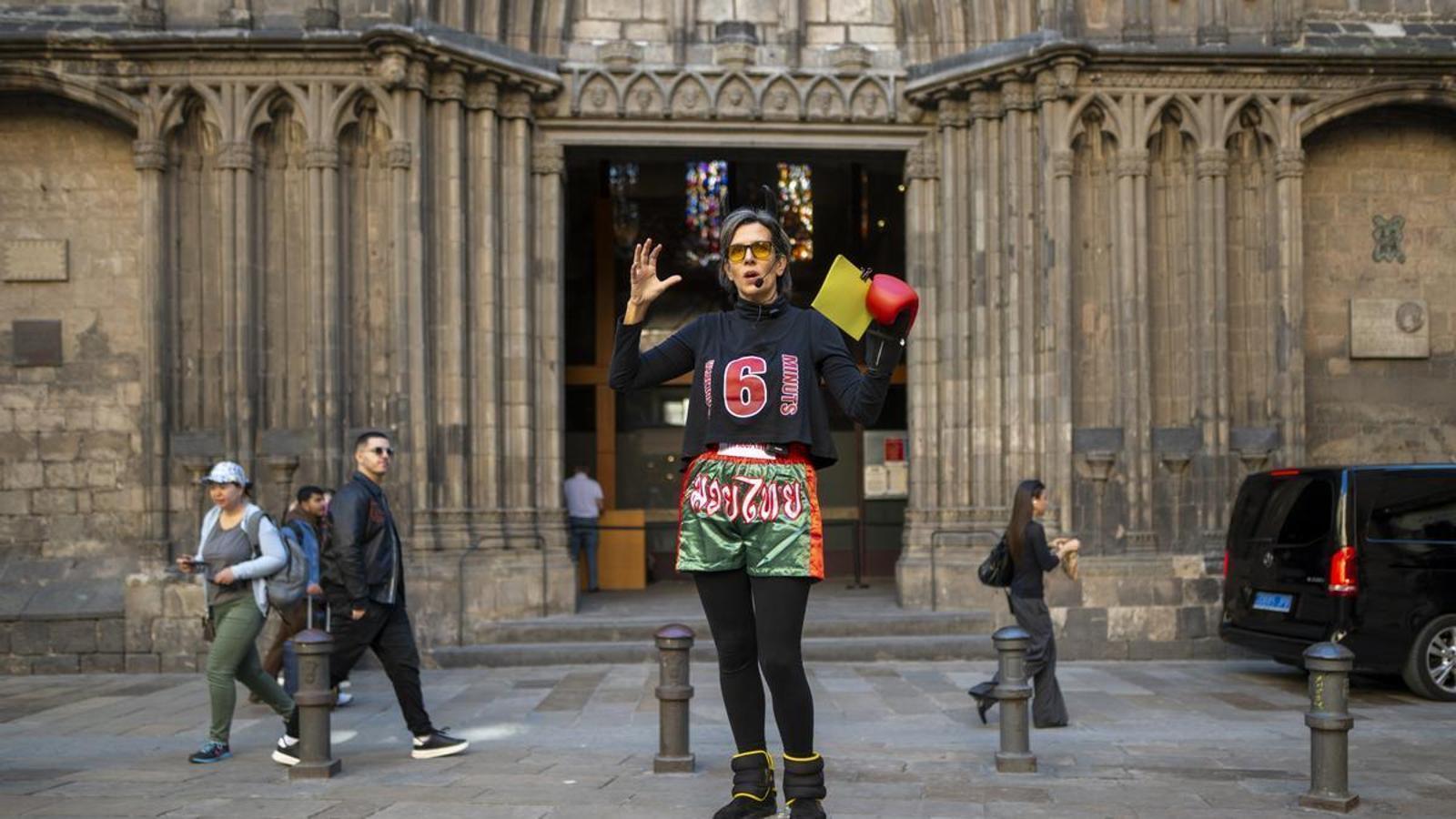
BarcelonaThe writer Carlota Gurt dressed as a little boxing devil standing firm on a stool. She rings a bell to stop tourists and passersby and explains that she will give 6 lectures of 6 minutes each at 6 points in the Gothic Quarter. "Is it a coincidence that it is the devil's number?". Obviously, no. Gurt puts her literary talent at the service of the bread-and-butter work she has to do, but also her critical capacity; it all goes in the same package. The route she will offer us this Wednesday is part of the Artistic Shop Windows cycle, a project promoted by the magazine Hänsel* and Gretel* to spread art through the shops (the decent shops that remain) in this ultra-touristed area.
She has titled it The Fallacy, which refers to an erroneous idea, because today she will dedicate herself to undoing the cliché that contrasts art and commerce. "Merchants are not cousins of Satan as they have wanted us to believe, from Balzac to Thomas Mann, from the Bible to Disney, and even Santiago Rusiñol. Neither are artists disinterested saints nor are merchants obtuse and insensitive people blinded by greed". In fact, shopkeepers have historically been discoverers, patrons, and allies of some of the best artists in history. That there are now those who sell thongs and penis magnets on Carrer Ferran is just a slip that history will not record (but the press will).
The first stop is at Sala Parés, on Carrer Petritxol, where a small bottleneck forms that is not for buying hot chocolate. Gurt explains to us, for example, that the first gallery in Spain promoted exhibitions of modernist poster art, a discipline that allowed personalities like Alexandre de Riquer (a professional mercenary, as a widower with nine children) to earn a living and that brought art to the street level. Without going any further, the contest to design the advertising for Anís del Mono was won by Ramon Casas and can still be seen on the facade of Colmado Múrria. "Can you imagine a mural by Miquel Barceló advertising Ametller Origen or Banksy on the shutter of the last haberdashery in Barcelona?".

A pair of municipal police officers follows the author's journey, and it is worthy of a sitcom, because I doubt whether they are protecting her or controlling her. It seems it is in case there are traffic problems. In the entourage comes the writer Melcior Comes, as well as the instigators of the act, Llucià Homs and Fèlix Riera, and the rest are spontaneous attendees. In Plaça Sant Felip Neri there are school children and in Plaça de la Cucurulla there are the perennial ice cream eaters. Here the devil takes the opportunity to highlight the special ugliness of this intersection given over "to the tastes of the tourism to which we submit ourselves abjectly," he says before pointing out the foul signage of every shop with the loudspeaker on, which makes me suffer. It is noticeable that Gurt has a monologue on tour because she has acting skills and memory, and she makes it pleasant and entertaining. I see a market for it, if they schedule it once a month.
Facts I didn't know. The cutlery shop in Plaça del Pi is on the ground floor of the old guild of resellers, that is, of the merchants, who paid for the baroque sgraffito on the facade, considered the oldest in the city, from the 18th century. 15th-century Flanders was key to creating an art market and emancipating artists from commissions and their financiers. And the best part: in 1878 Gaudí designed a display case for the Comella glove shop that even made it to the Paris Expo. There it won a prize and, above all, it attracted the attention of an astonished Eusebi Güell, and we assume that this is how the great genius was born... who today pours hordes of tourists onto Passeig de Gràcia. The effects of art are also unpredictable. That is why the tour ends at the Llibreria Sant Jordi, an architectural work of art converted into an irreducible cultural space in a lobotomized environment, and it does so with a conclusion from Carlota Gurt that explains the inseparable symbiosis between art and commerce: "If the merchants are the devil, the artists are Satan".
