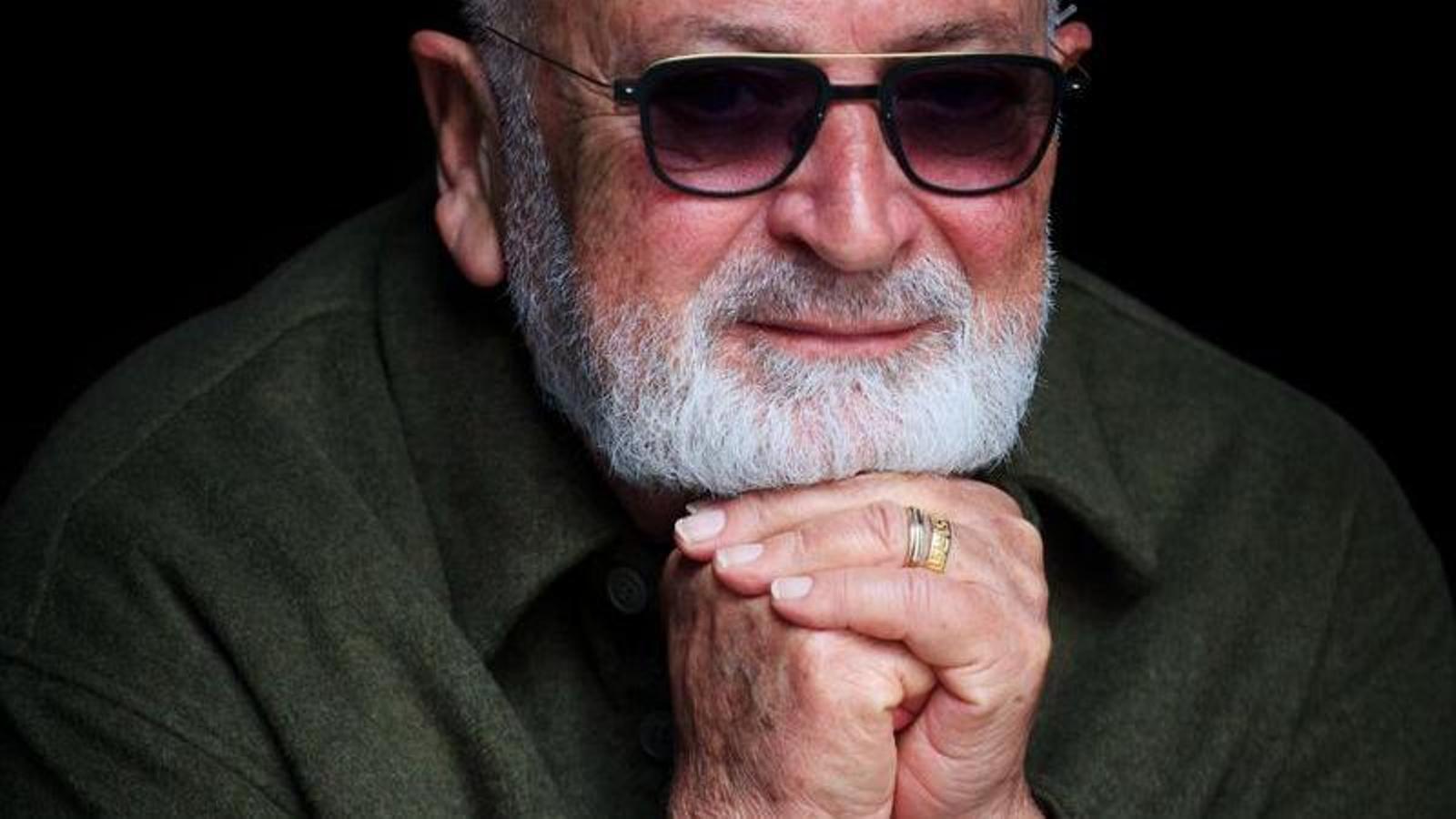
Biel Mesquida receives the Catalan Letters Honorary Award
The Mallorcan poet and storyteller culminates fifty years of a free and radical career

-
CAT -
CAST
BarcelonaThe absolute freedom and radical modernity of Biel Mesquida's (Castellón de la Plana, 1947) literature have earned him the 58th Catalan Letters Honorary Prize 2026, the highest recognition for the career of a Catalan writer, awarded by Òmnium Cultural. It is the definitive consecration of an author who has pursued overflowing beauty, experimented with language, fled from convention, and relentlessly scrutinized the abysses of his soul and our world. A Mallorcan born in the Valencian Community and published in Catalonia—and beloved everywhere—he thus culminates a fifty-year career as a poet, novelist, essayist, critic, and professor.
The jury recognizes his complex and diverse body of work, always written in Catalan; his role as an activist for the Catalan language and culture; and his dialogue with new generations and new technologies. "Biel Mesquida's works are baroque monuments that exude passion and bring Mesquida's lessons to their zenith: 'Good literature inspires reading and writing,'" the jury stated, considering him "a free, active author and defender of the values that make us passionate human beings in dark times." "He is an explorer of language, a passionate, turbulent, profound Catalan, deeply connected to life and the historical moment," said Xavier Antich, president of Òmnium Cultural, in the announcement made at the Nau Bostik in Barcelona. The presentation of the Honorary Prize, worth 20,000 euros, will take place on June 8 at the Palau de la Música.
"I'm not museum-worthy," Mesquida warns, faced with the praise. "I'm a living writer, I'm in the trenches of writing, in the daily and nightly struggle, more than ever in this time of war, of the Catalan language's emergency, of an overwhelming confusion that I imagined myself living in when I was old. I imagined myself reading and writing, surrounded by my great masters, building my work." It reminds him of the youthful struggles of the seventies, when he was a biology student and a worker at the Gran Enciclopèdia Catalana. In fact, he thanked all the friends from that time for the award, whom he remembered with nostalgia and whom he considers to have shaped him, from Baltasar Porcel to Jordi Cussà, including Joan Fuster, Joan Brossa, Pepa Llopis, Carlos Santos, Josep Palau, Fabià Puigserver, Maria Aurèlia Capmany, Borja Moll, Maria Àngels Anglada, Lluís Llach, Pau Riba, Montserrat Abelló, and Carme Sansa, among others.
Biel Mesquida admits he was "electrified by surprise" when he received the call from Xavier Antich at the end of February. "I was stunned, touched, and moved; my whole body vibrated with joy," he says, visibly moved. "Òmnium loved me. Òmnium loves me, I've emphasized that." That was a celebration and, above all, an incentive to fight, fight, and fight, in every trench.” The writer insisted that “we Catalans haven’t done the work for us; Francoism is still there, cloaked in false condescension, supporting those who would like a Catalan language and culture fragmented and ruined.”
“We writers are the Catalan language in its purest form. We are soldiers of the Catalan language in the pursuit of excellence,” he insisted, in a speech he had prepared, because he wanted it to be concise and serene, but it ended up being overwhelming and sparkling, like his recitals. For example: “No to wars, to genocides, to denationalizations, to illiteracy, to poverty and famines, to demoralization, to barbarism: no, we are not of that world!” "Thank you, Raimon." Or: "We must actively, modestly but effectively, campaign for enlightenment and against the obscurantism that necrocapitalist entities seek to maintain their privileges." He also called for the Catalan government to be "ambitious in its budget and act swiftly and urgently in this moment of emergency," given the "continuous attacks on the Catalan language," "the premeditated strangulation," and "the brutal misdeeds of the governments of the Balearic Islands and the Valencian Community."
A precocious writer
The son of Mallorcan teachers, Mesquida was literally born in a school, where his mother worked. An early reader in a home filled with books –Rodoreda, Ferrater, Foix, Costa y Llobera, Ausiàs March–, he often recalls that even from his school essays he never had "an easy reception –he admitted in an interview on the ARA“They criticized me for being blunt, too stark and critical. Even as a young man, I wasn't conventional.” Persecuted and mistreated by the police, in 1964 he left the “gray, dictatorial, and conservative” Mallorca to land in what he would consider his home, the University of Barcelona, where he studied biological sciences and information sciences, but above all, experienced his moment of political and cultural awakening, coming into contact with the early Tàpies and Maria del Mar Bonet. His interest in the Renaissance has led him to work with different entities, festivals, and collaborators over the years. His literature has also crossed all borders. The salt teenager (reissued in paperback in 2013), which won the Prudenci Bertrana, one bildungsroman which combines poetic perversion, symbolism, and a joyful homoerotic impulse, and which ended up being censored for two years. With a prologue by his friend and mentor Blai Bonet, it is still considered one of the most innovative books in contemporary Catalan literature, and, in fact, the jury for the Honorary Prize emphasizes that "it was revolutionary and opened Catalan literature to international currents." "Since its publication, it has opened the eyes, minds, and hearts of the freest possibilities of narratology," the jury continues. But from the beginning, Mesquida has dedicated himself to challenging any static considerations. In 1974 he published The beautiful country where men desire men, an erotic poetry collection of high sexual voltage and transgressive language that he distributed clandestinely in Barcelona in the 70s, and which was not published properly until 1985 (in the Pocket edition in 2012).

With body and soul
Mezquida has made constant breaking with tradition and linguistic ambition his trademark. As his friend Jordi Llovet saysHe writes "with body and soul." This has presented him with an extra challenge when it comes to publishing and reaching large audiences, but, in turn, it has earned him widespread critical acclaim and recognition from discerning readers. "I'm a niche writer, but, as Blai Bonet said, your twelve must follow you, and they have accompanied me; the reader gives me life," he affirms. His tenacity and stubbornness have done the rest. He has just published a book of poems with LaBreu. JunkA unique book of urgency against the "contamination" to which his land has been subjected. Among his poetry, which he considers the backbone of his literary production, titles such as [titles missing] stand out. How do you go from bird to air? (Ecafé Central-Eumo) and the book of books Carpe momentum (Eumo, 2021). "Aesthetic passion is an ethic and naturally it is a politics," he says.
The Mallorcan has contributed to broadening the limits of narrative with the baroque triptych ofExcelsior or the written time(Empúries, 1995; Ciutat de Barcelona prize and Catalan narrative critics' prize), the voluptuousness of Vertigo(Ediciones 62, 1999; City of Palma Prize and Valencian Country Critics' Prize) or the beauty of inner life of Llefre de ti (Club Editor, 2012). He has also extensively cultivated short fiction with The details of the world (Empúries, 2005: National Literature Prize), the stark altarpiece of Mallorca by I love you (Empúries, 2001) or We cornered (Empúries, 2008), the intimacy of Tremolo (Empúries, 2015) and the effervescent tales ofIncarnations(LaBreu, 2022); prose in the memorial walk of Steps through Palma(Vibop, 2023) and theatrical monologues in The messengers never arrive (El Gallo, 2012).
In recent years, Mesquida has been recognized with several awards and has freed himself from all reserve. "I've lost my fear and become a scoundrel," recognized the ARA"The only thing that makes someone a writer is having their own voice. I would like all my work to be a little piece of music I give to the reader," he acknowledges. A great advocate of reading, this Thursday he affirmed that he would only read, but "reading cannot make you lose the ability to write," which is why he writes daily, and has especially used the press to exercise his freedom and seek the feedback of the readers. He now has a text about "the civil war" in his hands. When he received the Lifetime Achievement Award in 2021 He launched his slogan, which he repeats today, now a mantra: "Love. And read, it makes us beautiful." He ends by reminding everyone that "Catalonia is not a nation: it is a piece of a nation" and closes his speech with a clear proclamation: "Long live the Catalan Countries! Long live the Catalan country! Long live the necessary independence to save the land, the language, and the culture."
