Barcelona created one of the first large hospitals in Europe 625 years ago: this was life inside
The creation of a large hospital in El Raval was possible thanks to an unusually rapid agreement
-
CAT -
CAST
BarcelonaIn the late 14th century, Barcelona had a network of care centers for the most disadvantaged, but they had become too small and inefficient. The black plague and crop-damaging plagues took a terrible toll: around 1340 the city had about 40,000 inhabitants, but by the mid-15th century the figure had fallen to 20,000; that is, it had lost 50% of its inhabitants in just one century. "More than an absolute degradation, the real problem was the lack of efficiency," explains Antoni Conejo, an art historian specializing in medieval architecture and hospitals. Faced with this, it was proposed to merge six of these small centers into a single institution: the Hospital de la Santa Creu. The first stone was laid on April 17, 1401, 625 years ago. The official foundation took place on September 5 of the same year with the authorization of Pope Benedict XIII. The great hospital was one of the first, if not the earliest, on the European continent to promote a merger of this type. The black plague and plagues that damaged crops caused real havoc: around 1340 the city had about 40,000 inhabitants, but by the mid-15th century the figure had fallen to 20,000; that is, it had lost 50% of its inhabitants in just one century. "More than an absolute degradation, the real problem was the lack of efficiency," explains Antoni Conejo, an art historian specializing in medieval architecture and hospitals. Faced with this, it was proposed to merge six of these small centers into a single institution: the Hospital de la Santa Creu. The first stone was laid on April 17, 1401, 625 years ago. The official foundation took place on September 5 of the same year with the authorization of Pope Benedict XIII. The great hospital was one of the first, if not the earliest, on the European continent to promote a merger of this type.
"The case of Barcelona is singular for the speed with which consensus was reached between the municipal power (the Council of One Hundred) and the ecclesiastical power (the bishop and the chapter of the cathedral). Subsequent experiences show that mergers of this type usually met with resistance and long debates for fear of losing control of these hospitals, but in Barcelona the pact was closed in just four months," says Conejo. For example, the Hospital d'en Pere Desvilar or de la Ciutat (founded in 1308) had a foundational clause that explicitly prohibited ecclesiastical management, which required a complex fit. This speed is explained, in part, by the excellent political relations between King Martin the Humane and Pope Benedict XIII (the king's wife, Maria de Luna, was related to the Pope), and by the fact that religious institutions saw in the union with the city a way to share expenses of centers that were already deficit and, at the same time, maintain a voice and vote. The management of the hospital center was formed by two citizens elected by the Council of One Hundred and two canons of the cathedral.
Destitute people of different nations and conditions
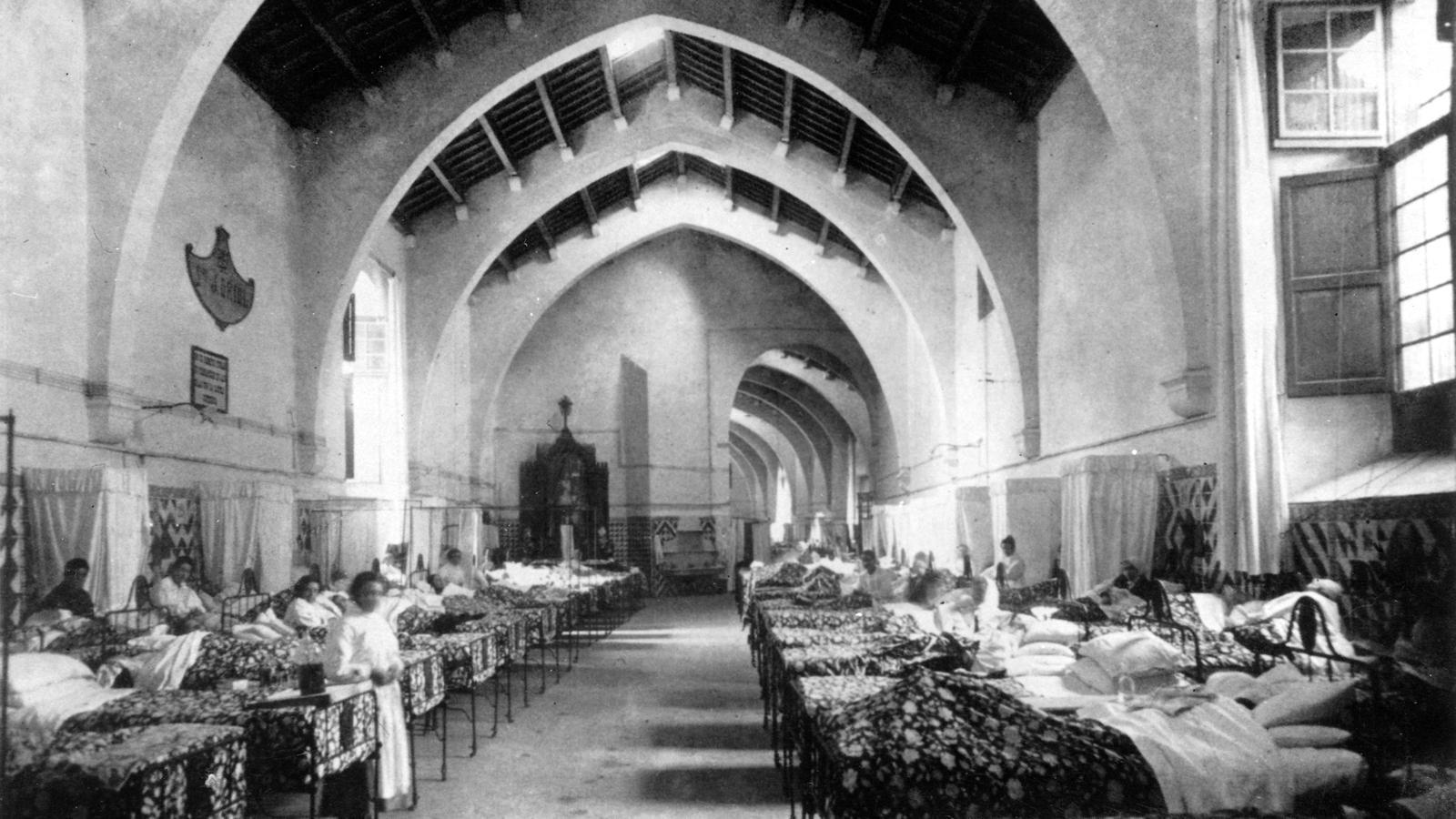
The ordinances of the Hospital de la Santa Creu approved in 1417 are quite explicit: "It had to welcome men or women: poor, crippled, lame, mad, injured (or wounded) or suffering from other various human miseries, abandoned children or other helpless people of various nations and conditions". In other words, it was the destination of the poorest. "The well-off classes had home medical care and did not set foot in the center," details Conejo. The institution understood care as an inseparable binomial: physical healing depended on medicine and food, but spiritual healing was considered equally fundamental. "In the medieval and modern eras, the essential purpose of the Santa Creu was to offer hospitality, welcoming people without resources. We should not understand it as a hospital where people went to be cured like today's," says Conejo. The staff that was part of the institution between 1430 and 1431 illustrates this quite well: there were 18 caregivers for the sick and children, 11 collectors of alms, 3 guardians, 4 chaplains and nuns, 5 cooks and bakers, 4 nurses, 5 notaries and 5 doctors. If in 1457 there were 367 inpatients, the vast majority men (345), between 1484 and 1492, the number was 1,917.
Caring for orphaned children
One of the great management challenges was the reception of orphaned and abandoned children (babies left at the hospital's doorstep). To alleviate the economic burden of their upbringing, the institution used "adoption contracts" to give them up for adoption. Families preferred boys because they could learn a trade and generate income, while girls tended to stay longer at the hospital. The institution followed up on these children after they were adopted. For example, the documentation includes the testimony of someone named Bernadó, who was adopted by a certain Jordi Miquel: "He is a good lad and thus lives and learns with Jordi Miquel, who is the master of the main school, and treats him like a son." These contracts were not definitive: the documentation shows that some families returned the children if they cried too much, did not eat, or were disruptive.
Over the centuries, the Hospital de la Santa Creu became a very powerful economic institution. "In addition to inheriting the properties of the six previous hospitals, it expanded its assets through private donations and inheritances from patients who died at the center, whose assets automatically passed to the hospital if they had not made a will," highlights Conejo. In this way, rigorously reflected in the patient records between the 15th and 19th centuries, the institution accumulated a considerable amount of movable and immovable property.
The construction of the building followed a common pattern of Catalan Gothic: vast halls articulated with pointed diaphragm arches and a wooden roof. "Locating it in the Raval responded to sanitary criteria, to move patients away from the center to prevent contagion, and to economic reasons, as it was an area of pastures outside the walls with more affordable plots of land," explains Conejo. The building definitively shaped the urbanism of the neighborhood (the triangle between La Rambla and Carme and Hospital streets) and became a landmark on the medieval diagonal of the city. The complex also housed its own moat or cemetery, located next to it. In fact, many interments have recently been found in the current Plaça de la Gardunya.
Shouts and chained patients
The charity-based care model changed radically between the late 18th and early 19th centuries, with the advent of the modern clinic, which gave hospitals an essentially sanitary function. By the end of the 19th century, the old Raval building had become completely obsolete and overcrowded. A hygiene and health report from 1848 already warned of the terrible conditions, especially regarding mental health. The patients were tied up with chains and their screams could be heard from the street in a Raval that had already been completely urbanized. This unhealthiness and overcrowding were not exclusive to the hospital, but to the entire industrial city enclosed within the walls, which led to the approval of the Cerdà Plan in 1860. This urban transformation sought to combat the extremely high mortality rates and epidemics through the construction of the Eixample.
The construction of the new hospital site outside the walls was made possible thanks to Pau Gil, a Catalan banker born into a family involved in finance. In his will, he stipulated that a part of his great fortune (specifically 3.06 million pesetas) should be allocated to the construction of a new hospital in Barcelona to replace the obsolete Santa Creu. Gil left clear instructions: the center had to respond to the principles of hygienism, incorporate the most advanced innovations, and bear the name of its patron saint, Sant Pau. His executors commissioned the project to Lluís Domènech i Montaner.
Domènech i Montaner designed a complex with a capacity for 1,000 patients, taking as a reference leading hospitals in the world, such as Johns Hopkins in Baltimore and Lariboisière in Paris, in addition to his own work at the Pere Mata Institute in Reus. The project was built on land north of Barcelona, outside the limits of the Eixample, articulating a true "garden city". The pavilions were independent, oriented from west to east to ensure sunlight, surrounded by nature, and connected by underground galleries. The area was divided into four quadrants to separate patients (north for infectious, south for non-infectious, east for men, and west for women), with the central pavilion (convent, kitchen, and pharmacy) in the middle of the intersection. On January 16, 1930, 28 years after the start of construction, King Alfonso XIII officially inaugurated the Hospital de la Santa Creu i Sant Pau.
With the center already fully operational, the 20th century brought a major transformation in the hospital's internal management thanks to Adela Simón. Trained at the School of Nursing of the Generalitat, Simón had to go into exile in England when Francoism invalidated her degree. There she enrolled at the Nightingale professional school. In 1958 Simón returned to Spain and subsequently joined the Hospital de Sant Pau. Under her leadership, the center moved from a traditional charitable care model to a model based on professionalism, technique, and autonomy in nursing management. With this contribution, she became directly responsible for introducing modern medicine's nursing practices throughout the State.
A privilege only shared with Bruges
The Domènech i Montaner modernist complex successfully fulfilled its sanitary function until 2007. In 2009, medical activity was moved to new, contemporary facilities. Then began the rehabilitation of the modernist complex, which today houses international institutions and is visitable, in addition to being part of the UNESCO World Heritage list since 1997.
"The medieval complex of the Raval has suffered a certain oblivion regarding its historical memory, as citizens tend to identify the space exclusively with the Library of Catalonia, forgetting its five centuries of hospital past – laments Conejo–. This historical value is immense: in fact, only the city of Bruges (Belgium) shares with Barcelona the privilege of preserving its triple hospital timeline intact: an original medieval hospital, a 19th century/modernist equivalent, and a large contemporary center". The historian, however, celebrates that a project has recently been approved in the Raval that will allow to rehabilitate and expand the spaces of the Library of Catalonia and the future District Library, as well as the rehabilitation of the theater and the chapel.

