Why do football clubs fall in love with La Garrotxa?
The quality of the natural grass and the tranquility of the surroundings have made the region a usual destination for professional teams
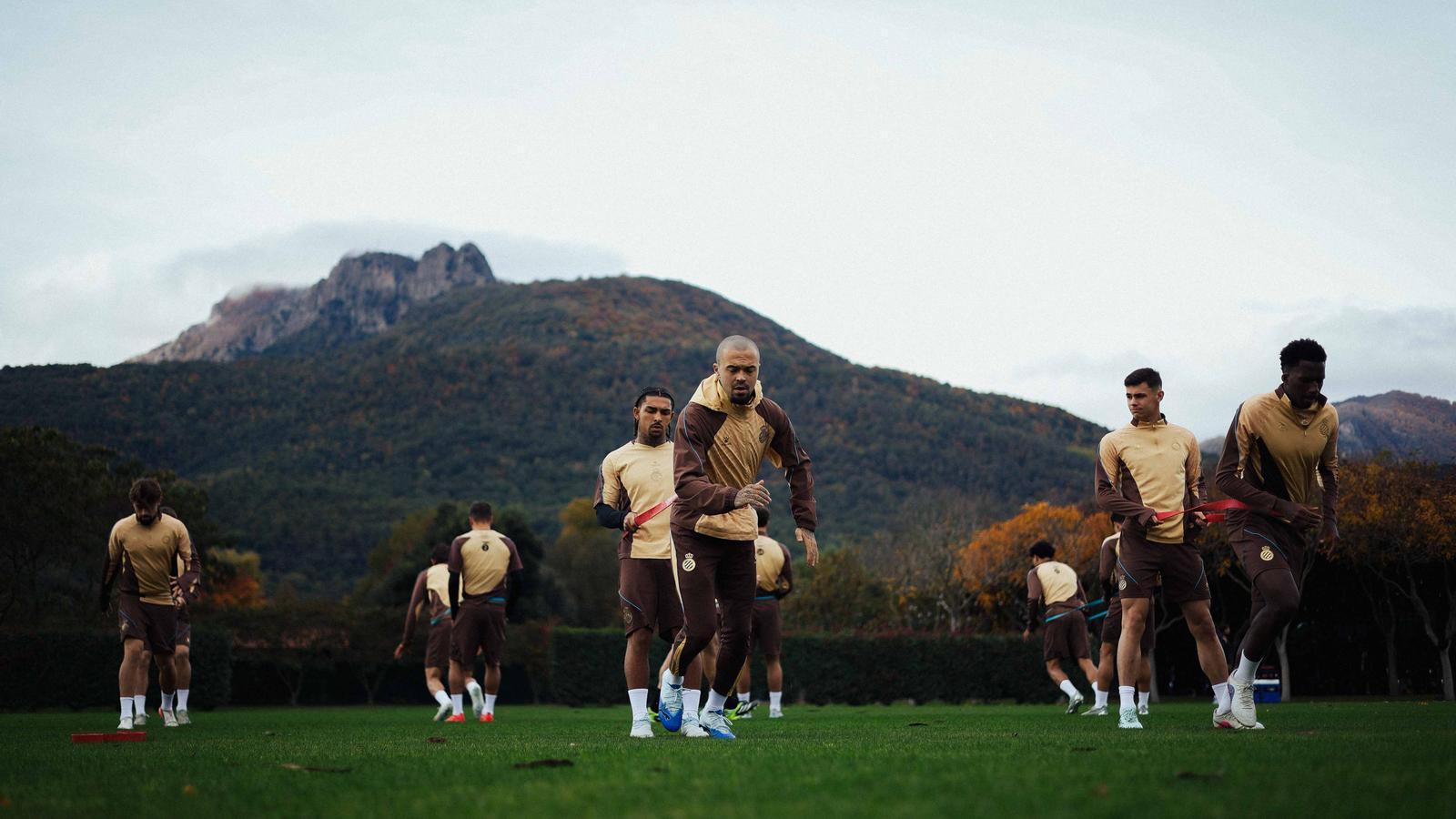

The Vall d'en BasRight in the middle of the Garrotxa volcanic zone, halfway between Les Preses and El Mallol, with Puigsacalm in the background, robins and titmice chirping, and a carpet of autumn leaves on the grass, Eder Sarabia tries to implement his football philosophy at Espanyol. For five days, the 'periquitos' have traded the noise of the city for the tranquility of the Vall d'en Bas with the goal of connecting with their new coach.
The secret of La Garrotxa is in the grass
“There are no distractions here. It is an idyllic place, designed to focus on football,” explains Jordi Morera, international director of Royal Verd, which these days hosts the blue-and-whites at Mas Brides, a training center with several natural grass pitches, a scarce commodity in Catalonia, and a well-equipped gym. With almost 25 years of history, this family business of international renown is in charge of the installation and maintenance of the turf at nearly 40% of the League's stadiums, among which is Cornellà-El Prat.
Since Mas Brides opened its doors in 2018, dozens of professional teams –“the Iraq national team and Valencia came recently”, says Morera– have passed through its facilities. The first was Rubi's Espanyol; Sarabia's Andorra also held a stage, in 2024. “My father was a visionary. He visited several complexes of this type to get inspired. He wanted to build a brand and replicate it back home,” reveals the international director of the company that has turned La Garrotxa, a region of only 60,000 inhabitants, into a first-rate football destination.
The envy of modest Catalan football
Other local entities have also contributed, as is the case with Olot. Their stadium, the envy of modest Catalan football, served as a test bed for Royal Verd, which is a sponsor of the club. “It is increasingly atypical to find natural grass pitches; especially in summer and during international breaks we have many requests. They are usually teams that train at Les Brides and want to play a match at the stadium,” explains Jordi Sargatal, director of operations at Olot.
“We try to lend it out because we understand that it is an asset for the club and the city, but sometimes we have to say no. The grass is very delicate,” adds the man in charge of looking after the health of the surface of the Olot municipal stadium, where Barça, Girona, or Espanyol have passed through. “Recently Southampton and Montpellier came, and also Arab clubs. The Girona-Liverpool Youth League match was played here because Liverpool wanted natural grass,” he adds.

In addition to Olot's, Royal Verd is also responsible for the Bosc de Tosca pitch. In the summer, the modest facilities of this club from Les Preses received a visit from the best team in Africa, Al-Ahly. Before playing the Gamper at Camp Nou, the Egyptians played two friendly matches against Badalona and Europa in La Garrotxa. “The pitch was a carpet. It surprised us a lot, considering it was the pitch of a Primera Catalana team,” say those from the Badalona side.
A football oasis within everyone's reach
Below the Primera Catalana, there is also competition on natural grass in La Garrotxa, a paradise for groundhoppers and amateur footballers, who feel as if they were playing in the meadows of the Scottish Highlands. Sant Privat d’en Bas, Argelaguer, Santa Pau, or Sant Feliu de Pallerols do not reach 2,000 inhabitants, but they all have natural grass pitches. They are picture-perfect. “In this region, we are special and, in that sense, we have a touch of romanticism,” summarizes Sargatal. The climate and the low population density work in its favor, but climate change and the proliferation of grassroots football threaten this uniqueness.
“We play on natural grass because we only have one first team. There is only a match once every 15 days,” says Martí Duran, the president of Joanetes, a team from a municipality of about 150 inhabitants that competes in Group 3 of Quarta Catalana, the last regional category. “When I was playing, the vast majority of pitches were dirt. We were among the first to install natural grass. It was in 1995,” calculates Duran, who is a lifelong resident of Joanetes, “a small village tucked away in a valley” renowned for its living nativity scene.
“The grass is mowed by the City Council; we are in charge of taking care of it. You have to be careful, especially when it rains a lot. If you play on it when it is very soft, you can destroy it,” comments Duran, who often receives indecent proposals. “People from outside really like the pitch because it is in the middle of nowhere, with the mountains in the background. Sometimes people from Barcelona have come, and we have rented it out to them so they could play a match. We are privileged,” concludes Duran with pride, the caretaker of one of the natural grass pitches that remains in La Garrotxa, the region that makes football clubs fall in love.

