Bound4blue, the force of the wind in maritime transport
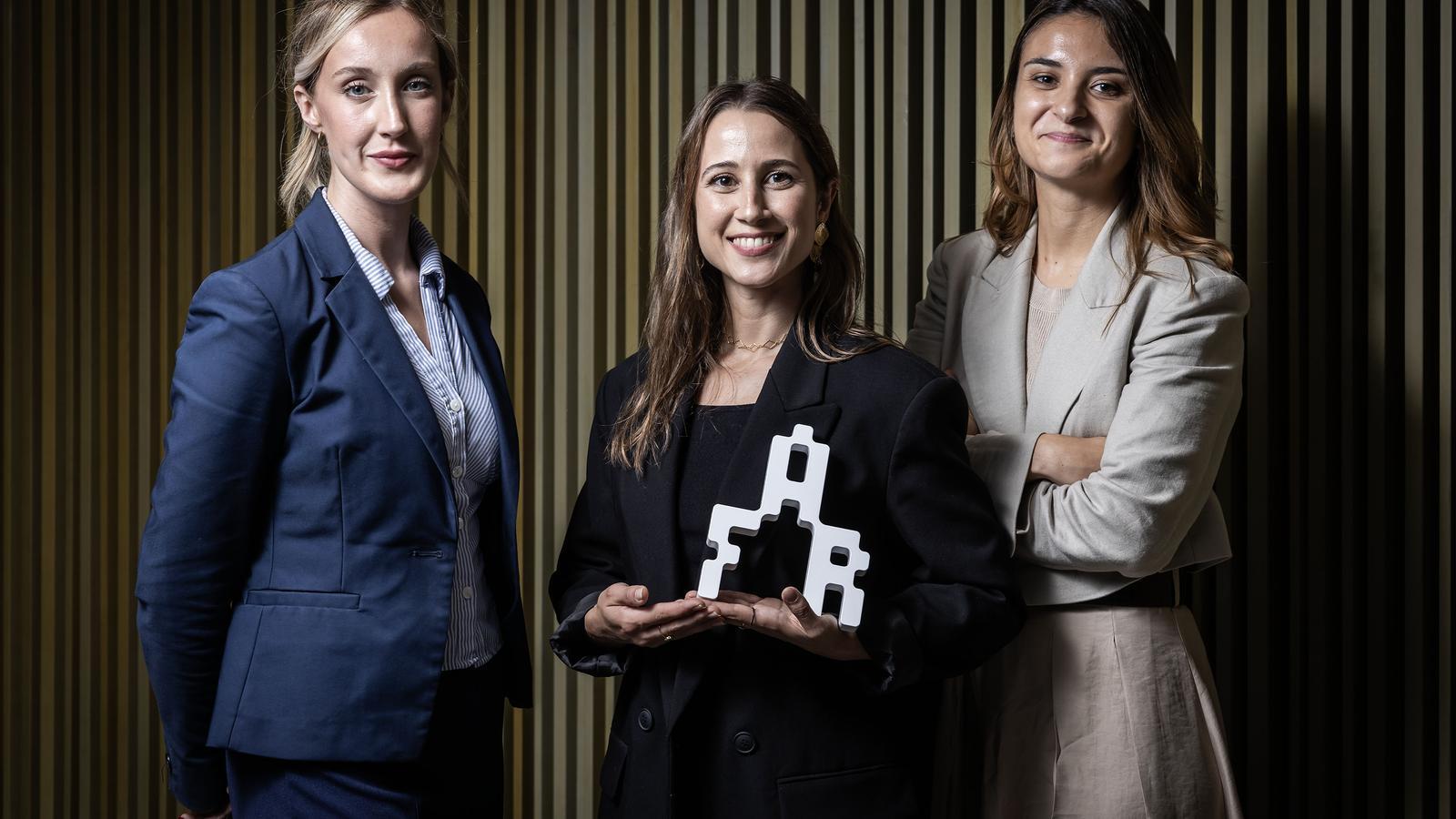
Bound4blue receives the Environment Award of the FAR Awards for contributing to the decarbonization of maritime transport with rigid suction sails
-
CAT -
CAST
The history of sailing spans thousands of years. From primitive boats to exploration ships and those used for modern sport or recreation to which this practice has currently been relegated. In the Age of Discovery, explorers, conquerors, navigators, and cartographers set out to sea on voyages to the ends of the world to explore maritime routes, conquer new lands, or conduct hydrographic studies driven by the force of the wind, and it is this principle that the Catalan technology company Bound4blue, winner of the Environment Award at the FAR Awards, has recovered to respond to one of the great current challenges of maritime transport: reducing fuel consumption and polluting emissions.
Behind Bound4blue are José Miguel Bermúdez, Cristina Aleixendri, and David Ferrer, three aeronautical engineers who decided to apply their knowledge of aerodynamics and propulsion to a sector, maritime navigation, apparently far from their specialty. The company was established in 2014 and, after years of developing the idea, it recovered the invention that in the 80s the famous oceanographer Jacques-Yves Cousteau dubbed the Turbosail.
Commander Cousteau
In 1985, the Alcyone, the famous oceanographic ship of Commander Cousteau that replaced the mythical Calypso, tested a system of rigid cylindrical sails that harnessed the force of the wind. The device never achieved commercial success, but it did demonstrate that it was effective. Now Bound4blue has recovered it four decades later, and has perfected that aerodynamic principle.
Bertrand Charrier, one of the scientists who participated in the development of the original system with Cousteau, joined the Catalan project in 2021. His incorporation allowed the Catalan company to directly leverage the knowledge of one of the creators of the original technology.
The return to maritime transport of sails, one of the oldest technologies in navigation, posed then, and also now, the possibility of solving one of the great environmental challenges of the 21st century: the decarbonization of an industry essential for global trade. Recovering the same rigid sails that Cousteau built for the Alcyone, Bound4blue now proposes a more efficient aerodynamic design and an automatic control system that adapts these tower-shaped sails to wind conditions. The result is a technology that has moved from experimental vessels to large commercial ships and that allows for the reduction of fuel consumption and polluting emissions.
Rigid steel sails
Bound4blue's rigid sails, known as eSAIL, take the form of vertical wings similar to those of an airplane that, through an air suction system, generate an aerodynamic force that helps propel the vessel. Ranging in height from 12 to 36 meters, depending on the model, they are made of steel and designed to withstand extreme maritime conditions. They integrate electric fans and a porous area that sucks in air to improve aerodynamics, and use special materials such as technical plastics in the shafts, bearings, and gears to prevent corrosion from saltwater without the need to lubricate them with oils.
The system operates automatically and adjusts its position according to wind conditions. It does not require the crew to maneuver the sails, and most interestingly, it is not necessary to replace the ships' engines. The technology can be incorporated into existing vessels, from oil tankers to cargo ships, ferries, or cruise ships, and it has already been adopted by major shipping companies such as Maersk, Airbus, and other international operators.
With its commitment, Bound4blue demonstrates that visionary ideas can end up becoming reality. Jacques-Yves Cousteau proved that it was possible to harness the power of the wind in an innovative way, and Bound4blue has turned that intuition into a commercial solution capable of contributing to transforming maritime transport and making it more sustainable.
-
Sector
Maritime technology, renewable energy and naval transport decarbonization.
-
Headquarters
Sant Cugat del Vallès (Barcelona) and Santa Cruz de Bezana (Cantabria), with offices also in Singapore and China.
-
Who is behind it
José Miguel Bermúdez, Cristina Aleixendri and David Ferrer, co-founders of the company and graduates of the School of Industrial, Aerospace and Audiovisual Engineering of Terrassa (ESEIAAT) at the UPC.
-
Purpose
To reduce fuel consumption, pollutant emissions and maritime transport costs by harnessing wind energy.
-
FAR Award
Environment
