The city that can still grow: Barcelona's future neighborhoods
The Catalan capital has several urban transformations underway that will allow it to accommodate more than 60,000 residents.


-
CAT -
CAST
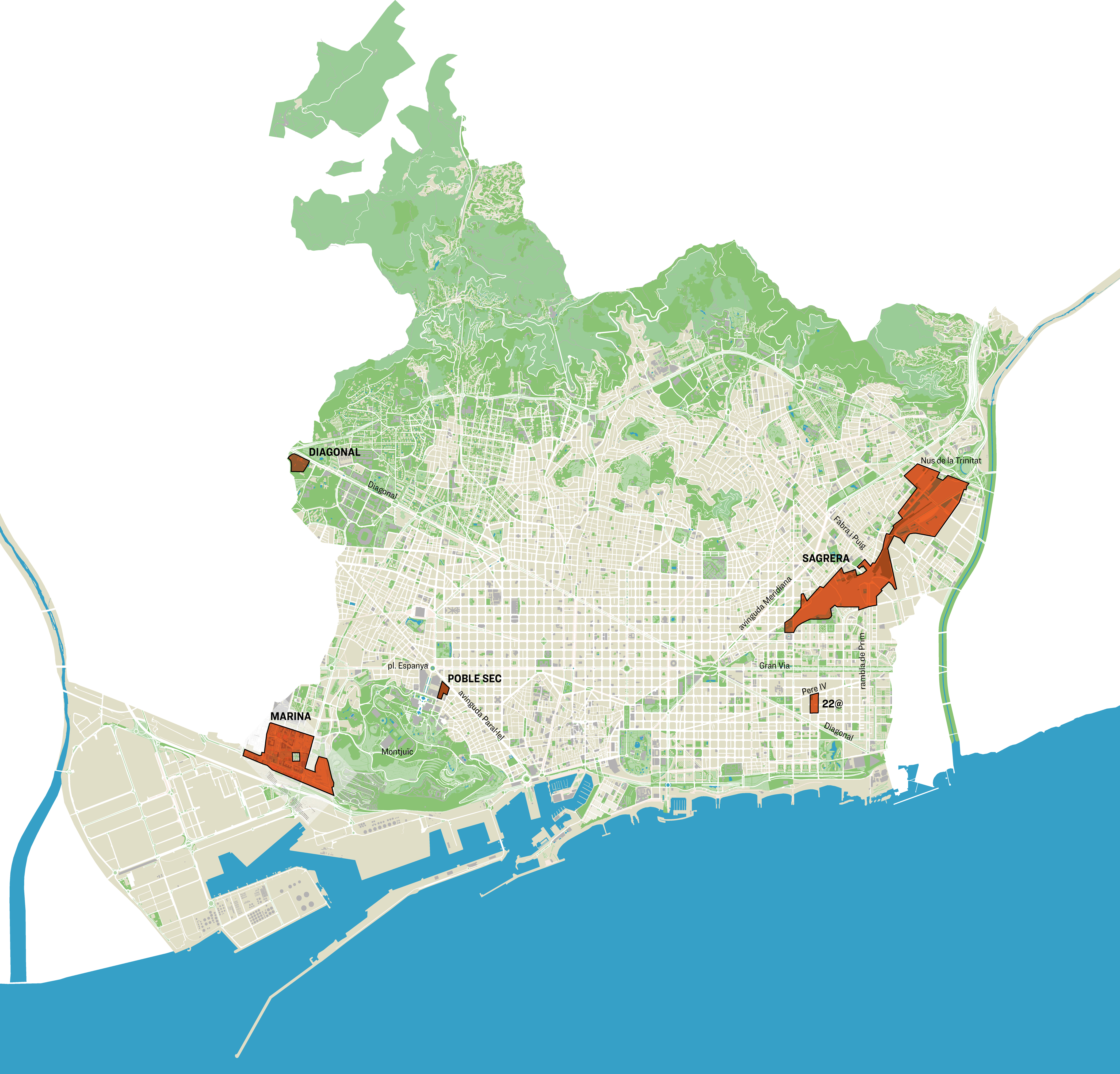
BarcelonaOn Thursday, Barcelona City Council announced the new timetable for the creation of a new mini-neighborhood With over 500 homes and new facilities next to Poble-sec, on land currently occupied by the Montjuïc Fairgrounds, this is an example of how the Catalan capital still has room to grow. And yet, viewed from a bird's-eye view—or plotted on a map—it seems difficult. Limited as it is by Collserola, the sea, the Besòs River, and Hospitalet de Llobregat, the Catalan capital cannot expand its boundaries. This forces it to exercise imagination every time it wants to find space, a recurring need given the profound housing crisis it faces. And yet, the city has projects underway to build new neighborhoods that, in total, will add more than 25,000 homes, with capacity for over 60,000 new residents.
Urban planners have long been trying to identify currently underutilized spaces that can be given new life. The city's chief architect, Maria Buhigas, often summarizes this graphically. Using a domestic metaphor, he invites us to think about our own homes: "We can hardly expand them, but one day someone arrives and that space that had always been a studio becomes a bedroom." Something similar happens in established cities like Barcelona. The difference is that, in this case, the studio that is transformed into a bedroom is usually located in industrial areas within the urban fabric or the result of new infrastructure construction that reconfigures the land.

- If you want to explore the map in more detail, openthe high-resolution versionin another tab.
This is the case with some of the major transformations the city is currently undertaking. Examples include the repurposing of former industrial land that has lost its vitality, the metamorphosis of the Marina del Prat Vermell—now with over 2,000 new residents and buildings under advanced construction to accommodate more—and the future Mercedes eco-district in Bon Pastor. Regarding urban transformations driven by major infrastructure projects, the Sagrera stands out, with several new housing developments along the more than 4 kilometers of the city that will undergo a complete transformation. And, although still in its very early stages, there are the potential developments around the upper part of the Diagonal, taking advantage of the relocation of the Hospital Clínic.
La Sagrera
13,500 new homes to heal a scar

When La Sagrera is discussed, attention is usually focused on the impact this mega-station will have on rail connections and mobility in Barcelona. But one of the city's major urban transformations is also taking place around it. Covering the railway tracks is intended to heal one of the scars of the Catalan capital and pave the way for a project that—in total—will add more than 13,500 homes—43% of them subsidized—accommodating 30,000 new residents and helping to reconnect the districts of Sant Martí and Sant Andreu. The transformation is divided into different areas, stretching from the Bac de Roda bridge to La Maquinista, following the route of the railway lines. The entire area, which will connect to a large linear park 4 kilometers long, is dotted with plans that, in many cases, also involve housing construction. Among them is the upper part of Rambla Prim, where the City Council plans to begin construction of 3,360 homes – 2,089 of them public housing – starting in 2029. In this area alone, which will include 21,656 square meters of facilities such as a kindergarten and a children's center, approximately 8,800 new residents are expected in the coming years. Other key areas of the transformation include the vicinity of the future La Sagrera station – with 2,230 new homes; the area of the former Sant Andreu Barracks, where construction has already begun and where 2,020 apartments are planned (60% of them subsidized housing); and the La Maquinista and Colorantes areas – with more than 1,000 homes planned in each. Not far from this area, another of Barcelona's planned transformations is underway. This is the new Mercedes eco-district in Bon Pastor, where 1,500 new homes are planned, 40% of which will be affordable.
La Marina del Prat Rojo
A metamorphosis equivalent to 72 blocks of the Eixample

When discussing Barcelona's growth, it's impossible not to mention Marina del Prat Vermell. This impressive 75-hectare space is the equivalent of 72 city blocks in the Eixample district, relocated to the foothills of Montjuïc. The project, which began in 2006, is the most advanced of the five areas analyzed in this article. Today, it's already possible to stroll among some of the new buildings that have been erected, housing some of the 28,000 new residents expected in the area. The development will eventually include 11,500 new homes—half of them subsidized—as well as 11.15 hectares of amenities, such as a park and market, and 13.5 hectares of green spaces.
As with the Hospital Clínic, the extension of the metro – in this case Line 2, which will have to tunnel through Montjuïc mountain to reach the Port from the city center – must be key to the development of an area that already has the Fira trade fair grounds and the Generalitat's administrative district, so it can cease to be a neglected playground.
MONTJUÏC
A mini-neighborhood taking advantage of the transformation of the Fira

The transformation of the Montjuïc Fairgrounds is another opportunity that the Catalan capital has seized to expand its housing and infrastructure. On Thursday, Barcelona City Council announced plans to begin construction in 2029 on the new mini-neighborhood next to Poble-sec, with the goal of completion by 2033. The project will include 500 affordable homes and 48 subsidized housing units, as well as new facilities such as the Italian Pavilion. The Espai Bombers (Fire Station) and the playground of the Mossèn Jacint Verdaguer School will also be expanded. The redevelopment of the area—which will create a pedestrian walkway between Lleida Street and Mexico Street, passing through a pedestrianized Maria Cristina Avenue—should help eliminate the barrier currently created by the Fairgrounds between Poble-Sec and Font de la Guatlla.
Puerta Diagonal
The opportunity of the relocation of the Clínic

Among Barcelona's various growth areas, Porta Diagonal is the one in its most embryonic stage. But the relocation of the Hospital Clínic to the top of the Diagonal is one of the most important urban transformations underway in the Catalan capital and its metropolitan area. Beyond the new hospital, the project should serve to redefine an area currently shaped by major road infrastructure.
Tal How did the ARA advance?The document outlining criteria for defining an urban strategy for this area, prepared by Barcelona Regional—and which is the embryo of the Master Plan already under development—proposes dismantling the complex road network that currently connects the B-23 with the Ronda de Dalt ring road. These visible road junctions could, similar to the approach taken with the Gran Via in Glòries, be resolved with tunnels that would allow for a rapid connection between the B-23 and the Ronda de Dalt, both for entering and leaving Barcelona. This undergrounding would free up 60,000 m² of developable land between Barcelona, Esplugues, and Hospitalet de Llobregat. This would represent a significant plot of land, and the portion corresponding to the Catalan capital is seen as an opportunity to accommodate a substantial number of homes near the new university campus. This, together with the design of a more pedestrian-friendly final section of the Diagonal and Ronda de Dalt, the extension of metro line 3, and the promotion of a public space that reconnects three previously divided cities, should transform the area into one of the new neighborhoods of Barcelona's future.
The 22@ North
More housing in the city's technology district
The northern part of the 22@ district is also undergoing a major transformation, with the urban improvement plan for the area between Pere IV, Selva de Mar, Venezuela, and Provençals streets already approved. This plan will allow for the construction of 238 subsidized housing units: 119 for rent and 119 for sale.