Taking refuge at the Placa Catalunya encampment: "How are you supposed to sleep peacefully on the street?"
The protesters who have been occupying the center of Barcelona for a month are finalizing preparations at the gates of the general strike

-
CAT -
CAST
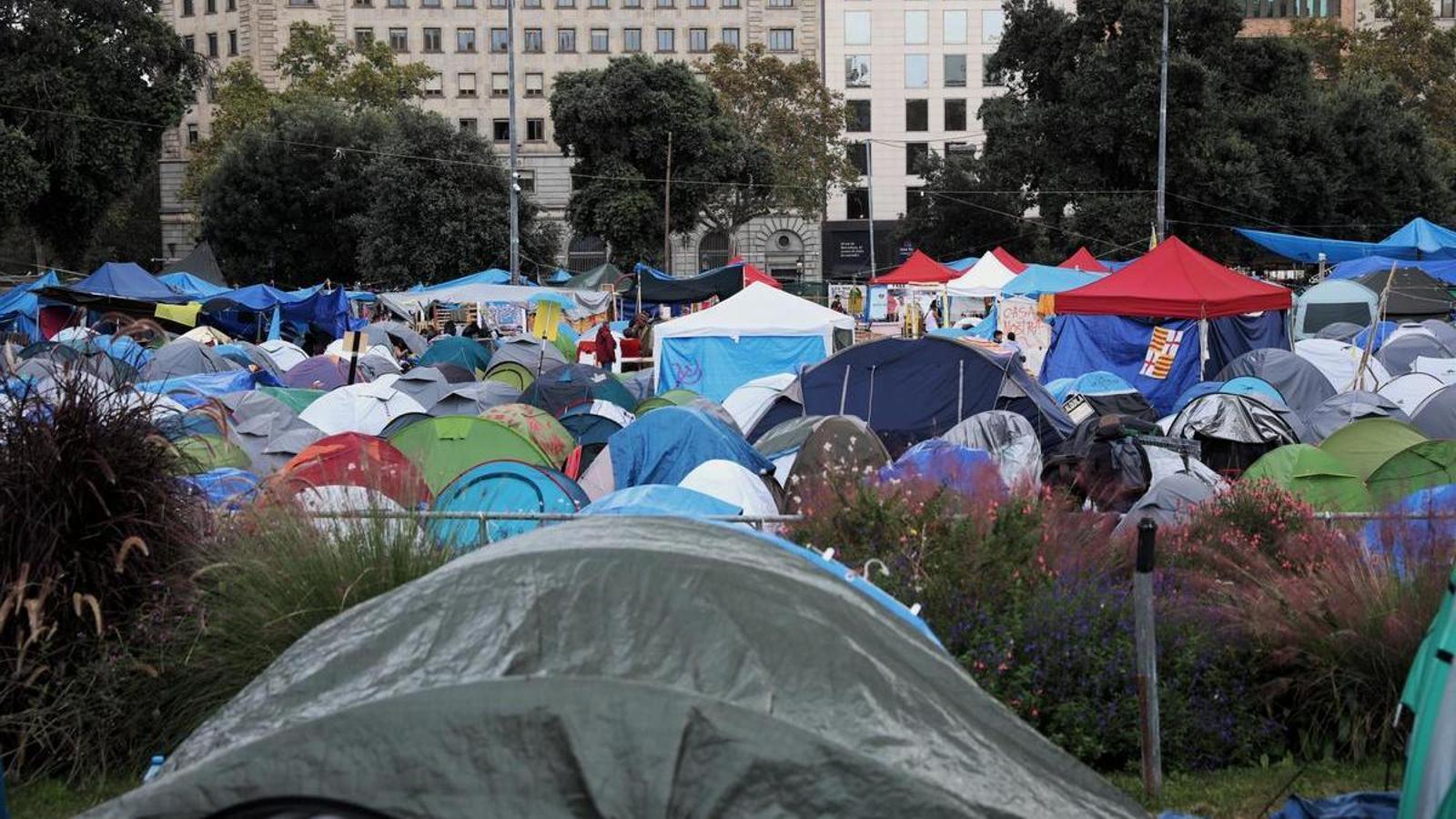
BarcelonaThe assembly at the Plaça Catalunya encampment starts late. It has rained and they are moving benches and chairs to the gates of the camp so that everyone can fit. Some people are reuniting after days without seeing each other and they hug; they no longer sleep at the encampment, but they have come to this afternoon's meeting anyway. They explain to ARA that there are fewer of them than a month ago, when the protest for the right to housing occupied the city center, but that now they are better organized and everyone knows each other. As people arrive, they form a circle around a bonfire burning inside a trash can. Among them are Sfaw and Juan, who have been at the encampment since the first week. Both were sleeping on the street, they came because they felt safer here and now they are asking for an alternative so they do not have to return there, given the risk that the square will be evicted once the general strike this Wednesday ends.
"On the street they rob you, they take your tent, how are you supposed to sleep peacefully?", asks Sfaw. He is 32 years old, he is Sahrawi and worked as a taxi driver, but he could not afford the rent, they kicked him out of his house and, as a result, he lost his job. "You have to take care of your image, and sleeping on the street I couldn't," he explains. He has now been sleeping in the open for almost a year, which is why when he found out that they had occupied the center he did not hesitate to come. The alternative is "dangerous and complicated," he insists. In this last month, he has met Juan, 39, who is a lifelong resident of Barcelona. He was born in Clot, but had to leave the neighborhood because he could not pay the rent and moved to La Pau, where the prices were more affordable.
"It didn't last long, because a few months ago they evicted me and since then I have been sleeping on the street," says Juan. Both of them are calling for a solution that would allow them to pay for a room in the city and, as long as it is possible, they assure that they will continue sleeping at the camp because they feel safer there. From afar, they observe how the assembly is taking shape: there are already about fifty people in a circle ready to begin the first order of the day. Sources from the camp organization explain that, although there are now fewer people than at the beginning, they are better organized, and while it is true that some people have left, others are returning. There are also people who go home to sleep every day and the next day continue with the tasks from the day before. However, there is a portion of the campers, like Sfaw and Juan, who, beyond the protest, have no alternative place to go and whose perspective is to remain in the city center.
"We are not a blockade"
At this evening's assembly there are two items on the agenda. The second one is precisely some workshops on homelessness for all participants, but beforehand, the preparations for Wednesday's general strike are detailed. "The campsite must be an exemplary place. Plaça Catalunya will be the nerve center of peace and tranquility; everyone must be able to take refuge here if they wish," exclaims Lluna, who is the one leading this assembly and who reads the first item on the agenda with the help of a megaphone. She explains that there will be paella with chicken and vegan rice for everyone who wants it, courtesy of the NGO Xama. Those camping there will be able to eat for free, and those coming from outside will have food and drink for three euros. "Remember, no act of vandalism without a political message. We are not a blockade," continues Lluna, who insists that they will welcome everyone who comes to spend the day in Barcelona to participate in the afternoon demonstration.
Once she finishes reading the first item on the agenda, it is the turn of the rest of the assembly members. One of them proposes joining the picket lines that will be in the city center and asks: "Are there volunteers to picket at El Corte Inglés?" Before finishing the question, there is already a multitude of raised hands. Another suggests reinforcing the barricades in the square to prevent the police from evicting them, and together they organize a group to go look for more fences with which to block the agents' path. Everyone takes turns saying their piece about what is a priority and what is not, and the different actions they will take on the day of the strike are defined. Although there are different opinions on what should be done with the fortifications, they finally conclude that this Tuesday's dinner will be held at 10 p.m. at the doors of El Corte Inglés, so those who wish can stay longer and will be ready to start organizing the next day's picket lines.
