"It's incredibly strange": the state of the tracks is the focus of the investigation into the train accident in Córdoba
Puente states that it is now too early to know whether a problem on the road is the "cause or consequence" of the accident.


-
CAT -
CAST
Barcelona"It's very strange that it happened on a straight stretch of road." This was one of the first assessments made on Sunday night by railway experts, train drivers, industry workers, and even the Minister of Transport, Óscar Puente. The area where they collided Two trains in Adamuz (Cordoba), an accident that has already left at least 40 deadIt's flat terrain: a long straight stretch with the only element being a switch.
"We're not talking about an old track; we're talking about new materials in good condition. It's very strange," insisted the Minister of Transport, who has already indicated that "it will take at least a month" to find out exactly what happened. Hours later, the Italian operator Iryo explained that the train involved in the accident had undergone an inspection just four days prior.
The president of the Railway Accident Investigation Commission (CIAF), Iñaki Barrón, pointed to "the interaction between the track and the train" as a possible cause and almost ruled out that it was "a human error, a signaling problem, or an electrification issue." In this vein, news reports indicated that the accident could have been caused by a welding failure in the track, but Puente stressed that this is, at this point, "just more speculation" and that the investigation will determine whether this is "the cause or the consequence" of the accident. Speaking to La 2, the minister stated that part of the infrastructure has been "destroyed" by the collision and that investigators are still "gathering data." "Determining at this time that there is a welding problem is completely unfeasible," he emphasized, adding that all recovered material will have to be analyzed in laboratories. This is everything we know so far about the accident:
How did the accident happen?
The first official statement about the incident arrived almost five hours after the accident (and after many different hypotheses). The text describes how at 7:45 p.m., the Iryo train traveling between Málaga and Madrid derailed in Adamuz (Córdoba), crossed onto the adjacent track, and in turn caused the derailment of another high-speed train, a Renfe Alvia traveling in the opposite direction from Madrid to Huelva. Initial reports indicate that the Iryo train cars that derailed were the two at the end [see photographs]. As a result, the first two cars of the Alvia train traveling in the opposite direction on the other track were thrown off course, detached from the rest of the train, and fell down a four-meter embankment. The difficult terrain and the condition of the cars are complicating the search and rescue efforts for possible victims.

"It's strange and difficult to explain," Minister Puente insisted last night. The president of Renfe, Álvaro Fernández Heredia, even told Cadena SER that "it cannot yet be concluded that the Alvia train collided with the Iryo carriages or with any other element of the track." The reason this hypothesis remains open is that, according to the president of the Spanish operator, technicians noticed a "bogey," one of the train's wheels, was missing and "has not yet been located."
What is the terrain and network like at the site of the accident?
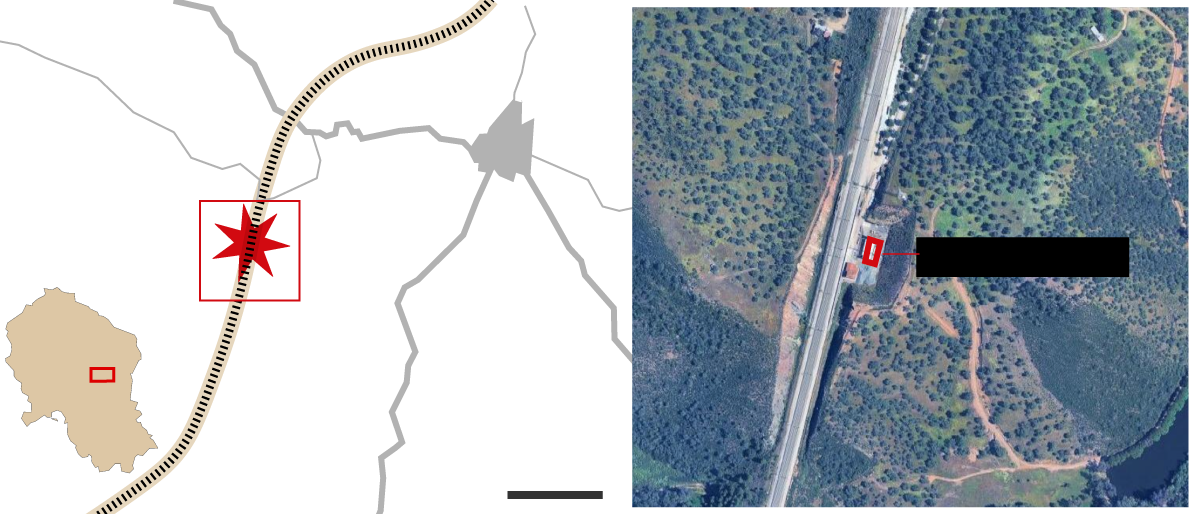
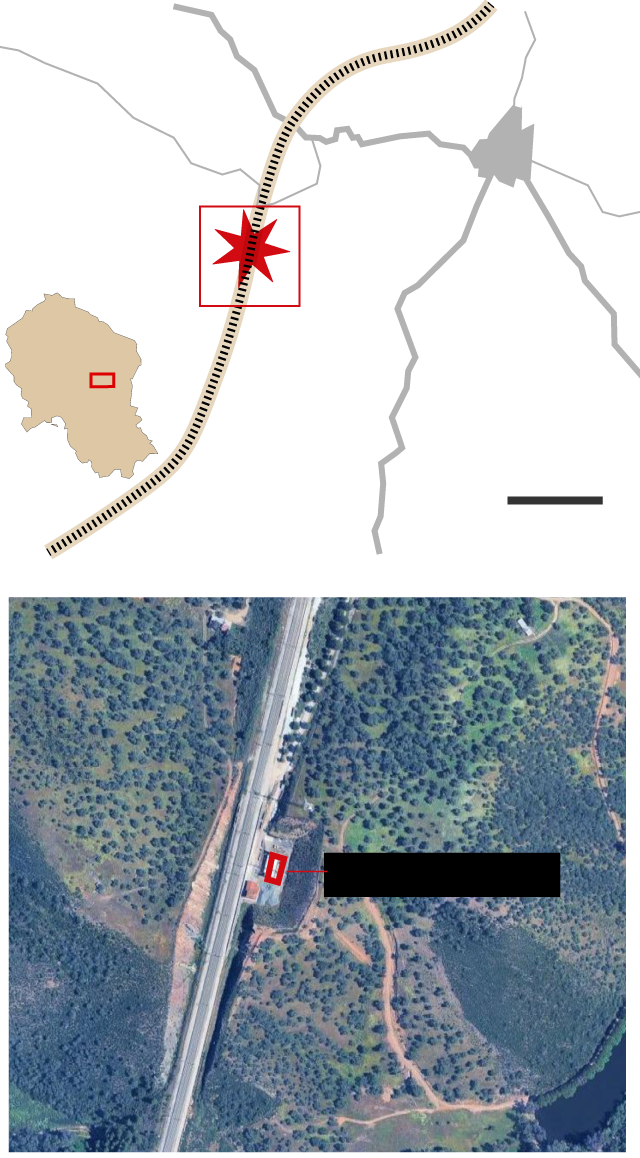
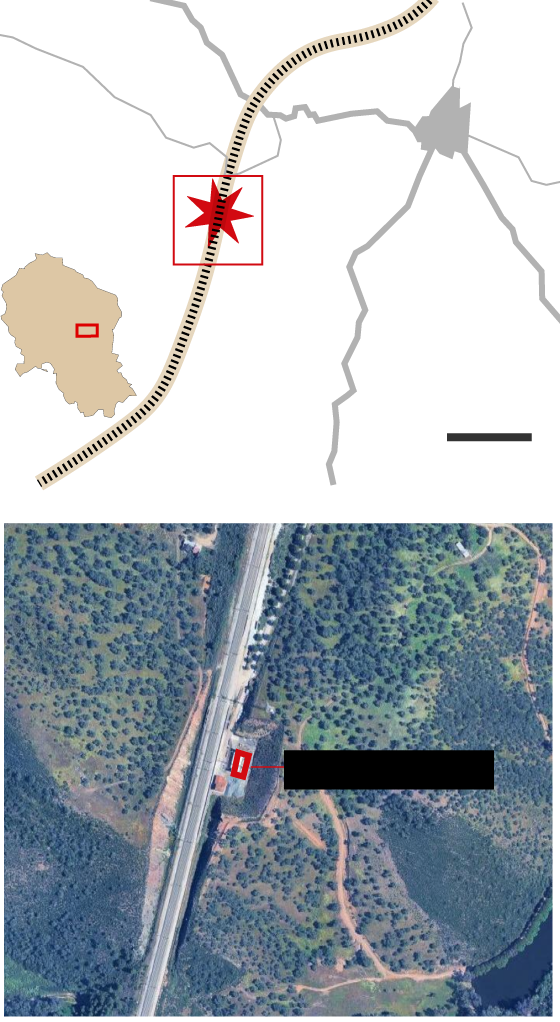
What is known is that the accident occurred on a flat, very straight stretch of track. It's located about 10 kilometers north of Córdoba, just past the Sierra de Andújar mountain range and the Despeñaperros ravine. "It's after one of the last curves and a tunnel before the vast plain of Córdoba," explains Juan Carlos Salmerón, director of the Terminus Center for Transport Studies. Several sources agree that this section of the network is completely automated, where "human error is not an option."
A-3001
Adamuz
ACCIDENT
Edifici tècnic
A-421
Córdoba
2 km
A-3001
Adamuz
ACCIDENT
A-421
Córdoba
2 km
Edifici tècnic
A-3001
Adamuz
ACCIDENT
A-421
Córdoba
2 km
Edifici tècnic
"As for the network, what's there is the bare minimum of a station: that is, two switches and a building that isn't for passengers, but rather houses the electrical components and motors," Salmeron explains. Images of the accident clearly show the Iryo train that crashed coming to a stop in front of this building. The switches in that area are controlled from the control centers in Madrid.
The condition of the train (and the speed at which it was traveling)
The train, built in 2022, had been inspected just four days prior, on January 15th. According to Iryo's president, Carlos Bertomeu, it is a "state-of-the-art" train that has passed all inspections, "the last one very recently." Salmeron agrees: "It's a very new train, especially compared to what we're used to seeing on the Spanish rail network," adding that it's difficult to understand what could have happened, especially considering that the train didn't derail from the start, but rather from the rear. The president of Renfe explained that, according to initial reports, neither train was exceeding the speed limit; in fact, they were traveling below it. The Iryo was traveling at 210 km/h and the Alvia at 205 km/h, when the maximum speed limit for that section is 250 km/h.
The road, from 1992
The section of track where the accident occurred—the oldest high-speed line in the country, dating back to 1992—had been renovated in May, and, moreover, some seventy trains had passed through that point (three in the previous 20 minutes) without incident. In recent hours, official statements from Adif, the infrastructure manager, have been released, covering the period between May and December. These statements highlight that at least five incidents were recorded in this area due to the state of the infrastructure, breakdowns, or signaling problems after the infrastructure renovation.
However, in all these incidents, the only consequence had been "minor delays," according to the operator itself. Regarding the points switch and a possible error or failure of this mechanism, Cárdenas explains that, although it is an "important and delicate" structure—it allows trains to change tracks—it is a very controlled and secure system. "Point switches have a very, very rigorous safety system. When we pass over the tracks with the trains, we occupy sections of the electrical circuit that close and can no longer be manipulated: the points switch cannot be moved if there is a train passing through that section," explains this expert train driver.
The 20 seconds in which everything happened
There is another key factor that has made the accident far more serious than it could have been: the fatal coincidence that, at the exact moment of the derailment, another train passed by on the adjacent track within seconds. The president of Renfe described the situation as occurring "in a matter of 20 seconds." Fernández Heredia pointed out that, in that time, neither the alarm nor the safety systems would have been able to stop a high-speed train in time. Cárdenas recalls that "stopping a train of this type, at that speed, takes a kilometer and a half." "Even if the driver had activated the emergency safety system, the train would not have stopped in time," he explains. Cárdenas and Salmerón also emphasize the severity of the accident. In fact, there is no precedent in Spain for a collision between two trains at that speed, each train traveling at over 200 kilometers per hour.
"The first two carriages of the Alvia train have been separated from the rest of the train. I haven't seen anything like this in 40 years," Cárdenas exclaimed in surprise. The speed and weight of both trains were such that the president of the Andalusian Regional Government, Juanma Moreno, explained in statements to RNE that the force of the impact was so great that bodies have been found "hundreds of meters" from the crash site.
Sabotage, another difficult option
For Cárdenas, the third scenario, sabotage, is just as complicated to describe and understand as the other two. He states that the intentional manipulation of the track or systems at this specific point, at the precise moment when two trains coincided, "is a virtually impossible operation to plan," says the train driver, who emphasizes that accessing the tracks is also not a "simple" operation.
Salmeron agrees that planning an intentional act is not impossible, but it is very complicated, and points out that, despite what happened, "it's absurd to distrust the Spanish high-speed rail network." "It's a highly automated network, with double, triple, and quadruple safety factors, and where speeds cannot be exceeded because they are automated in many places," he explains. The problem, he notes, is that any high-speed accident has a much greater impact. "The priority is to determine the cause [of the accident]: what happened and what can be done to prevent it from happening again," concluded Iryo's president, Carlos Bertomeu.
