Tourists at the Louvre while France burns
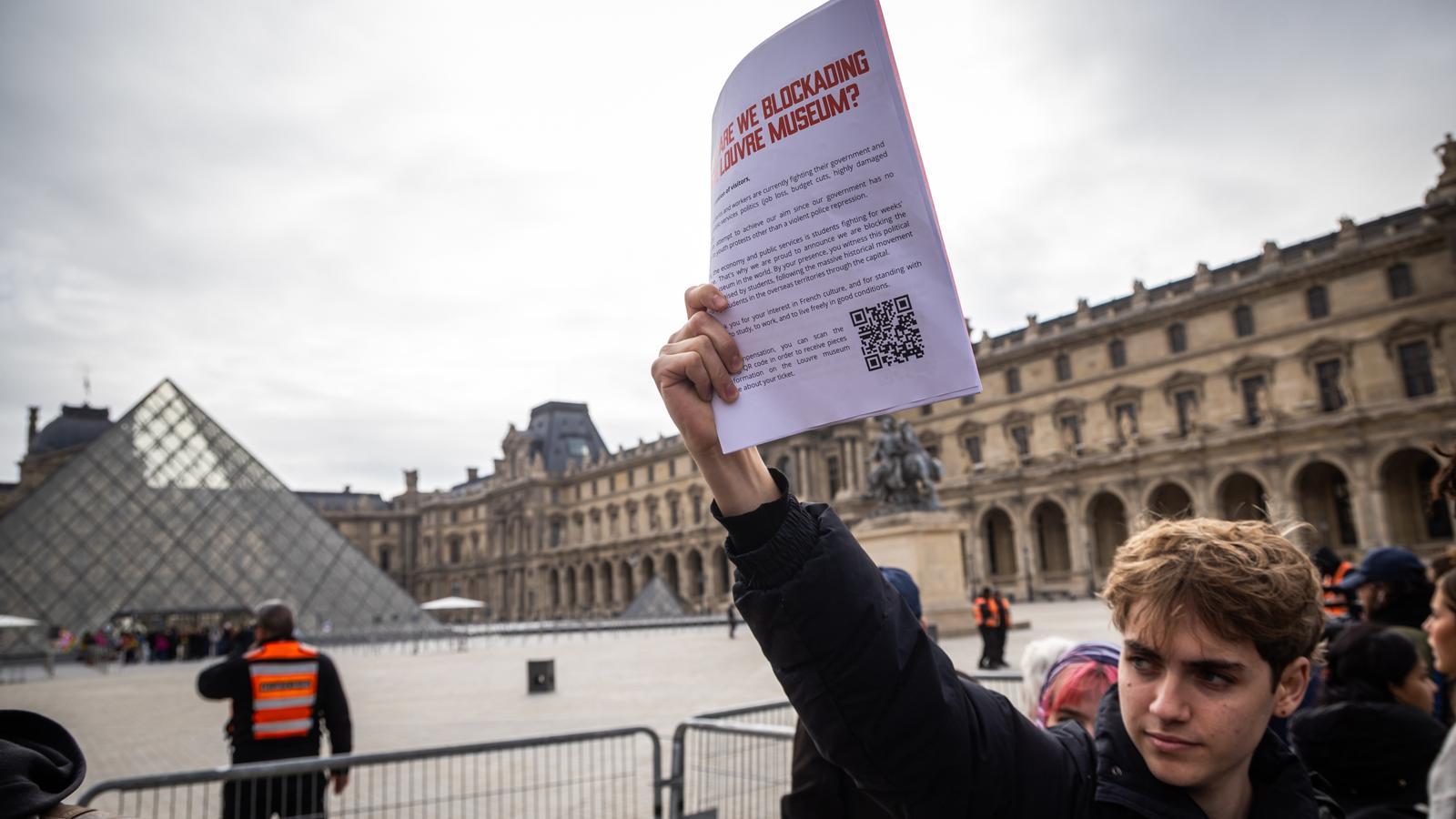

The French protests of October 19 reached the Louvre. Initiated by young people, due to the cost of living and the crisis of public services, they are the manifestation of what many analysts and sociologists, such as Christophe Guilluy, call "the financial catastrophe of Macron's ultraliberal project". About fifty students from the art school registered at the museum blocked its entrance. To the cry of "Whose is the Louvre? It is ours!", they witnessed how the tourists became furious, insulted them, protested. But what were the tourists demanding? Their voice manifested the desire to enter, they declared their innocence, but they did not express the reason why they were there. Shortly after, the museum closed its doors.
The Louvre founded its school, the Higher Center for Studies of the Ministry of Culture and Communication, in 1882 and has about 2,000 students. From this point of view, the museum belongs more to the students than to the tourists. In 2025, the most visited museum in the world received 9 million users, 73% of whom were foreigners. In universal museums, universality is a symptom of hyper-congestion. In fact, in one day as many tickets are counted as were produced throughout a year in the fifties. From this point of view, the museum belongs more to the tourists than to the artists.
The building was created in the 12th century and its use has oscillated between a fortress and a palace, that is to say, between defense and the representation of the ruling class. Historically linked to the monarchy, in 1793, in the context of the French Revolution, it became a museum of the people and for the people. The building was expropriated, along with the works, which, like many collections in such museums, was the result of historical looting committed by political and religious power. As a notable fact, it should be remembered that in 1815, after the fall of Napoleon, the military officer and diplomat Miguel Ricardo de Álava went to the Louvre to recover more than 280 Spanish works of art that Napoleon had plundered.
One of the jewels in the crown, even though it is located in the Louvre-Lens building, is the painting Liberty Leading the People, by Eugène Delacroix. It represents the French during the revolution of July 28, 1830, when the people of Paris rose up in arms against King Charles X of France. The image shows the union of the bourgeoisie and the popular classes against monarchical despotism, and an allegorical, nationalist liberty, wearing the Phrygian cap of the liberated. One of the main characters is a boy, who symbolizes the future of the people, that is to say, he presents the youth as a promise of the future, just as we also find in demonstrations in France, Italy, Spain... André Malraux, in his book The Imaginary Museum, already told us that what we interpret in a museum as a work of art was not so in its origin: neither the crucifixes, nor the works of Phidias or Cimabue were paintings or sculptures, but images that fulfilled a religious, mythical, symbolic function. The modern museum is what has confined the work to the fetishism of the author. This is how Malraux expressed it, and those who have come after. That is why the tourist, what they demand, surely, is that the promise that every form of culture relegated to its advertising character proposes be fulfilled: they want to portray the image as if in that gesture they could possess it, but without the need to understand it. Simply, they want to fulfill the global agenda of mass tourism. While Delacroix's painting bases its meaning on the denial and overcoming of a painful reality, the tourist does so on the affirmation of themselves as an emanation of the power of the global financial economy, which turns everything it touches into a financial asset and franchise urbanism, in a suspension of the world and of conflict.
Susan Sontag said that "industrial societies turn their citizens into image junkies, which are the most irresistible form of mental pollution." The massive touristification of museums means that the interest is no longer trying to grasp the background of the images, but rather walking among them. Only in this way can one understand why the tourist is incapable of linking the inside of the museum with its immediate off-field, that is, the city and its people. The tourist wants to go inside to contemplate images that resonate with what the city offers them outside, but ignores it.
Three days later, Macron bans the right to strike in different French cities; in Paris, it is carried out in places that the authorities call "key", those linked to political establishments, large department stores, and tourism, such as in front of the Louvre. The executive power and the economic power of a large city are defined, precisely, through their relationship with their management of tourism and the networks of expats who decide to go and live in cheaper countries, working remotely, without paying taxes, taking advantage of the local public resources, increasing the price of land, changing the physiognomy of the cities, their language, their customs.
This reminds me of another image from the same days, the burning of a part of the Limoges City Hall, which had already caught fire in May 1871, when the French president Thiers established a policy of fierce military repression against the communards (members of the Commune), in which between 10,000 and 30,000 people were murdered, 40,000 were arrested, and more were sent into exile. It is surprising the general irritation caused by the burning of a portal of a previously reconstructed city hall, since we do not find the same reaction when sacrifice zones are built (petrochemical plants, nuclear power plants, data server parks, intensive monocultures, airport expansion projects, megacruisers, theme parks, franchise commerce...). In the name of the economy, we approve the lethal surgical operation, but we criminalize the furious protest, while the tourist feels with the strength of the conqueror in front of the Louvre, thinking that the problem of those young people is not theirs, that their presence is on the sidelines of the altercation, when, precisely, the violence is founded on this moral superiority of the tourist and their perverse sensation of immunity in the face of a conflict that, as a consequence of their presence, hinders the freedom of expression of the people; that same people of whom the museum speaks to us, but there is no one to listen to them.
