Squatters vs. large landlords
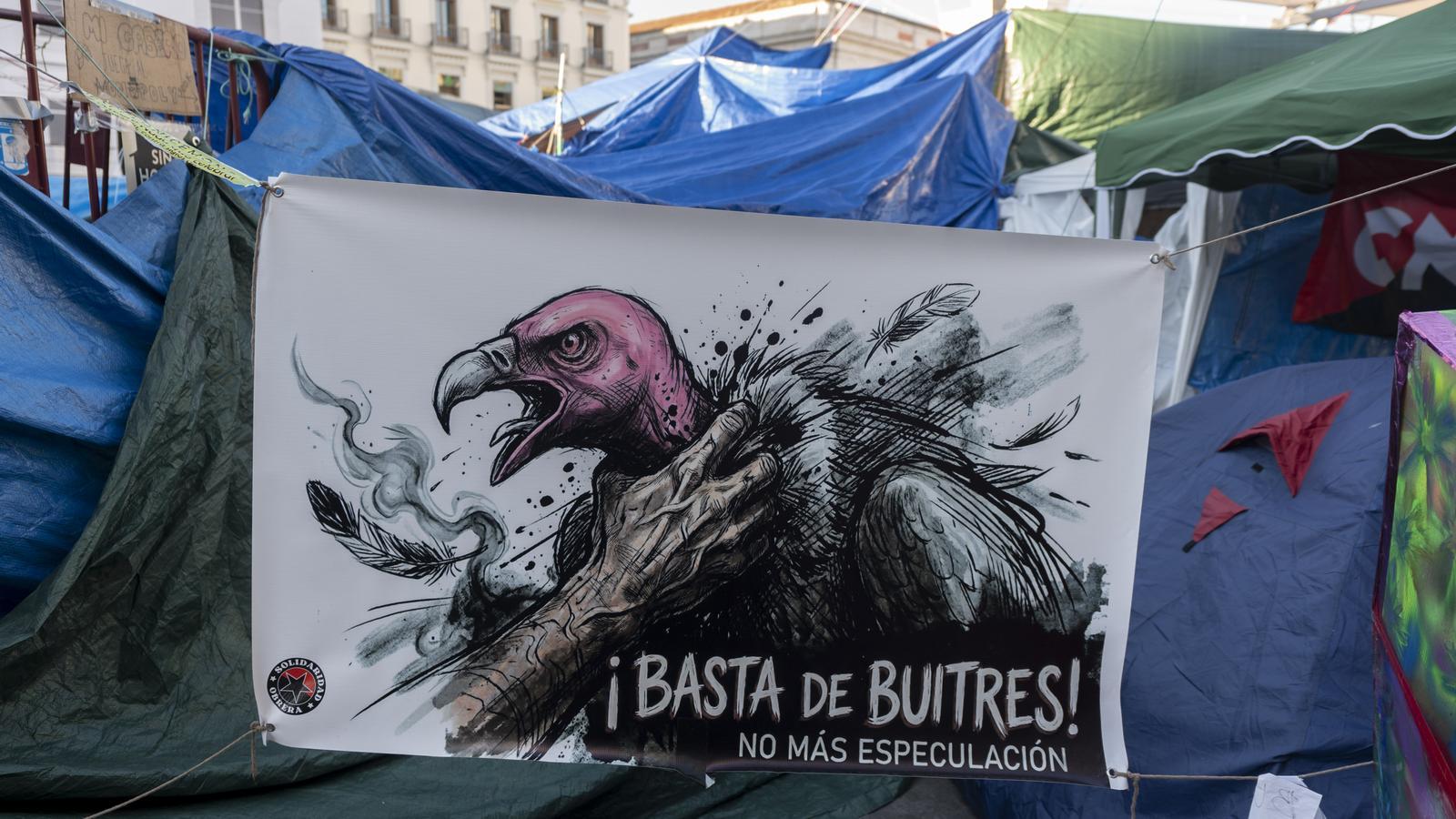

The Spanish political debate increasingly resembles sports talk shows or social chronicles. And you, who are you with? With the squatters or the large property holders? What an absurd dilemma! But if we reach the maximum synthesis of electoral offers, as presented to us on social media, it seems we are driven to this kind of Manichaeism. And we cannot afford it: We have two enormous challenges ahead, which are housing and immigration. Both are intimately related, and have to do with the Problem with a capital P, which is the impoverishment of the middle and lower classes, and the bankruptcy of public services. It is a question of economic model, but for the parties, the pundits, and the influencers it is easier and more comfortable to reduce it to a cultural issue, of values. Equality/freedom. Order/disorder. Identity/diversity. Broncano/Motos. And here at home, too, Spain/Catalonia. Or Hispanicity/Catalanicity. Or Islam/Orriols.
People are becoming desperate seeing how their daily life degrades and politics only offers frivolity and finger-pointing that distracts. Everyone gathers behind defensive slogans. Disenchantment takes to the streets to cast blame, and tension is a palpable reality, including violence. The Spanish media collaborates in this, aligning itself shamelessly, attacking and playing the victim at the same time. Not even comedians survive if they do not protect themselves behind one trench or another. The Catalan "fracture" due to the Process, fanned and inflated by the Spanish press, is a real joke compared to what is happening in Madrid, where only an inopportune spark is missing for things to heat up for real. Not to mention France: In Paris, Lyon, and other cities, legitimate protest mixes with vandalism and feeds the extremes. The fear of an authentic civil confrontation (which will be partly social and partly ethnic) could favor Marine Le Pen in the presidential elections. It would not be the first time that Europe surrenders to authoritarianism out of fear of a revolution. And even though we are not in 1933, it cannot be denied that history rhymes, as Twain said.
I would like to be able to say that in our home, Catalanism can and must be a refuge value, a meeting point that has historically been inclusive and interclassist. But Catalonia is a part of Europe and its problems are ours, even more acutely. The lack of housing and low wages are blocking entire generations. The middle class, our backbone, is becoming impoverished at an accelerated rate. Public services have not grown at the pace of the population. Strong immigration, combined with our low birth rate, threatens internal cohesion and the continuous integration of newcomers, which has historically been our great value. And political Catalanism is still not prepared to respond to all of this. One part has turned towards the far-right (that is, towards the fear of the “caliphate”) and the rest has two serious problems: It has been infected by the tension from Madrid, and is too focused on the memories, which are becoming increasingly vague, of 2017.
If by a miracle the progressive majority is repeated, it will be necessary to keep rowing in the negotiation (now, without the blackmail of repression). On the other hand, a foreseeable PP-Vox government will call for regrouping efforts in Catalonia, preparing for conflict. And in the Catalan political scene, a weakened PSC (in the Generalitat and in many town councils) will have to sit down and talk with pro-independence forces. It has nowhere else to turn. If windows of opportunity open, they must find us with our homework done.
