France and collective indignation
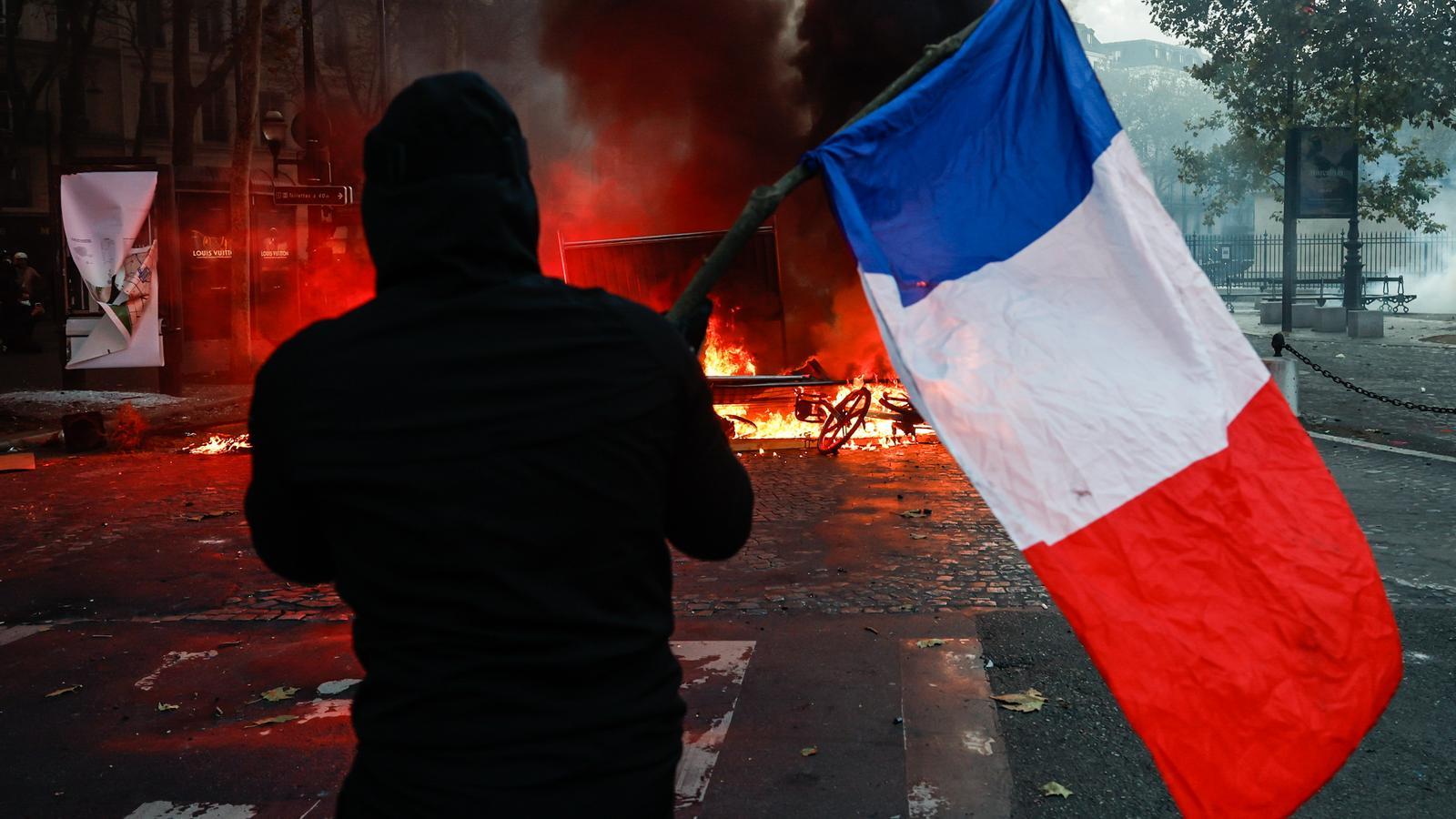

Images of destructive anguish and uncontrolled looting take the headlines of a much deeper decomposition sweeping across Europe. The massive mobilizations in France have brought together students, parents, teachers, unions, and yellow vests against the rising cost of living; against government proposals to cut pensions, delay the retirement age, and increase university fees; it is a protest against the lack of teachers, or the state of abandonment of many educational centers in the banlieues, which counted, for many weeks, on the peaceful participation of some mayors from the most affected localities. It is not just an intergenerational crisis, but also a generalized unrest against an increasingly unequal redistributive system.
The fed-up feeling is general. Protests are also growing in Italy and Belgium due to the cost of living and cuts in education. Riots in Milan, Turin, and Bologna and shouts of “Money for schools and not for war” in the streets of Rome. Housing encampments are spreading in Portugal and are also mobilizing young Greeks. Albania has been experiencing a whole week of violent student protests with the burning of official buildings included, after months of frustration over the government's indifference to peaceful demonstrations against corruption, and the lack of tangible improvements in their daily lives. And in Germany, the unrest is expressed against military service and the government's arms spending.
The causes may differ, but the feeling of anguish and discontent is shared. The protests have become the expression of a collective frustration over the cost of living, extreme wealth disparity, government paralysis, and a declining social welfare system.
In France, the living conditions of more than 40% of the population have stagnated or worsened since the post-Lehman Brothers economic crisis. Meanwhile, the 10% of the largest fortunes in Europe accumulate almost 60% of all continental wealth. In contrast, the bottom 50% only accumulate 5%. Fifteen years ago, the combined wealth of billionaires around the world was 4.5 trillion dollars. By 2024, this figure had more than tripled, reaching 14.2 trillion dollars. These are figures from the EU Tax Observatory, a research organization funded by the European Union, led by the French economist Gabriel Zucman.
It is for this reason that the agony of Macronism will experience its death sentence this autumn. Emmanuel Macron came to power in 2017 as a “Jupiterian” president, who intended to place the head of state above everyday politics, projecting a distant authority and a technocratic brilliance. The reality, however, has translated into arrogance and disconnection. The president is a lame duck permanently condemned to political instability, with the country more fractured than ever, and a state that is indebted and unreformable. French public debt is nearing 120% of GDP, its highest level since 1946 and double the limit established by the EU. The markets are concerned because France's borrowing costs are higher than those of Greece and the uncertainty over the outcome of the next presidential and legislative elections is driving interest rates even higher.
Macron was supposed to regenerate and transform the French political scene, but he has not been able to avoid, instead, the deepening degradation of the system, nor the pessimism and unrest that have fueled and enlarged the longest-standing far-right in the European Union. While the Élysée attacks the France Unbowed left and accuses it of fueling disorder, the leaders of the National Rally, Marine Le Pen and Jordan Bardella, feel like the immediate electoral winners of the chaos and offer their party as the only one capable of restoring order to the country.
The moment is crucial for Europe; just at the beginning of an electoral supercycle that must decide the political future of Spain, France, Italy, and Poland and, with them, that of the European Union in general. France is too big to fail –as was said during the financial crisis–, but dysfunctional enough to drag down the economic stability of the entire Union.
