Larrosa gets his accounts approved through legal channels, but without allies
The lack of candidates for a vote of no confidence allows the PSC government to continue, but with greater fragility than ever.


-
CAT -
CAST
LleidaThis week, the municipal budgets for Lleida for the 2026 fiscal year were automatically given initial approval. Lacking any support, the governing party of the Paeria (PSC), in a clear minority (9 of the 27 councilors), resorted to a legal avenue provided by the local government law to pass it. And they did so by risking their leader, at least in theory. The opposition parties had a full month to agree on a candidate to lead a motion of no confidence, an option permitted by the law itself. But they didn't even try. The arithmetic is what it is (a three-way tie with five councilors each for the PP, ERC, and Junts), and that left no room for negotiation. Mayor Fèlix Larrosa has managed to pass a budget for now without consensus, but with the uncertainty of what the city's politics will bring in the next fifteen months before the next municipal elections.
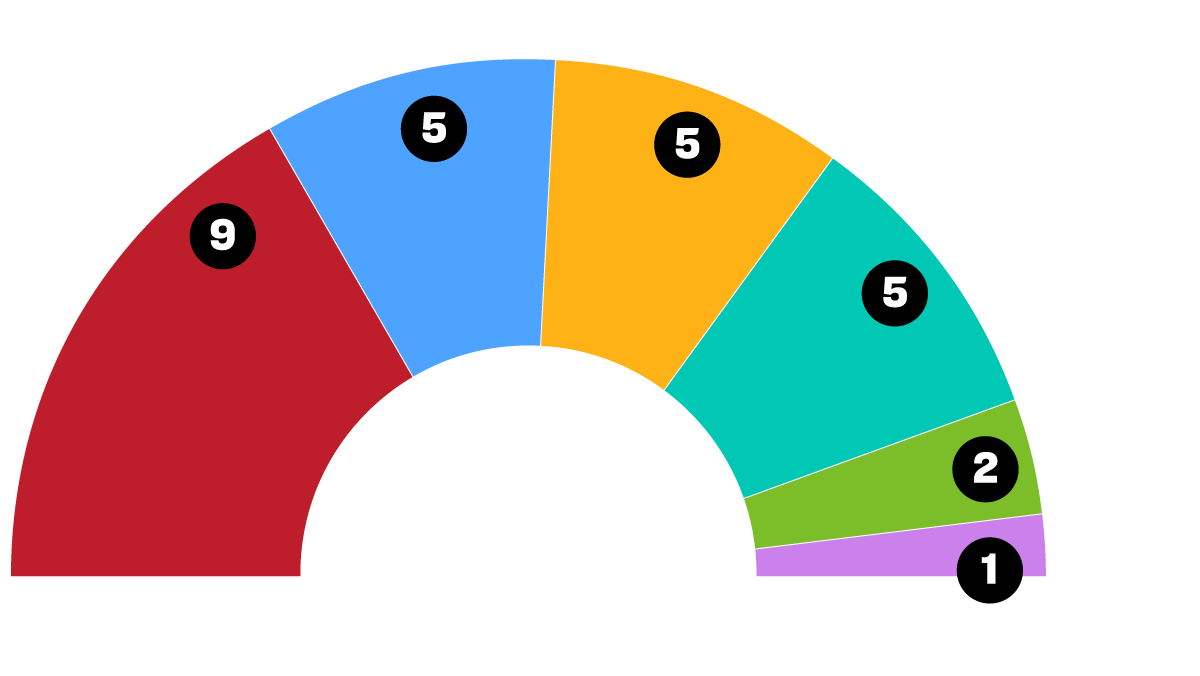
PP
ERC - AM
PSC-UNITS-CP
JUNTS PER
CATALUNYA
LLEIDA -
COMPROMÍS
MUNICIPAL
VOX
COMÚ DE LLEIDA
PSC-UNITS-CP
PP
ERC - AM
JUNTS PER CATALUNYA LLEIDA -
COMPROMÍS MUNICIPAL
VOX
COMÚ DE LLEIDA
PSC-UNITS-CP
PP
ERC - AM
JUNTS PER CATALUNYA LLEIDA -
COMPROMÍS MUNICIPAL
VOX
COMÚ DE LLEIDA
Defeat in the budget plenary session
During the first half of the legislative term, Larrosa's government was able to function with relative normality thanks to the support of the five Junts councilors, who voted in favor of the main policy priorities (including last year's budget). But things took a turn for the worse in the plenary session of December 23, when all the opposition groups voted against the 2026 budget. The governing team presented them a month earlier as "the most expansive in the city's history"A record figure of 262 million euros, of which 63 million were planned for investments (double that of last year), with the intention of prioritizing, according to municipal sources, social action, "with a very important commitment also to housing policies, in which 7.2 million euros will be allocated", they argued.
The mayor explains that "an extended budget wouldn't have been enough," because in addition to improvements in services like cleaning, there were many investments committed to by other administrations, such as the Pla de Barris (Neighborhood Plan), for which the city has secured a 50% subsidy. The PSC (Socialist Party of Catalonia) asserts that the budget has the backing of other administrations, such as the Generalitat (Catalan government) and the national government, "with contributions of funds for strategic projects, which will allow us to undertake works such as resolving the flooding problems in the Segre River or the transformation of the Historic Center."
But all the opposition groups criticize the lack of any willingness to reach a consensus on the part of the municipal government. Even the Junts group, which until now had been its ally during this legislative term, opposed the PSC's budget. "It's an expansionary budget, but the investments haven't been agreed upon," explains Junts spokesperson Violant Cervera. She laments that spending is concentrated on the Pla de Barris (Neighborhood Plan) and the Urban Agenda model, "not at all priorities," and regrets that "they don't solve the day-to-day problems of the citizens."
The other groups also voted against it, arguing that there had been no dialogue whatsoever. The Republican spokesperson, Jordina Freixanet, lamented the lack of a "minimum agreement" in the budget plenary session and called for "a change of course, model, and leadership" for Lleida.
Fèlix Larrosa asserts that all the municipal groups (except Vox, with whom the Socialists have no intention of forming a coalition) had access to the budget information and began discussions a month before the debate. "Let's not be fooled," warns the mayor, lamenting that their amendments were not submitted on time. "I ask all the spokespeople to reflect on this, because the public doesn't understand," concludes Larrosa, regretting that the groups' "red lines" prevented any agreement.

In any case, after the budget was rejected, the governing team set in motion the legal process to leave office without allies. They began with a vote of confidence. Had they passed, the budget would have been automatically approved. Since they failed to do so, the opposition groups have had until the end of January (which concludes next Saturday) to file a motion of no confidence and remove the mayor. Obviously, there was no candidate, and therefore, the vote of confidence is considered granted and the budget approved automatically. "It's a tool we have," argued Mayor Larrosa, citing other cities like L'Hospitalet and Zaragoza, which have found themselves in a very similar situation. "My interest is that the city moves forward, that the people of Lleida feel reassured by our policies, and that we advance in civic pride," declared Larrosa. The possibility of a motion of no confidence has never been raised. The opposition groups have not brought it up at any point, and there haven't even been any courtesy calls. The projects of the three major groups are completely different. Even antagonistic.
"We've found ourselves in this situation because we're facing an exhausted government," denounces PP spokesperson (and leader of the opposition), Xavier Palau, "a minority government that has been unable to establish synergies with the other political forces." Palau asserts that the agreements with Junts have created "a mess, which has ultimately led us to this deadlock."
And now, what?
There are still fifteen months left in the legislative term, and it seems the governing coalition has lost its partner. Council member Violant Cervera insists she has never been beholden to the Socialists and reiterates that "we are not partners with the PSC, we are partners with the city." For Junts, things haven't changed. "We're still where we were," Cervera explains. "So far, we've honored the budget agreements," she says. "Any issues that come up from now on, if we believe they are beneficial for the city and can improve the lives of its citizens, we will vote for them." If not, they will file objections or vote against them.
"The main obstacle we face right now is the mayor's approach to politics and governing," says Jordina Freixanet. "From now on, these budgets will have to be implemented, as well as various city-level policies, and the mayor will need support," warns the Republican spokesperson, recalling that the split between the PSC and Junts "was expected" long ago. "We must have a sense of city," Freixanet urges, lamenting that the PSC is now flirting with the Popular Party, referring to the latest extension of the bus contract and the approval of the new urban development plan, two policies that have already received the support of the PP.
The PP has specifically raised the need to seek "spaces and negotiations for stability and minimum agreements between the groups" to provide stability to the city over the coming months. However, their spokesperson admits that it will be difficult to reach an agreement with those who have been governing for 46 years (referring to the PSC, ERC, and Junts) and who have led the city "to a deadlock in the inclusion model," says Xavier Palau.
Memories of 2022
The vote of confidence resulting from the lack of budget approval is a tool with precedents in the Lleida City Council. It occurred in January 2022, when the then Republican mayor, Miquel Pueyo, managed to get his budget approved. which had previously been rejected first in an ordinary plenary session and then by losing a vote of confidenceThe ERC's budget had the support of Junts i els Comuns, which formed a governing coalition, but the councilors from the latter group withdrew their support at the last minute. This opened the door to a motion of no confidence, which, in this case, was thoroughly considered. It was precisely the Socialist Fèlix Larrosa, then leader of the opposition, who negotiated until the very last minute to secure the necessary support to become the new mayor, but it proved impossible. Ultimately, the lack of a candidate allowed Miquel Pueyo to pass his budget and even complete his term.

For many, the current scenario is clearly different from that of 2022. The current mayor points out that his group governs in minority, while the previous administration governed with a three-party agreement that gave it an absolute majority in the council. But some see a correlation. Violant Cervera warns that "the archives don't lie" and recalls that in 2022, Larrosa demanded Mayor Pueyo's resignation for being unable to reach agreements. "The reasons are the same now; that is, it stems from a budget that hasn't been approved because the city council has been unable to reach a consensus on it beforehand," says Violant Cervera. Obviously, Larrosa is not resigning. And he seems visibly calm about the political landscape that awaits him.
