Empty shelves and gas stations without gasoline: Italy promises aid to truckers to stop the strike
Meloni's government unlocks 105 million euros to help transport companies cope with the rise in fuel prices
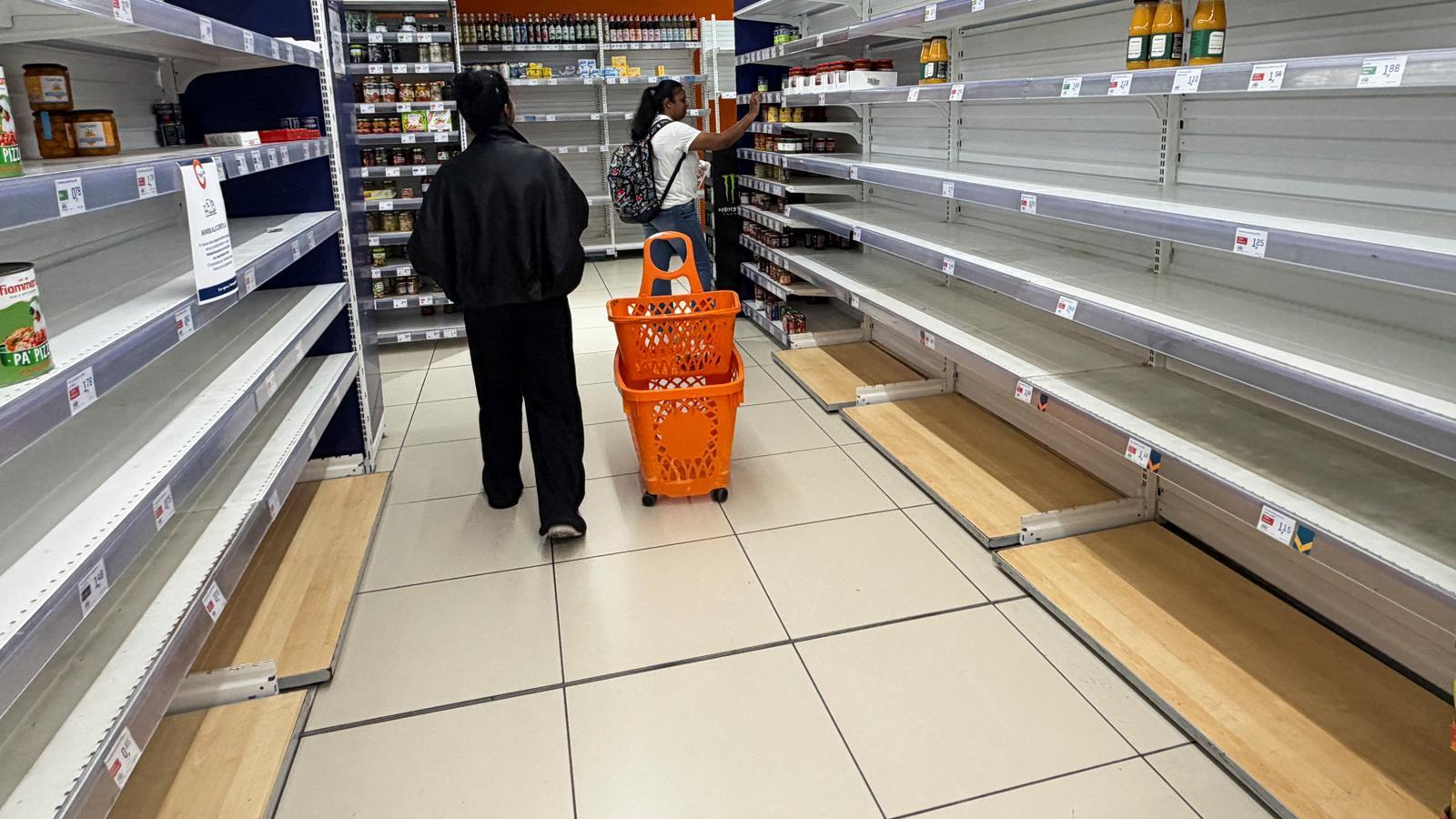

RomeEmpty supermarket shelves, tomatoes at six euros a kilo... this is one part of the picture left by the wildcat strike led by Italian transporters to protest against the increase in fuel prices. The other part of the image is the lines of trucks that have been blocking the country's main highways for a week, causing shortages, especially in the southern regions of Italy.
Food such as fruits, vegetables, greens, meat, fish, and milk remain trapped in immobilized trucks, while the cold storage rooms of agricultural holdings are approaching their capacity limit, as warned by the agricultural organization Coldiretti. Problems are also affecting the fuel supply at gas stations.
In the Calabria region, the epicenter of the mobilization along with Campania, the situation has normalized in the last few hours, following the suspension of the truckers' protests by the regional logistics federation. However, they continue to threaten to resume the mobilization if the meeting scheduled for October 27 in Rome with the Minister of Infrastructure and Transport, Matteo Salvini, does not adequately meet their demands.
The Italian government sent a first response to the transporters this Thursday. The Council of Ministers approved a decree to "immediately" release aid worth an additional 105 million euros, which brings the total resources allocated to road transport companies to cope with the rising cost of fuel to more than 126 million euros. "These are not promises, but resources that are already reaching the sector. The Ministry of Transport has already started paying," argued the Italian Prime Minister, Giorgia Meloni.
Among other demands, the transporters were demanding the immediate release of 480 million euros, which companies in these sectors expected to receive between March and August in the form of tax credits to cover diesel expenses. "Companies will receive an advance of these tax credits in the coming days, the amount of which we will later cover in full," explained Meloni. The head of the Italian executive also announced that the controls for these types of aid will be carried out "afterwards," since, as she stressed, "those who work cannot remain at a standstill, waiting for bureaucracy."
According to the agricultural organization Coldiretti, the price of agricultural diesel has risen in recent months from 0.85 to 1.20 euros per litre, while heavy transport in Italy costs 1.12 euros per kilometre compared to 1.08 euros in France and 1.04 euros in Germany.
A week of strike
The measures announced by the government come after a week of transport strikes that have caused road blocks and shortages in supermarkets and gas stations, especially in the southern regions that are more dependent on road transport due to the lack of railway infrastructure.
Nearly 32,000 Italian companies will be able to benefit from this aid, to which another 60 million euros have been added to reduce the price of agricultural fuel by 45 euro cents per liter, as announced by the Minister of Agriculture, Francesco Lollobrigida, who labeled the road blocks as "unjustified". Furthermore, he denounced that the truck drivers' protests had only served to worsen the crisis already being experienced by many companies, which have lost part of their perishable production as a result of the strike.
The government had threatened to identify the striking truck drivers who are blocking roads in the south of the country to begin the removal of pickets. "If tire slashing, aggression, and violence continue, we will move to another front," warned Salvini. The also Vice President of the government and leader of the far-right League hypothesized that organized crime could be behind the truck drivers' protests. A hypothesis that also had the support of the Minister of Justice, Carlo Nordio, who considered it "very likely" that mafia organizations were taking advantage of the protests for their own interests.
