Pork exports outside the EU blocked due to two cases of swine fever in wild boar in Collserola
The Catalan government is restricting access to Collserola Park due to the disease, which had not been detected in Spain since 1994.


-
CAT -
CAST
BarcelonaThe Catalan government confirmed on Friday two positive cases of African swine fever (ASF) in two wild boars found dead this week in the municipality of Cerdanyola del Vallès (Vallès Occidental), and has therefore activated its contingency plan against the disease, according to a statement from the Department of Agriculture, Fisheries and Food. The plan's measures include an immediate ban on pork exports outside the EU. These two cases are currently the only ones found in Spain, so there is no evidence that the disease is affecting any farms in Catalonia. "So far, no outbreaks have been detected in domestic animals in Catalonia," the Ministry of Agriculture stated in a press release. However, at a press conference, the Catalan Minister of Agriculture, Òscar Ordeig, stated that there is a "high" probability of new cases being found in Catalonia. The last case detected in the state was in 1994.
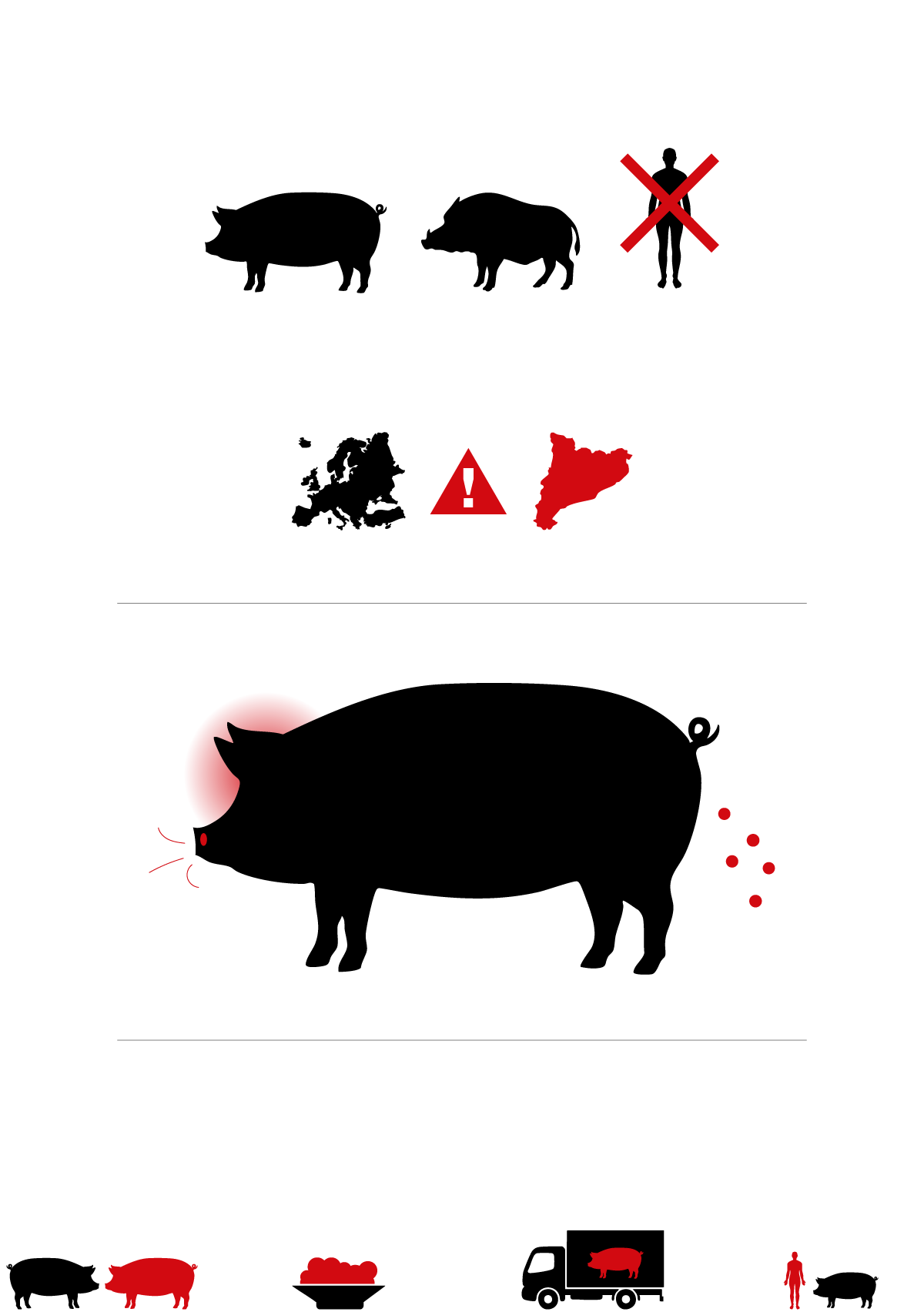
És una malaltia vírica molt contagiosa que pot causar
la mort al 100% dels porcs d’una granja infectada.
Només afecta porcs domèstics i senglars, no afecta els humans ni altres animals.
Porcs domèstics
Senglars
Avança ràpidament per Europa i un cop arriba és difícil de controlar.
El risc d’entrada a Catalunya és molt elevat, amb greus repercussions
econòmiques per al sector porcí i per a l’economia de tot el país.
No hi ha tractament ni vacuna eficaç per controlar-la.
Quins són els símptomes?
Febre
Depressió
La gravetat i la distribució
de les lesions varia també
en funció de la virulència
del virus
Diarrea sagnant
Trastorns
respiratoris
Sagnat del nas
Vòmits
Enrogiment de la pell de les orelles, abdomen i potes
COM ES CONTAGIEN?
Per contacte directe amb altres porcs o senglars infectats.
Pel consum de productes derivats i carns d’animals infectats.
Per mitjà d’objectes contaminats i transport de bestiar.
Per persones en contacte amb animals o llocs infectats.
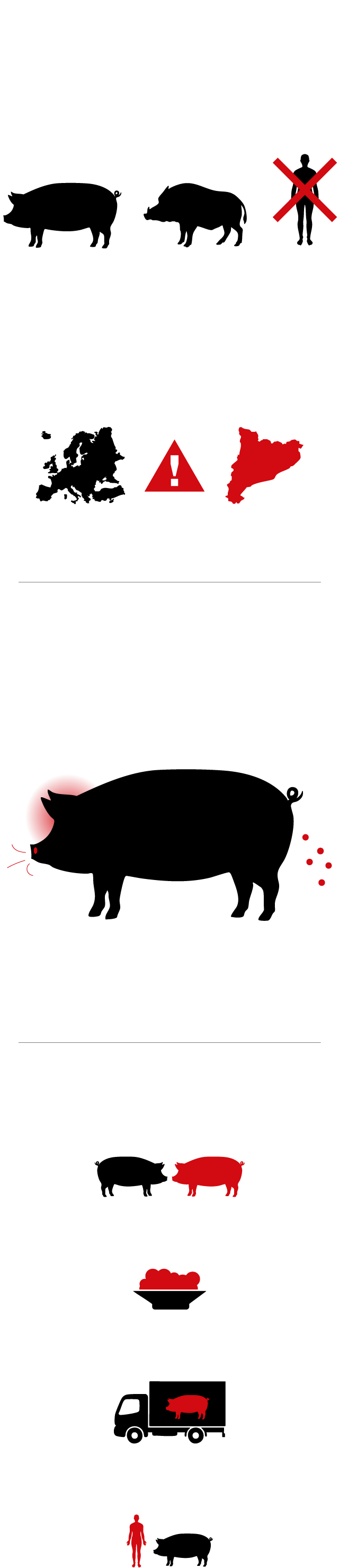
És una malaltia vírica molt contagiosa
que pot causar la mort al 100% dels
porcs d’una granja infectada.
Només afecta porcs domèstics i senglars,
no afecta els humans ni altres animals.
Porcs domèstics
Senglars
Avança ràpidament per Europa i un
cop arriba és difícil de controlar.
El risc d’entrada a Catalunya és
molt elevat, amb greus repercussions
econòmiques per al sector porcí
i per a l’economia de tot el país.
No hi ha tractament ni vacuna
eficaç per controlar-la.
Quins són els símptomes?
La gravetat i la distribució de les
lesions varia també en funció
de la virulència del virus.
Febre
Diarrea
sagnant
Depressió
Trastorns
respiratoris
Sagnat
del nas
Vòmits
Enrogiment de la pell de les
orelles, abdomen i potes
COM ES CONTAGIEN?
Per contacte directe amb altres porcs o senglars infectats.
Pel consum de productes derivats i carns d’animals infectats.
Per mitjà d’objectes contaminats i transport de bestiar.
Per persones en contacte amb animals o llocs infectats.
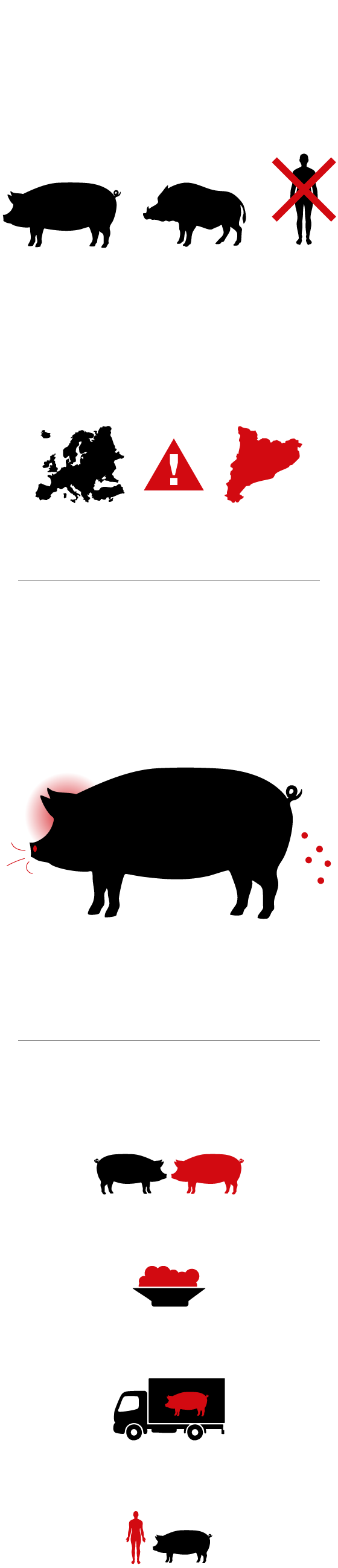
És una malaltia vírica molt contagiosa
que pot causar la mort al 100% dels
porcs d’una granja infectada.
Només afecta porcs domèstics i senglars,
no afecta els humans ni altres animals.
Porcs domèstics
Senglars
Avança ràpidament per Europa i un
cop arriba és difícil de controlar.
El risc d’entrada a Catalunya és
molt elevat, amb greus repercussions
econòmiques per al sector porcí
i per a l’economia de tot el país.
No hi ha tractament ni vacuna
eficaç per controlar-la.
Quins són els símptomes?
La gravetat i la distribució de les
lesions varia també en funció
de la virulència del virus.
Febre
Diarrea
sagnant
Depressió
Trastorns
respiratoris
Sagnat
del nas
Vòmits
Enrogiment de la pell de les
orelles, abdomen i potes
COM ES CONTAGIEN?
Per contacte directe amb altres porcs o senglars infectats.
Pel consum de productes derivats i carns d’animals infectats.
Per mitjà d’objectes contaminats i transport de bestiar.
Per persones en contacte amb animals o llocs infectats.
African swine fever (ASF) is a disease caused by a virus that has no effect on human health (neither through contact nor consumption of meat), but is highly contagious between wild boar and pigs, with mortality rates approaching 100%. It manifests with fever and hemorrhaging in the skin and internal organs of the animals, and there is no vaccine. The Director General of Agricultural Production Health and Animal Welfare of the Spanish government, Emilio García Muro, has recommended not interacting with wild boar in the cordoned-off area so as not to frighten them and cause them to flee to other areas, risking the spread of the virus.
"The wild boar were found dead on November 25th and 26th in Cerdanyola del Vallès and, following established protocols, were collected by members of the Rural Agents Corps of the Department of the Interior and Security" and taken to the Animal Health Research Center, where they were analyzed. The same samples were sent to the National Reference Laboratory in Algete, near Madrid, where both cases were confirmed as African swine fever (ASF) on Thursday night. Rural agents have begun searching for more dead animals in the area where the two wild boars infected with ASF were found. The disease prevention protocol requires the creation of a 20-kilometer surveillance perimeter starting from the point where the animals were found. The 39 livestock farms and slaughterhouses within this perimeter have had all movement of pigs restricted. The affected area, where hunting is also prohibited, includes, among others, municipalities such as Mollet del Vallès, Santa Coloma de Gramenet, Sant Cugat del Vallès, Sant Quirze del Vallès, Ripollet, Montcada i Reixac, Santa Perpètua de Mogoda, Polinyà, Terrassa, Sabadell, Rubí, and several neighborhoods of Barcelona.
The regional minister has declared that Catalan pig farms are "among the safest and most modern" in the world. However, he asked farmers to "take extreme measures" in controlling, disinfecting, and preventing the spread of the virus. The government has also decided to restrict access to Collserola Park due to the swine fever outbreak. In the area closest to the affected point (within a 6 km radius), encompassing 12 municipalities, a total closure of access to the natural environment has been decreed, along with the suspension of all hunting and forestry work, a ban on any activity in rural areas for biosecurity reasons, and the installation of physical barriers and information provided by the Catalan government.
For its part, the farmers' union Unió de Pagesos has called for calm and asked the Department of Agriculture to implement 24-hour surveillance of wildlife crossing points within a 20-kilometer radius of where the two wild boars affected by African swine fever (ASF) were found.
Exports prohibited outside the EU
Furthermore, all exports of pork, pork products (including sausages), hydrolyzed protein, and pet food containing pork to countries outside the EU are restricted as a "preventive measure," explained García Muro. For the time being, the government has suspended 121 export permits, which will be reinstated according to regulations and the response of each country. Some countries are opting to prohibit the entry of pork from Spain, while others are more flexible and consider the origin of the meat. For example, the authorities of China, South Korea, and the United States (some of the largest markets for Catalan pork) would agree to regionalize the suspension, thus only blocking the entry of products from the Barcelona area. Pork exports are one of the pillars of the agri-food industry in Catalonia and last year represented 19% of total Catalan food and beverage exports. In this regard, Ordeig assured that the Catalan government is working "quickly, in a coordinated and transparent manner" to "minimize as much as possible" the economic, social, and sectoral impact of the disease, although he expects it to be "significant." Unió de Pagesos (Farmers' Union) requested that, "without jeopardizing animal health," the Spanish government "not overstep its bounds with trade restrictions to avoid unnecessary economic repercussions for pig farmers." The epidemic has been spreading across Europe for years, entering in 2014 through Russia and, from there, jumping to Belarus and Ukraine. "During June 2023, the presence of the disease was confirmed for the first time in Bosnia and Herzegovina and Croatia, in July in Kosovo, and in September in Sweden. At the beginning of 2024, the disease was detected for the first time in Montenegro and Albania," the Catalan government reported.
García Muro considers it unlikely that the virus arrived in Catalonia through the entry of wild boars from other countries where there have also been outbreaks, and has pointed out as the most possible hypothesis, although very preliminary, that it has spread through some type of waste with pig remains from deaths that have been found in an area near the AP-7, the C-58 and the C-16.
The livestock sector in Spain is currently affected by three epidemics, two of which have cases detected in Catalonia. African swine fever (ASF), which impacts the pig sector, is the latest, following... contagious nodular dermatosis which last month forced the culling of hundreds of cows on farms in Alt Empordà and the establishment of a 50-kilometer security perimeter in Catalonia and Northern Catalonia.
In addition, the livestock industry has also been affected by avian flu, which has forced confine in enclosed spaces The chickens raised in open spaces on all farms in the state have been affected. However, avian flu has not affected any Catalan farms, as the outbreak was located in Castile and León.
