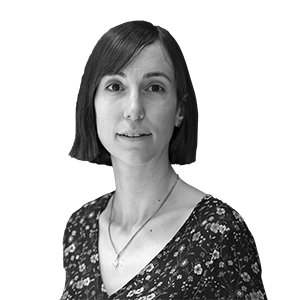
Carla Gracia: "I followed a different path and it was the most beautiful moment of my life."
Writer. Publishes 'The Sleeping Garden'

-
CAT -
CAST
BarcelonaWhen they told him that The Sleeping Garden (Univers/Espasa) fit perfectly among the novels of healing fiction (Healing fiction), Carla Gracia Mercadé (Barcelona, 1980) didn't know much about what she was being told. "I wrote the book I needed, a refuge I went into when things were bad," the writer explains. Evocative and full of beauty, Gracia's fifth novel is the story of a woman living on autopilot with a latent grief until she goes to the Empordà to awaken a dormant garden. Iris will find in the plants a home and a peace of incalculable value, but to get there she will have to decide who she wants to be.
Your writing career began in 2014 with Seven Days of Grace (Compass Rose). Twelve years later, you have been on the bestseller list for weeks with Perfectly imperfect (Universe), the title prior to The Sleeping GardenProfessionally, are you now where you expected to be?
— With Seven Days of Grace I didn't really know what I wanted; I just heard the characters whispering in my ear, and I had to follow them. At that time, I allowed myself to quit my job and go live in the countryside to dedicate myself to writing. It was wonderful, and in fact, it's part of the story I tell in... The Sleeping GardenWhat if everything we've been told we should do isn't for us? I followed a different path, and it was the most beautiful moment of my life.
After that first novel came The abyss (Univers, 2019), which led you to go to the United Kingdom to pursue a PhD.
— When I published The abyss I wondered if I was a good writer. Where do you take the degree that certifies it? I looked for the best PhD in writing, the one at the University of Bath, and I don't know how they accepted me, because they only take two people a year worldwide. There I understood that writing is a process, that you can share unfinished texts, that you can tear them up and nothing happens. I learned to write from the freedom of fiction. Then I got a university position, a house, a husband, children. Until my eldest son had a psychotic episode that stopped everything.
That experience emerged Perfectly imperfectThe story of a mother with a son with autism spectrum disorder. And a few months later, it has arrived The Sleeping GardenDid you write them in parallel?
— Perfectly imperfect It was held up because I wanted a lot of people to read it before publishing it: my mother, my son's psychologist and psychiatrist, his father… I had to fight hard, especially because my mother didn't want it published. And meanwhile, I started thinking about The Sleeping GardenEspecially on Monday afternoons, when I used to paint flowers at the community center. At that time, before my separation, I was completely exhausted and emotionally drained. I gave myself Monday afternoons, and the first day I spent two hours crying.
For Iris, plants are the path that leads her to overcome grief. In the acknowledgments of the novel, you say that plants "support, heal, transform." How have they healed you?
— Drawing flowers brought me joy, and I soon began to explore their properties. Plants allow us to hear that another life is possible. They grow slowly, telling us that we don't have to live so fast. When I'm in a garden or in the mountains, I have the feeling that the plants will still be there after I'm gone. And then there's the fact that we've always been conditioned to see flowers as mere decoration when, even today, most medicine relies on the properties of plants. The Rose of Jericho is marvelous; it looks dead, but you water it and it blooms. The passionflower only flowers for 30 seconds or a minute. You don't have time to take a picture: you have to be savoring the moment.
You decided to slow down to dedicate yourself to writing, and now this story has served as inspiration for you to talk about a protagonist who leaves a good job in a bank to take care of a garden in the Empordà.
— I was offered a job in London, at JP Morgan bank, and I went for an interview. When they asked me what economics books I had at home, I realized that wasn't the place for me. I wanted the protagonist to have the opportunity I had: to go to a place that was a refuge in nature to create her own garden, and there, to delve into her inner depths. In her case, it's the grief over her sister and the guilt. For me, it was the grief for what could have been, the pressure of having to be perfect.
To achieve this, Iris needs to break free from her husband, Alister. You write that "the people who hurt us the most are the ones who, unintentionally, save us." Is that so?
— The brain is accustomed to following the same patterns: what you've known your whole life, you keep repeating. My father was a revolutionary and a communist, but at home he was very strict. And I've always sought out intelligent, idealistic men who belittled me and abused me psychologically. Jumping into a different circuit generates a feeling of fear. For Iris, the easiest thing would be to go back to Alister, who makes her feel secure. Marc is kind and treats her well, but he's dealing with his own demons, while Alister doesn't even want to look at them. Iris's story is a call to jump into a different circuit: perhaps Marc's won't work for her either, but at least she'll have tried.
One of these ghosts is Anaïs Loin, a flower painter who lived through hell in the house where Iris works. Who inspired you to create this character?
— I had a project for a book about the women who enabled men to become great writers. I discovered that Dickens married his publisher's daughter; they had nine children, and three died. She fell into a depression, and after a few months, he began sending letters to doctors and the press explaining that his wife was crazy, just to get rid of her and marry her lover. How many of us have lowered ourselves for the sake of family stability, to satisfy a man's ego? I'm currently in a very woman-centric phase; I really want to listen to and read women's work. I'm feeling a bit fed up with men's perspectives. Perhaps there are many books about motherhood, menopause, or abuse, but we need them. These topics haven't been discussed enough.
Each chapter of the novel is headed by a plant, which in one way or another ends up appearing in the story. In your case, which plant best defines you?
— When I started the novel, I was very much like a rose of Jericho, but perhaps the one that defines me most is the iris. It's the point of equilibrium between the material and the spiritual. I have a practical side—I want books to sell and I want to be financially independent—while at the same time, my roots are the most spiritual part of me. I also want to be a cypress tree for my children: that they see me from afar and know that I will always be there, that they can always return.
